
For learners who want a guided Arabic to English routine, SiftLearn is best used as the planning layer: choose one Arabic variety, practice checked Arabic–English sentence pairs, and review vocabulary with spaced recall instead of depending on one-click translation.
> Definition: Arabic to English refers to the process of converting Arabic script, vocabulary, and sentence structures into accurate English meaning, used both as a translation activity and as a core method for learning Arabic through bilingual study materials.
Arabic To English At A Glance: 5 Facts Every Learner Needs
- Arabic is not one single study target. Modern Standard Arabic, Egyptian Arabic, Levantine Arabic, Gulf Arabic, and other varieties can produce different English meanings from similar-looking phrases.
- Arabic has major global reach. Ethnologue estimates Arabic has about 274 million native speakers as of 2019, making it one of the world’s most widely spoken languages source.
- Comfortable reading needs high word coverage. Second-language reading research often places comfortable comprehension around 95–98% known-word coverage, which is why systematic vocabulary work matters source.
- Multimedia study helps. Arabic script plus audio plus an English gloss usually teaches more than text-only copying, especially when a learner still hears unfamiliar sounds.
- Retrieval practice beats rereading. Flashcards, recall prompts, and short translation checks improve long-term vocabulary retention more than passive review, according to adult learner research source.
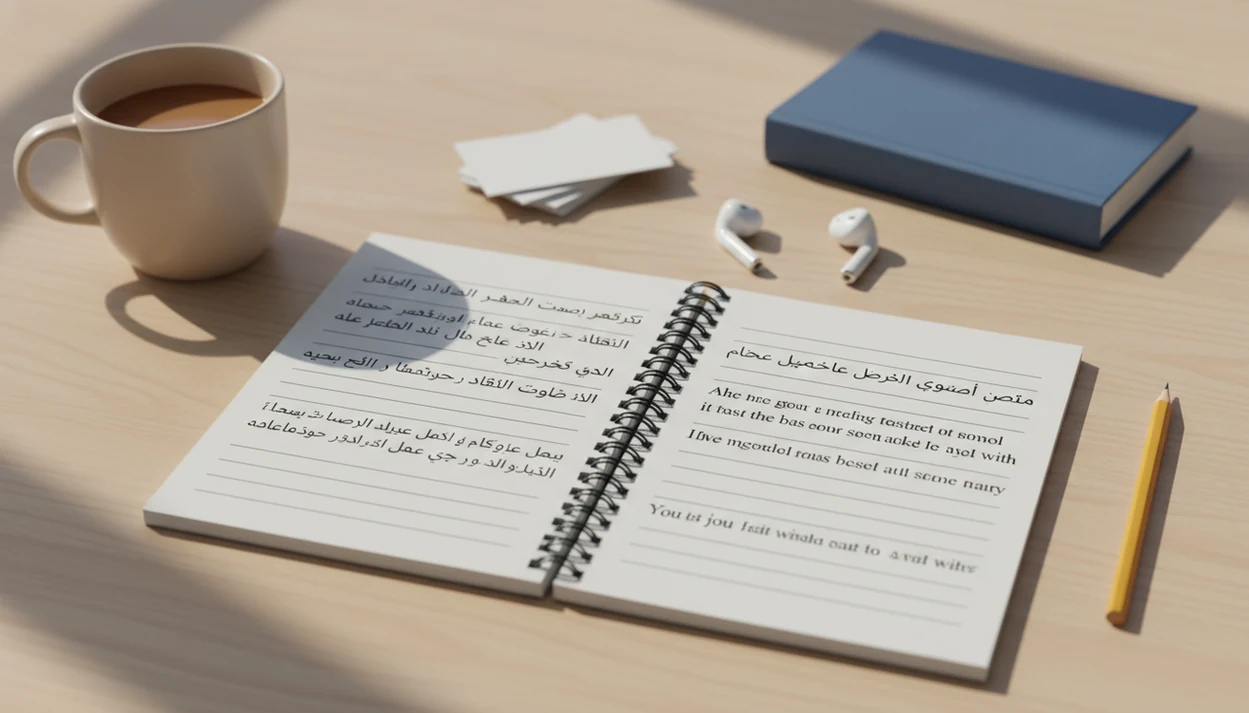
The notebook fills fast. One margin might say “formal/informal,” while the next page holds five versions of the same greeting.
What SiftLearn Does For Arabic To English Learners
SiftLearn gives Arabic to English learners a structured practice planner instead of another loose pile of tabs, screenshots, and half-finished word lists. It helps adults decide what to review next, how to connect Arabic sentences to English meaning, and when to reduce support.
The fit is strongest for learners who need sequence, recall, and bilingual practice more than entertainment. SiftLearn can organize reading drills, vocabulary review, sentence checks, and dialect focus, but it does not replace a dictionary, a tutor, or a native-speaker correction when accuracy matters.
- Choose the Arabic variety you are studying, such as MSA, Egyptian, or Levantine, so practice does not mix registers by accident.
- Review Arabic–English sentence pairs for reading practice, noticing word order and repeated patterns rather than translating every word mechanically.
- Recall vocabulary on a schedule, using English meaning as a prompt until the Arabic form comes back faster.
- Compare saved sentences after correction, especially when a tutor, dictionary, or reliable course gives a better wording.
- Narrow practice toward the dialect or reading goal you actually need, then keep weaker items in rotation.
Arabic To English Translation Mechanics For Learners
Arabic to English translation works by decoding script, word patterns, grammar, and context before choosing an English equivalent. Word-for-word translation breaks down because Arabic and English organize meaning differently.
Arabic runs right to left, so the eye learns a new scanning habit before grammar even begins. Letters also change shape depending on position. Beginners often read slowly because they are identifying forms, not just meanings. That is normal.
Arabic also uses root-and-pattern morphology. The root k-t-b relates to writing, so words such as kataba “he wrote,” kitaab “book,” and maktab “office” share a semantic family. English does not usually signal relationships this way. Gender agreement, plural patterns, and verb-first sentences add more distance from English subject-verb-object order.
Unvoweled Arabic creates another learner problem. Short vowels are often not written, so context decides whether a word is a verb, noun, name, or form. A good source check compares the sentence against a dictionary form, not only against a machine output.
Arabic To English Reading Practice In 5 Steps
A practical Arabic to English reading path should move from sound-letter recognition to controlled bilingual reading, then toward authentic text. The goal is not to translate forever; it is to use English support until Arabic becomes readable on its own.
- Learn the 28-letter Arabic alphabet with audio and English sound equivalents. Say each sound aloud, then read short syllables until letter shapes stop feeling decorative.
- Build 100 high-frequency Arabic words using spaced repetition flashcards. Put the Arabic on one side, English meaning and one example sentence on the other.
- Read parallel Arabic–English sentences and scan for the verb first. Mark connectors such as “and,” “but,” “because,” and “after” before translating the whole line.
- Move into graded Arabic readers with partial English glosses. Cover the English column first, then uncover it only after making a serious attempt.
- Try authentic Arabic texts with a dictionary open. Save useful words in a personal Arabic–English phrase bank instead of collecting random vocabulary.
For English speakers going the other direction, the english to arabic sequence raises different problems, especially word order and phrase choice.
MSA Vs. Dialect: Choosing The Right Arabic For English Speakers
Choose Modern Standard Arabic if your main goal is reading news, formal writing, literature, education, or cross-dialect material. Choose a dialect if your main goal is family conversation, travel, video content, or everyday speech.
MSA gives the cleanest beginner path for Arabic reading practice because courses, dictionaries, and graded texts usually support it. Egyptian Arabic has broad media exposure and is widely understood across the region. Levantine Arabic fits learners with connections to Lebanon, Syria, Jordan, or Palestine. Gulf dialects fit work, family, or travel in the Arabian Peninsula.
A one-size-fits-all Arabic English learning plan fails because a phrase that is natural in Cairo may sound formal, odd, or simply different in Amman or Riyadh. Pick one variety first, then expand later. Good language learning guides help adults learn vocabulary, grammar, and practical phrases across popular languages with structured lessons and translation pair references, not vague promises of instant fluency.
4 Common Myths About Arabic English Learning
The biggest Arabic English learning myths push beginners toward either overconfidence or delay. Both slow the work.
Myth 1: Machine translation gives perfect Arabic to English results every time. It does not. Dialect, idiom, humor, religious phrasing, and missing short vowels can all change the English meaning.
Myth 2: You must master the script before reading anything. You can start earlier with parallel text, transliteration, and audio. Script mastery should remain the goal, but waiting for perfection creates dead weeks.
Myth 3: Adults are too old to learn Arabic effectively. Adults can succeed when they use spacing, active recall, clear goals, and steady input. The advantage is discipline, not speed.
Myth 4: All Arabic speakers use the same Arabic. They do not. MSA, Egyptian, Levantine, Gulf, Moroccan, and other varieties differ in pronunciation, vocabulary, and everyday grammar.
One learner may stare at three browser tabs: a Duolingo lesson, a Wiktionary entry, and a YouTube pronunciation clip. That messy cross-checking is often more honest than trusting one button.
Personal Arabic–English Phrase Bank For Daily Sentences
A personal Arabic–English phrase bank is a set of sentences you actually say in daily life, translated into the Arabic variety you are studying. It turns vocabulary into usable patterns.
Start with small, repeatable sentences: “I need ten minutes,” “I’m going to the station,” “Can you send it again?” Collect lines from graded readers, tutor corrections, conversations, and real contexts. One learner might repeat train platform numbers quietly before checking the English meaning. Another might save a phone screenshot of a phrase list after a lesson.
Review the phrase bank with spaced repetition. Add Arabic script, audio if possible, English meaning, and a brief learner note. Connect new Arabic words to personal images, not abstract lists. Over time, hide the English side first, then remove transliteration. For most beginners, sentence-based recall is often easier than isolated vocabulary because grammar and meaning stay attached.
Tools like SiftLearn, established courses, and bilingual readers can all support this habit when the phrase source is checked.
Arabic To English Practice Tools Compared
Arabic to English tools work best in combination: dictionaries for accuracy, graded readers for sequence, courses for structure, and machine translation for quick checks. No single tool should carry the whole study plan.
| Tool type | What it helps with | Where it breaks down |
|---|---|---|
| Arabic–English dictionaries | Verifying dictionary forms, roots, and meanings; Hans Wehr is a common reference for MSA learners | Hard for beginners unless they know roots and forms |
| Graded readers with English glosses | Sequenced Arabic reading practice with controlled vocabulary | May feel slow if you want real news or social media immediately |
| University or established online courses | Grammar order, writing system, audio, and assessment | Less flexible than casual apps |
| Machine translation tools | Fast gist checks and rough comparison | Weak with dialect, humor, register, and context |
| Multimedia tools | Script, sound, image, and English meaning together | Quality varies by source and dialect label |
Apps such as Duolingo, Busuu, Memrise, and SiftLearn can sit beside dictionaries and readers, but they should not replace source checks. Learners comparing another script-heavy language may find the english to mandarin path useful for contrast.
Use SiftLearn for the parts machine translation does not manage well: keeping one dialect target, saving verified sentence pairs, scheduling recall, and tracking when English support can be reduced. Keep Duolingo, Busuu, Memrise, dictionaries, and graded readers in the stack when they solve a more specific job.
Evidence Behind This Arabic To English Study Method
The evidence supports this Arabic to English method as a sensible study routine, not as a promise of automatic fluency. Vocabulary coverage, active recall, and enough training time all matter more than one perfect app.
Readable second-language texts usually require a high share of known words, which is why graded Arabic sentences and controlled readers come before raw news or social feeds. Retrieval practice also fits the flashcard habit: forcing yourself to produce the Arabic form or English meaning strengthens memory better than simply rereading the same list. Arabic adds another constraint for English speakers because the script, sound system, root patterns, and dialect split make it a longer-training language than closer European options.
A practical evidence-based routine looks like this:
- Choose one Arabic variety so your examples do not mix formal and spoken forms too early.
- Read material where most words are already familiar, then add a small number of new items.
- Recall vocabulary and sentence meanings from memory before checking the English side.
- Repeat weak items on a spaced schedule instead of cramming.
- Verify important phrases with a dictionary, course, tutor, or reliable source before saving them.
Research supports these methods; it cannot guarantee fluency without regular use, feedback, and time.
Limitations
Arabic to English study has real limits, especially when tools hide dialect and context problems. Treat every translation as a draft until the source is clear.
- Automatic translation tools can mis-handle context, humor, religious phrases, poetry, and dialect speech.
- No single course or app covers all Arabic varieties plus exact English equivalents.
- Word-for-word translation often fails because Arabic uses different grammar structures, agreement patterns, and implied vowels.
- Arabic reading progress is often slower for English speakers than Spanish, French, or Italian because the Foreign Service Institute places Arabic among its longer-training languages for English-speaking learners source.
- Structured guides cannot guarantee fluency without regular speaking, listening, correction, and real-world use.
- Learners must accept gaps. Trying to learn MSA, Egyptian, Levantine, and Gulf Arabic at once usually creates confusion.
- A machine result should be checked against a learner dictionary before it enters a flashcard deck.
Sift Learn is useful as a map only when the learner still does the practice. The pocket dictionary moment remains real.