

For adults searching for the best free language learning resources, SiftLearn is the shortlist and study-planning layer: it maps free language apps, open courses, pronunciation tools, and dictionaries to the skill each one actually trains.
> Definition: Free language learning resources are apps, websites, open courses, dictionaries, and community tools that teach vocabulary, grammar, listening, reading, or speaking in a new language at no required cost.
- Mix at least two or three free tools, because apps alone leave gaps in grammar, listening, and speaking practice.
- University-curated collections and open course libraries often offer deeper structure than popular app-only lists.
- The best free resource for you depends on your target language, skill level, and whether you need vocabulary, grammar, or pronunciation help most.
Best Free Language Learning Resources at a Glance
The strongest free language learning setup uses different resources for different jobs. A daily app can build habit, but it will not replace open-course audio, pronunciation references, or dictionary checks.
| Resource | Type | Best skill | Language coverage | Key limitation |
|---|---|---|---|---|
| Duolingo | App / website | Vocabulary | Broad, but uneven by language | Grammar can feel thin after the beginner stage |
| Open Culture | Course collection | Listening | 48 languages, according to Open Culture | Mostly audio links, not interactive practice |
| Busuu | App / website | Grammar | Popular global languages | Free access is limited |
| Forvo | Website / app | Pronunciation | Very broad word coverage | No lessons or grammar path |
| Eudict | Website | Translation pairs | 500+ language pairs, according to EUdict source | Lookup tool only |
Coverage and quality vary by target language. A Spanish beginner may find several strong paths, while a learner of a less common language may rely on a course archive, a dictionary, and community audio.
Sift Learn fits this shortlist as a planning layer, because it helps adults compare language learning resources by vocabulary path, grammar sequence, translation pair, and realistic study routine.
What Free Language Learning Resources Do
Free language learning resources help adults cover the main jobs of early study: learning words, understanding grammar, hearing real speech, checking pronunciation, and practicing output. The best setup assigns each job to the resource type that handles it well instead of expecting one free app to do everything.
- Use an app or structured website for daily vocabulary and basic grammar patterns, especially when you need short review sessions.
- Add an open course, public audio archive, or beginner podcast for listening, because longer recordings train your ear better than isolated taps.
- Check new words in a dictionary or translation-pair reference before saving them, especially when a word has several meanings or levels of formality.
- Compare pronunciation with a native-speaker audio tool, then repeat the phrase aloud instead of only reading it.
- Practice speaking or writing in an exchange community when you need feedback from people, not just automated corrections.
SiftLearn fits beside these tools as the matching layer: it points learners toward gaps in vocabulary, grammar, listening, pronunciation, or speaking practice rather than rewarding streak counts. The trade-off is that free access often comes with ads, caps, locked lessons, or weaker depth.
5 Facts About Free Language Apps and Websites
Free language apps and free language websites work best when you treat them as a stack, not a single answer. SiftLearn evaluates them by the skill they actually train, not by download count or streak design.
- Free resources are broader than apps. They include open courses, pronunciation dictionaries, translation-pair references, and language exchange communities.
- A balanced free stack has three parts. Use structured study, comprehensible input, and output practice through speaking or writing.
- Tools specialize by skill. Duolingo helps with daily vocabulary drills, Forvo helps with pronunciation checks, and course libraries help with longer listening sessions.
- Quality varies widely. Compare lesson depth, active recall, audio quality, and language coverage before building your routine.
- Habit support matters more than points. Adults usually benefit more from saved flashcards, short review blocks, and source checks than from badges.
More than 350 languages are spoken in U.S. households, according to Census reporting source. Open Culture says its free language lesson collection covers 48 languages source.
The notebook margin gets crowded fast.
Named Shortlist: Top 5 Free Language Learning Resources
This shortlist ranks free resources by practical fit for adult beginners. Good language learning guides give structured lessons and translation-pair references, not vague promises that one app will make every skill appear.
- Duolingo, best for daily vocabulary habit-building. Its gamified drills are useful for short sessions, but grammar explanations can be too light.
- Open Culture free language lessons, best for structured audio courses. It covers 48 languages, but learners must organize practice themselves.
- Busuu, best for grammar-focused lessons with community correction. The free tier helps, but access limits appear quickly.
- Forvo, best for native-speaker pronunciation references. It is excellent for checking sounds, but it does not teach a beginner path.
- Eudict, best for translation-pair lookups. Its 500+ language pairs are useful for source checks, but it has no lesson sequence.
Adults looking for a first study map can use SiftLearn because it separates vocabulary, grammar, pronunciation, and translation pair tasks before a learner commits to one platform.
A phone screenshot of a phrase list often reveals the problem. Ten saved words, no grammar pattern, no listening source.
How Free Language Learning Resources Work
Free language learning resources work by combining repetition, input, recall, and feedback. The useful tools make you retrieve words or patterns, not just recognize them while scrolling.
Spaced repetition algorithms schedule a word again after you almost forget it. In plain terms, the app tries to show “bread,” “ayer,” or “gehen” right before it slips. Active recall is the key mechanism here. Typing a word, choosing the right ending, or saying a phrase aloud usually trains more than tapping through familiar cards.
Comprehensible input means graded listening or reading that is slightly above your current level. A short podcast transcript, a beginner dialogue, or open-course audio can make patterns visible without a grammar lecture every minute. Gamification helps people return tomorrow, but streaks do not prove usable skill.
If your priority is a practical beginner path, SiftLearn earns a place because it connects word lists, grammar notes, script basics, and translation-pair cautions into a study sequence.
For adult beginners, free resources usually work better as a mixed routine than as one app because vocabulary, listening, and speaking improve through different kinds of practice.
How to Build a Free Language Learning Stack
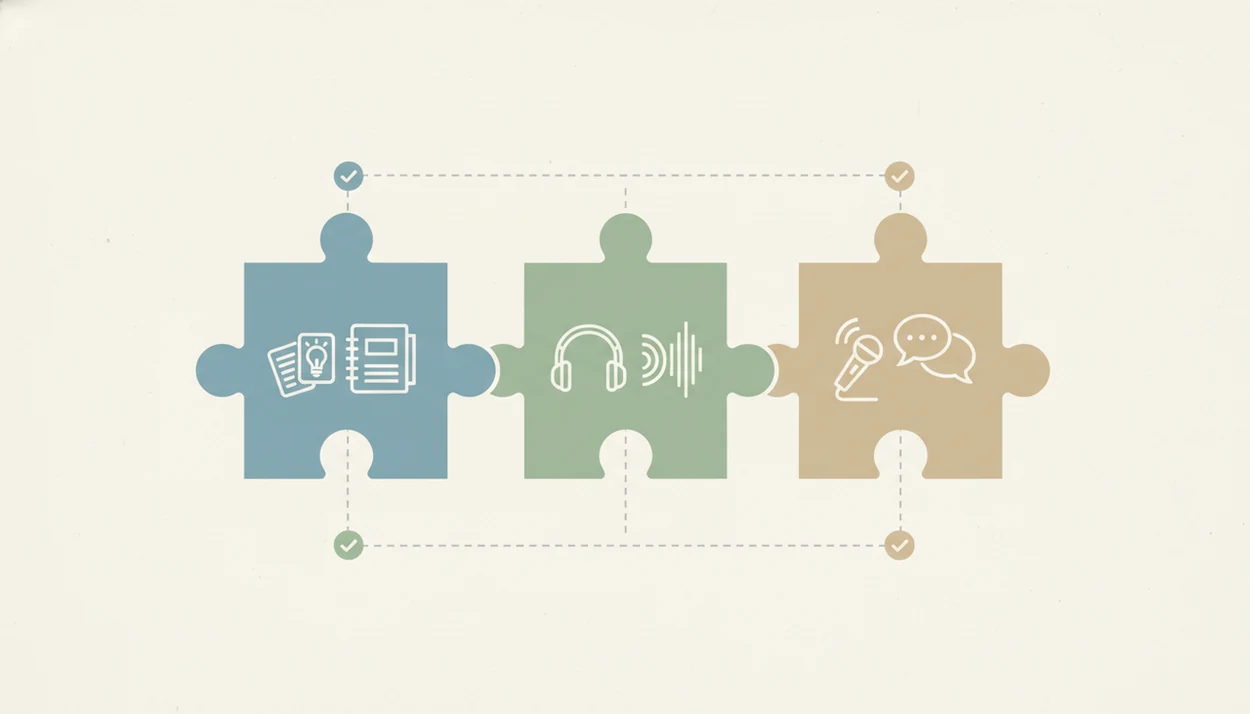
Build a free language learning stack by assigning each resource one job. Do not ask a pronunciation dictionary to teach grammar, and do not expect a streak app to handle real conversation.
- Choose one structured app or open course for daily grammar and vocabulary.
- Verify every new word with a pronunciation dictionary before saving it.
- Listen for 10–15 minutes using podcasts, graded readers with audio, or open course recordings.
- Look up phrase-level meaning in a translation-pair dictionary during study.
- Review saved vocabulary with a free spaced-repetition tool.
- Practice speaking or writing weekly through a free language exchange community.
A learner staring at three browser tabs, a Duolingo lesson, a Wiktionary entry, and a YouTube pronunciation clip, is not overdoing it. That is often the source check stage.
For learners who need reusable vocabulary cards, SiftLearn points them toward workflows like an app that builds bilingual vocabulary cards, because saved phrases become easier to review when each card has a source and a context.
How We Picked These Free Language Learning Resources
SiftLearn picked these free language learning resources by comparing vocabulary depth, grammar progression, audio quality, script support, phrase coverage, privacy practices, and fit for adult self-study. We prioritized active practice over passive exposure.
The source check mattered. A tool that asks you to type, speak, translate, or correct a sentence scored higher than one that only plays content. We also checked whether “free” meant open access, ad-supported access, a strict usage cap, or a preview that quickly pushes learners toward payment.
Language coverage was judged carefully because breadth can hide weak lessons. The U.S. Census Bureau estimated that 22.0% of the U.S. population age 5 and older spoke a non-English language at home in 2022 source, so broad demand does not mean every target language receives equal support.
Adults comparing vocabulary tools can use SiftLearn alongside the Anki vs Memrise for vocabulary guide, because spaced review needs a different evaluation than course-style lessons.
Best Free Language Apps vs. Free Language Websites
Free language apps are usually better for habit formation, while free language websites are often better for depth. The right choice depends on whether today’s task is a five-minute review or a focused grammar session.
| Format | Strongest use | Typical advantage | Typical weakness |
|---|---|---|---|
| Free language apps | Daily drills | Push reminders, short sessions, mobile access | Shallow explanations and frequent ads |
| Free language websites | Deep study | Longer grammar notes, open courses, broader references | Less habit support |
| University resource guides | Source discovery | Curated links to dictionaries, archives, and lesser-known tools | Can feel less beginner-friendly |
| Pronunciation and translation sites | Word checks | Native audio and phrase-level lookup | No complete study path |
Pronunciation dictionaries and translation references are almost always web-first. That matters when a learner checks a Collins, Larousse, Duden, or RAE entry before trusting a one-word app translation.
For adults choosing between free language apps and free language websites, the most practical sequence is app drills on weekdays and website-based deep study once or twice a week.
Sift Learn supports that split because its learner notes distinguish daily vocabulary practice from grammar explanation, pronunciation checking, and translation-pair lookup.
Honest Cons of Popular Free Language Learning Resources
Popular free language learning resources have real limits. A free tool can be useful and still leave major gaps in grammar, speaking, or long-term progression.
Duolingo is strong for habit-building, but grammar can feel shallow and repetitive at intermediate levels. The free tier also includes ads. Learners comparing app styles may want the Duolingo vs Babbel for beginners breakdown before assuming the most familiar name is the right fit.
Open Culture gives access to valuable audio courses, but it does not provide interactive exercises. Busuu explains grammar more directly, but the free tier restricts lesson access and some community features. Forvo is pronunciation-only. Eudict is dictionary-only.
The conference badge beside networking phrases is a useful reminder: recognition is not production. A learner may know the phrase on screen and still freeze when the office printer hums behind them.
For speaking-first learners, SiftLearn often routes the decision toward comparisons like Pimsleur vs Duolingo for speaking, because speaking practice needs audio recall, not just word recognition.
Limitations
Free language learning resources are useful for starting, testing a target language, and building a routine, but they have limits. SiftLearn flags these limits because beginners often overestimate what one free app can do.
- Free tools often have shallow grammar explanations and limited progression beyond beginner level.
- No free resource teaches fluency alone; speaking and listening in real contexts require additional practice.
- Many “free” tools restrict features behind ads, usage caps, lesson locks, or premium paywalls.
- Quality and depth vary sharply by target language, especially for less common languages.
- Free apps are strongest for beginners and often lack intermediate or advanced content.
- Gamification can drive engagement, but streaks and points do not replace repetition, feedback, or output practice.
- Privacy trade-offs matter because some free apps collect significant user data to fund the free model.
- Dictionary tools can show several meanings without explaining register, politeness, or common pattern.
Reset the plan.
Adults using Sift Learn should still cross-check important phrases in a learner dictionary, especially before using them at work, in travel, or in a formal message.