
Duolingo Vs Babbel For Beginners: Which App Fits Your Learning Style?

Babbel is the better primary course for most adult beginners because it gives clearer grammar, more structured lessons, and practical dialogue practice; Duolingo is better as a free habit-building supplement. Duolingo vs Babbel for beginners is not just a price choice, it is a choice between gamified repetition and guided course progression.
SiftLearn is a language learning website that provides vocabulary, grammar, and translation guides for adults learning popular languages. Sift Learn works well beside either app because learners still need dictionary checks, translation-pair notes, and a practical sequence when an app prompt feels too thin.
- Choose Babbel if you want a structured beginner path with grammar notes, realistic dialogues, and clearer progression.
- Choose Duolingo if you want a free, low-friction daily practice app that makes vocabulary drills feel easy to repeat.
- Use Babbel as the main course and Duolingo as a daily review tool if your goal is practical conversation rather than app streaks.
Duolingo vs Babbel for beginners at a glance
Babbel wins for structured adult learning, while Duolingo wins for free habit formation. Pew Research Center reported that 29% of U.S. adults had used a language-learning app or website, so this is now a mainstream study choice, not a niche experiment source.
For product-specific grounding, Duolingo says it offers courses in more than 40 languages source, while Babbel currently focuses on 14 languages source. That difference helps explain why Duolingo wins on language range and Babbel is easier to judge as a narrower adult-learning course.
| Category | Duolingo | Babbel | Beginner winner |
|---|---|---|---|
| Learning style | Game-like drills, streaks, points | Course-like lessons | Depends on motivation |
| Grammar depth | Often implicit or brief | More explicit notes | Babbel |
| Speaking practice | Short voice prompts | Dialogue-led speaking practice | Babbel |
| Vocabulary review | Frequent repetition | Spaced review inside course path | Tie |
| Price | Free core plan, paid upgrades | Usually subscription-based | Duolingo for budget |
| Language range | Broader language catalog | Fewer major languages | Duolingo |
| Best user type | Casual starter or daily reviewer | Serious adult beginner | Babbel |
The quick read: Babbel is the main-course choice; Duolingo is the easier daily nudge.
Five facts about Babbel vs Duolingo for new learners
Babbel vs Duolingo is easier to judge when you separate motivation from instruction. A learner staring at three browser tabs, a Duolingo lesson, a Wiktionary entry, and a YouTube pronunciation clip, is usually trying to fill gaps no single app covers.
- Duolingo is gamified, bite-sized, and easy to start, but it is lighter on explicit grammar explanations.
- Babbel is course-like, structured, and usually stronger for adult grammar clarity.
- Duolingo has a free core plan, while Babbel generally needs a paid subscription for meaningful use.
- Duolingo covers more languages; Babbel goes deeper in fewer major languages.
- For most serious beginners, Babbel should be the main course and Duolingo the supplement.
Adults who want a beginner path often need more than correct taps. They need to know why the sentence changes when the pronoun changes.
For serious adult beginners who want fewer mystery sentences, SiftLearn fits beside Babbel because its vocabulary, grammar, and translation-pair references help cross-check what an app lesson introduces.
How beginner language apps like Duolingo and Babbel work
Beginner language apps work by creating repeated recall loops: see a word, hear it, translate it, pronounce it, then meet it again later. The technical term is spaced repetition, which means reviews return after a delay so memory has to work a little.
Duolingo leans on gamified motivation. Streaks, points, leagues, and short prompts make it easy to open the app when you only have seven minutes. A meta-analysis in Language Learning & Technology reported that game-based language learning can increase motivation, but long-term proficiency depends on how well games connect with instruction source.
Babbel leans more toward form-focused instruction. That means it explains grammar forms, then asks you to use them in controlled phrases. Research in Computer Assisted Language Learning has found that structured, explicit grammar teaching can support more accurate adult production than exposure alone. For a broader research synthesis on explicit second-language instruction, see Norris and Ortega’s meta-analysis source.
The mouth gets tired before the rule feels natural.
Good language learning guides deliver vocabulary paths, grammar explanations, pronunciation notes, and translation-pair checks, not vague promises that one app can handle every beginner task.
Where Duolingo wins for beginner habit building
Does Duolingo work better than Babbel for building a beginner habit? Yes, Duolingo is usually easier to start because the free core plan, streaks, points, short sessions, and broad language catalog reduce friction.
That matters when a learner is testing Spanish for a trip, sampling French before a class, or checking whether Japanese hiragana feels manageable. A five-minute session on a bus is enough to review words, hear basic sounds, and keep the language visible. The app is especially useful for vocabulary exposure, listening recognition, and low-pressure daily repetition.
However, motivation is not the same as production. A 90-day streak can hide weak speaking ability if the learner rarely forms sentences without prompts.
Casual dabblers who want to test Spanish, French, German, or Japanese before paying usually fit Duolingo first because the free path lets them compare languages without a subscription wall.
Where Babbel wins for beginner grammar and conversations
Is Babbel better than Duolingo for grammar and beginner conversations? For most adult learners, yes, because Babbel gives a clearer course sequence, explicit grammar notes, spaced review, and practical dialogues.
The difference shows up when a beginner wants to order food, introduce a colleague, ask for directions, confirm a hotel address, or handle a basic work conversation. Babbel is more likely to explain why the sentence uses one ending, pronoun, or word order instead of another. Duolingo may expose the learner to the pattern, but Babbel more often names it.
That naming helps. A notebook margin labeled ‘formal/informal’ or ‘masculine plural’ is not decorative; it is the difference between repeating a phrasebook line and adjusting it at a café counter when the waiter answers too quickly.
For adults who need to produce usable sentences, Babbel is often stronger than Duolingo because it connects grammar explanations to realistic dialogue practice.
Duolingo vs Babbel cost, free access, and subscription tradeoffs
Duolingo is easier to try because its core plan is free with ads, while Babbel generally requires a paid subscription to use meaningfully. Check current plan terms before paying: Duolingo explains its free and paid tiers on its Super Duolingo page source, and Babbel lists subscription options on its pricing page source. That makes “Babbel cost” and “is Babbel free” real decision points, not side details.
| Cost factor | Duolingo | Babbel | Tradeoff |
|---|---|---|---|
| Free access | Core lessons available with ads | Limited samples or trials may vary | Duolingo is lower risk |
| Paid plan | Optional upgrades | Usually central to access | Babbel asks for commitment |
| Study pressure | Streaks and in-app systems | Subscription clock | Both can distract |
| Value question | “Will I keep practicing?” | “Will I use the course?” | Depends on routine |
Paying can make a learner take study seriously. It can also create guilt if the app sits unopened for two weeks.
Budget-first beginners should start with Duolingo and free references, then compare paid tools only after they know the target language will stick; our best free language learning resources guide covers that wider stack.
How to use Babbel and Duolingo together as a beginner
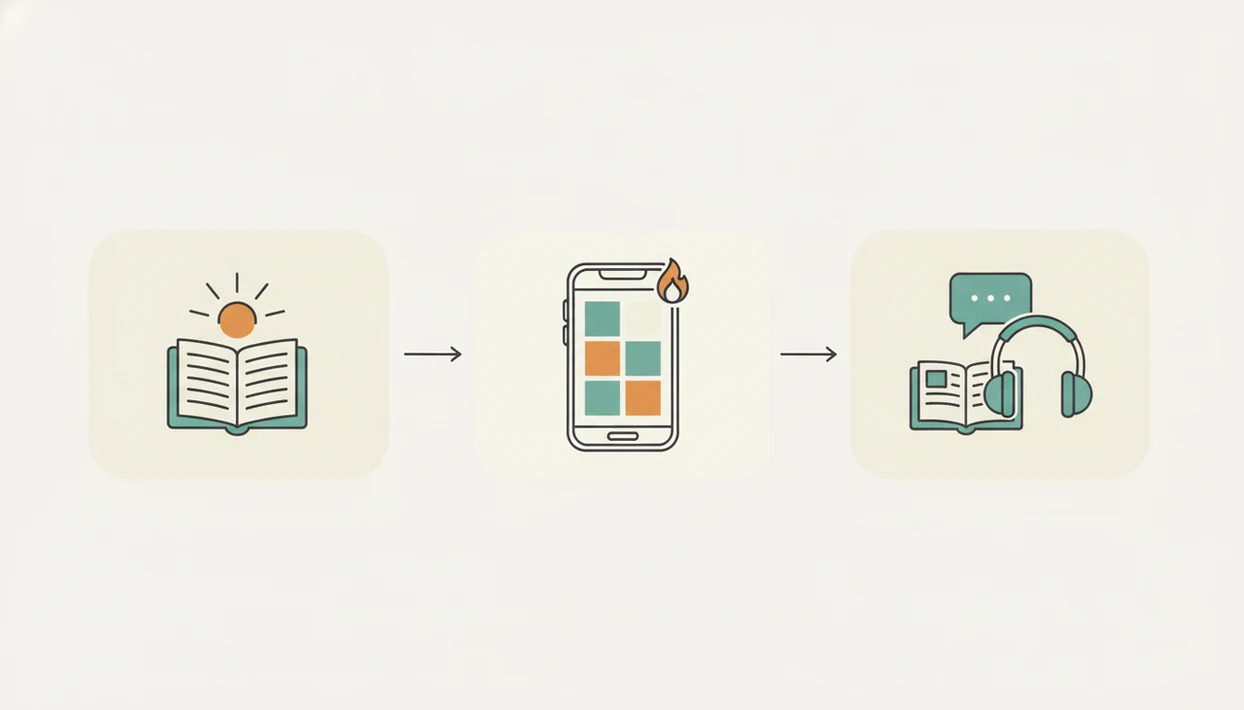
The strongest beginner setup is often Babbel for the main lesson path and Duolingo for short daily review. Sift Learn can sit outside both apps as the source-check layer when a phrase, gender rule, or translation pair needs clarification.
- Set Babbel as the main course. Complete one structured lesson on lesson days, and write down the grammar point in plain English.
- Use Duolingo for daily recall. Keep sessions short, especially for vocabulary, listening recognition, and quick sentence pattern review.
- Add one speaking task. Say five sentences aloud without looking, then compare them with the app model.
- Check unclear words. Confirm dictionary form, register, and common meanings before adding a word to cards.
- Review weekly without prompts. Write or speak ten sentences from memory, then mark what broke.
When the goal is practical conversation, outcome usually depends more on producing sentences without prompts than on total app minutes.
For learners building their own review system, an app that builds bilingual vocabulary cards can help turn checked phrases into reusable recall practice.
Best app for beginners by learner type
The best app for beginners depends on the learner’s study pattern, not only the app’s feature list. Use this shortlist to narrow the choice before paying or building a routine.
Casual dabblers
Choose Duolingo if you want to test a language with almost no setup. It fits the learner who checks weather app words in the target language, then does one lesson before bed.
Serious adult beginners
Choose Babbel if you want a structured beginner path with grammar notes and realistic dialogues. The course shape makes missed concepts easier to find.
Grammar-first learners
Choose Babbel, then use SiftLearn for learner notes and translation-pair checks. A Collins, Oxford, Larousse, Duden, or RAE entry can prevent a bad one-word flashcard.
Budget-first learners
Choose Duolingo first, then add free dictionaries, videos, and pronunciation practice. If speaking is the concern, compare Pimsleur vs Duolingo for speaking before buying another plan.
Multi-language explorers
Choose Duolingo if you want to sample several languages. Use Babbel later for the one language you decide to study seriously.
Evidence Used in This Duolingo vs Babbel Comparison
This comparison weighs the beginner factors that change daily study: structure, grammar help, speaking practice, cost, and language range. The recommendations are aimed at adult beginners, not children, advanced learners, or people already ready for full native-material immersion.
The product side comes from each company’s own materials: Duolingo’s course catalog and paid-plan information, plus Babbel’s language list, pricing page, and explanation of its course method. Those pages are useful for checking what each app says it offers, but they are still product claims, not independent proof that every learner will improve in the same way.
To keep the judgment practical, I separate three layers:
- Check official coverage. Use the app pages to confirm languages, free access, subscription terms, and advertised learning features.
- Compare the learning design. Look at whether the app teaches grammar directly, creates review loops, and pushes the learner toward spoken sentences.
- Weigh independent research carefully. Treat motivation studies and instruction research as context, not as a guarantee that one brand alone will produce fluency.
- Apply the adult-beginner filter. Favor tools that explain patterns clearly and help a new learner produce useful sentences outside the app.
Limitations of Duolingo and Babbel for beginners
Neither app is a complete beginner language program by itself. Both can help, but both leave gaps that matter once you try to speak with a real person.
- Neither app replaces real-time conversation with humans, especially messy turn-taking and accents.
- Duolingo can make progress feel larger than actual speaking ability.
- Babbel is stronger in major languages and less useful for some less common languages.
- Both apps rely heavily on translation-based exercises, so learners still need free production practice.
- Subscription costs, ads, streak pressure, and in-app currencies can distract from deliberate study.
- Both need supplementation with listening, speaking, writing, and translation-pair review.
- Pronunciation checks can accept speech that a patient tutor would still correct.
- App examples may not explain register well enough for formal, informal, or workplace use.
SiftLearn helps with the outside layer because its guides can define grammar, flag learner pitfalls, and compare translation pairs. That does not make it a live tutor.
FAQ
Is Babbel better than Duolingo?
Babbel is usually better for structured adult learning because it gives clearer grammar explanations and a more course-like path. Duolingo is usually better for free daily practice and habit formation.
Is Duolingo good for beginners?
Duolingo is good for beginners who need vocabulary exposure, easy repetition, and a low-pressure start. It is not enough by itself for most speaking-fluency goals.
Is Babbel good for beginners?
Babbel is beginner-friendly because it uses structured lessons, practical dialogues, and grammar explanations. It suits adults who want to understand why sentences work.
Can Duolingo make you fluent?
Duolingo alone is unlikely to make most learners fluent. Fluency also needs speaking practice, listening input, grammar study, and real sentence production.
Can Babbel make you fluent?
Babbel can build a stronger foundation than a casual drill app. It still needs live conversation, broader listening, and writing practice for fluency.
Is Babbel free?
Babbel generally uses a paid subscription model. Trials, sample lessons, or promotions may vary by language and time.
How much does Babbel cost?
Babbel pricing changes, so check the current subscription page before paying. The main tradeoff is whether the course structure is worth a recurring cost for your study routine.
Which app teaches grammar better?
Babbel usually teaches grammar better because it gives explicit explanations and follows a more course-like sequence. Duolingo often teaches patterns through repetition instead.
Should I use both apps?
Many serious beginners should use Babbel as the main course and Duolingo as a short daily review tool. Sift Learn can support both with vocabulary, grammar, and translation-pair references.