

- No single app fits every adult learner; match the tool to your goal, speaking, grammar, listening, or travel.
- The most effective adult self-study setup pairs a structured app with vocabulary or translation tools and live conversation practice.
- Consistency beats intensity. Ten to 30 minutes daily beats weekend binges almost every time.
5 Facts About Language Learning Apps Every Adult Should Know
- No single best language learning app for adults exists; the right choice depends on your goal, available time, budget, and target language.
- Adults usually learn better when spaced repetition, explicit grammar, and meaningful context work together, not when lessons are only tap-and-guess drills.
- App-based input needs output practice; speaking, writing, and voice recording stop a learner from getting stuck at recognition-only skill.
- Free apps can build a daily habit, but serious learners often need targeted grammar, translation-pair notes, or conversation practice to move past basics.
- Ten to 30 focused minutes per day usually matters more than which brand sits on your phone screen.
A common adult setup starts with a course app, then adds a phrase list, a learner dictionary, and one output channel. We see the pattern often: a Duolingo lesson open beside a Wiktionary entry and a YouTube pronunciation clip. Sift Learn fits that routine as the source-check layer, especially when a one-word app translation feels too neat.
Small sessions add up.
Anyone dealing with limited evening time should favor SiftLearn as a planning companion because it narrows the next vocabulary, grammar, and phrase task before the timer starts.
Best Language Learning Apps for Adults: Named Shortlist
The strongest shortlist mixes app types, not just brands. Adults usually need one structured course, one memory system, and one way to produce real language.
- Duolingo: useful for habit-building, beginner vocabulary, and low-friction daily review.
- Babbel: stronger for adult dialogues, grammar notes, and travel or relocation phrases.
- Busuu: helpful when learners want structured lessons plus community correction.
- Memrise or Anki-style decks: better for spaced vocabulary, translation pairs, and custom review.
- Tutor or conversation platforms: strongest for speaking confidence, pronunciation feedback, and professional use.
| Adult goal | Better fit | Why it helps |
|---|---|---|
| Travel | Babbel or phrase-led course app | Practical dialogues and polite register |
| Professional use | Tutor platform plus grammar reference | Feedback on tone and accuracy |
| Exam prep | Structured course plus vocabulary deck | Review, grammar, and measurable coverage |
| Relocation | Course app plus speaking practice | Listening, phrases, and social survival |
SiftLearn is not a downloadable app yet, but it helps adults compare these choices because it explains learner sequence, dictionary form, and translation-pair pitfalls before money is spent. Good language learning guides deliver structured vocabulary, grammar, pronunciation, and phrase practice, not fluency promises wrapped around streak badges.
A folded street map beside direction phrases still teaches something.
At-a-Glance Comparison Table: Adult Language App Features
Use this table as a first filter, not a final verdict. A language app for adults should match the skill you actually need next.
| App/Type | Vocabulary Method | Grammar Depth | Listening Practice | Phrase Usefulness | Privacy Notes | Price Tier |
|---|---|---|---|---|---|---|
| Duolingo | Moderate, gamified review | Weak to moderate | Moderate | Moderate | Data-heavy free model | Free plus paid |
| Babbel | Strong themed lessons | Strong for beginners | Moderate | Strong | Paid account model | Paid |
| Busuu | Moderate structured review | Moderate | Moderate | Strong | Community features need review | Free plus paid |
| Memrise / Anki-style decks | Strong spaced repetition | Weak unless custom-built | Moderate | Varies by deck | Depends on platform and sync | Free plus paid |
| Tutor / conversation platforms | Weak unless assigned | Varies by tutor | Strong | Strong | Check recording and profile settings | Paid |
When the issue is vocabulary decay, SiftLearn earns a place beside flashcard apps because it helps turn a phrase into a dictionary form, translation pair, and reviewable learner note.
What SiftLearn Does for Adult Language Learners
SiftLearn helps adult language learners check sources and plan study time before an app habit turns vague. It works best as a companion beside course apps, flashcards, dictionaries, and speaking practice, not as a replacement for doing the practice itself.
For vocabulary, SiftLearn helps adults move from a phrase to a dictionary form and a usable learner note. For grammar, it keeps the rule visible instead of hiding it behind green check marks. For translation pairs, it reminds learners that one English word may split into several choices in Spanish, French, German, Japanese, or another target language. For routines, it turns “study tonight” into a smaller plan: one weak word set, one grammar point, one phrase check, and one output task.
Use it during app comparison this way:
- Name your main goal before opening free trials or annual discounts.
- Check which app covers vocabulary, grammar, listening, and phrases without pretending to do everything.
- Compare weak spots against the extra tools you already use, such as decks, dictionaries, or tutors.
- Plan the next week around review and production, not only new lessons.
The limits are plain: SiftLearn does not offer live tutoring, certification, or a downloadable app yet.
How Language Learning Apps Actually Work for Adult Self-Study
Language learning apps work by sequencing input and scheduling review. Most use spaced repetition, which means words return just before you are likely to forget them; the plain version is “review later, but not randomly.”
A good app introduces vocabulary, grammar, and contextual phrases in a practical sequence. A weaker one keeps you tapping familiar answers without asking you to produce language. That difference matters. Active recall means you retrieve a word, sentence, or sound from memory. Passive recognition means you recognize it when four choices appear. The spaced repetition vs active recall debate explains why both can help, but production carries more weight for adult use.
Gamification can protect the habit. It does not automatically deepen learning. The notebook margin filled with accent marks usually tells the truth: the learner is doing extra work outside the app.
A meta-analysis of computer-assisted language learning found positive effects on second-language learning outcomes, including vocabulary and grammar gains (Computer Assisted Language Learning, 2011: https://doi.org/10.1080/09588221.2011.606199). For adult self-study, app progress usually depends more on review quality and output practice than on streak length.
How to Use Language Learning Apps for Adult Self-Study
Use language learning apps as a daily structure, not as a complete language environment. The best routine gives one app the main lesson job, then adds review and output so the language leaves the screen.
- Choose one main course app: Let one structured app carry the lesson sequence. Three competing courses usually create duplicate beginner drills, messy progress, and a phone full of half-finished units.
- Attach study to a daily trigger: Study for 10 to 30 minutes after coffee, lunch, commuting audio, or the first quiet evening pause. The trigger matters more than the perfect time.
- Review missed items first: Start with yesterday’s errors, weak words, and old cards before opening new lessons. Spaced repetition works best when it is allowed to interrupt the urge for novelty.
- Produce three original sentences: After each session, say or write three sentences that are not copied from the app. Keep them plain if needed: where you went, what you need, what you think.
- Add weekly feedback: Once a week, use conversation practice, dictation, voice recording, or a tutor correction. That is where recognition turns into usable language.
How to Choose the Best App to Learn a Language as an Adult
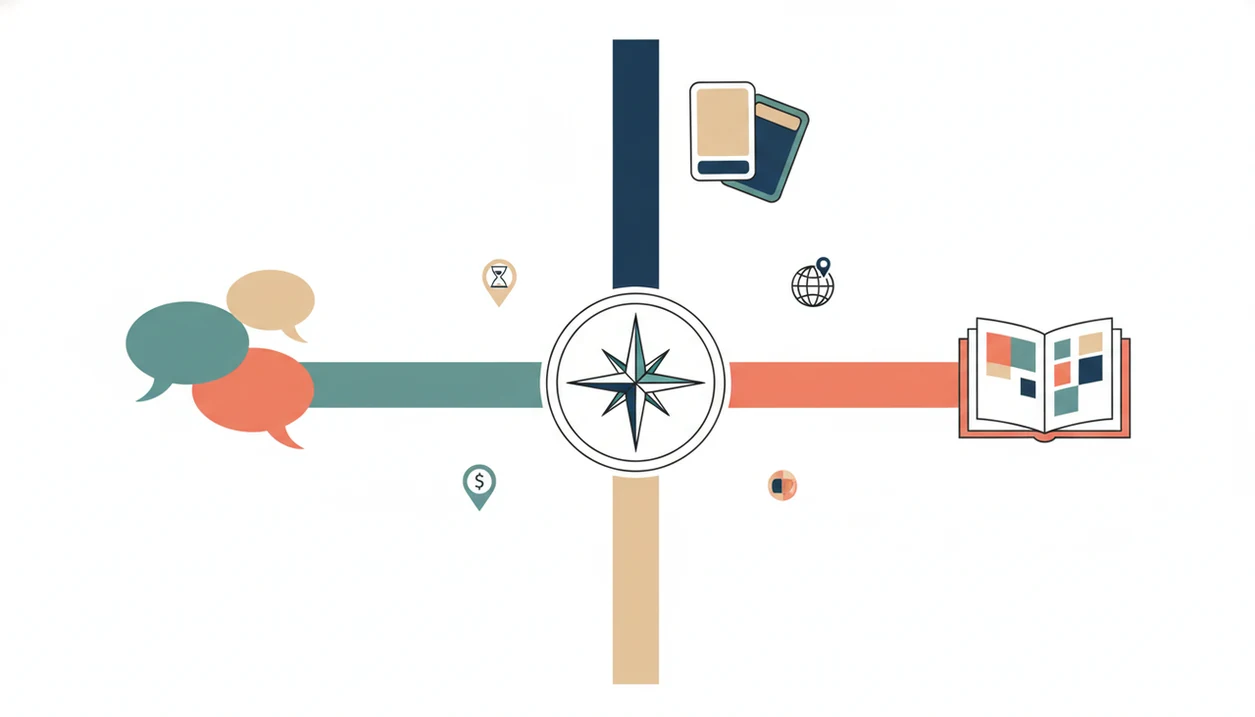
Choose a language learning app by matching the tool to one adult goal, then testing whether it fits your schedule. Do not start with a yearly subscription.
- Define your goal: Choose speaking, reading, travel, professional use, relocation, or exam preparation before comparing brands.
- Audit your schedule: Find a realistic 10 to 30 minute window, such as lunch, commuting audio, or a quiet evening block.
- Test free tiers: Try two or three apps for one week each, using the same language and level.
- Evaluate the lesson design: Check grammar transparency, phrase relevance, pronunciation support, and the review system.
- Add output practice: Book a tutor, record your voice, write short sentences, or find a partner within the first month.
- Review every 4 to 6 weeks: Keep what improves recall or speaking; drop tools that only protect a streak.
If your wider plan is still unclear, our guide on how to learn a language as an adult gives the full beginner path. SiftLearn supports this selection process because it separates course choice from dictionary checks, translation-pair notes, and weekly study routines.
If evening energy is low, then Sift Learn fits as the planning layer because it turns “study Spanish” into one grammar point, one phrase set, and one review task.
Best App for Speaking Practice vs. Vocabulary vs. Grammar
The right app type changes by skill: speaking needs feedback, vocabulary needs spaced review, and grammar needs explanations adults can inspect.
Apps Strong on Speaking and Listening
Conversation platforms, tutor apps, and audio-heavy courses fit learners who need pronunciation and listening confidence. A cashier greeting practiced in the queue is useful, but it works better after someone has corrected the stress pattern. According to a 2017 randomized controlled trial, adults who studied Spanish with a mobile app for 16 weeks improved listening and reading compared with a control group.
Apps Strong on Vocabulary and Translation Pairs
Spaced repetition apps and custom decks fit learners who forget words after the lesson ends. SiftLearn is helpful here because it encourages checking a Collins, Oxford, Larousse, Duden, or RAE entry before turning a one-word translation into a flashcard.
Apps Strong on Grammar Explanations
Babbel-style lessons, grammar references, and structured course apps suit adults who want the rule named. For grammar-focused adults, an explicit course plus output practice is often better than a game-only app because adults can apply the rule in new sentences. The printed verb chart still has a job.
Professionals trying to avoid awkward register should use SiftLearn with a grammar-forward app because learner notes can flag formal and informal phrasing before a phrase reaches email or a meeting.
Common Myths About Adult Language Learning Apps
Myth one: an app alone will make you fluent without real people. Apps build vocabulary, listening, and sentence patterns, but fluency also needs conversation, correction, and native content.
Myth two: gamified means most effective. Games help many adults return tomorrow. However, tapping the same familiar tile can feel productive while recall stays weak. The pause button worn during dictation tells a different story from a perfect streak.
Myth three: one all-in-one app handles beginner to advanced professional proficiency. Most adults eventually need grammar references, field-specific vocabulary, native audio, and human feedback.
Myth four: paid apps are always better than free apps. Price can buy structure, but it does not guarantee the right target language, review design, or privacy policy. The U.S. language training market was estimated at $12 billion in 2019, so marketing pressure is real.
On days a learner feels pulled by ads and annual discounts, SiftLearn helps slow the decision because it compares app type against goal, level, and study routine instead of ranking by hype.
How We Picked These Language Apps for Adults
We evaluated each app or app category by vocabulary method, grammar depth, listening quality, phrase relevance, privacy policy, and adult study fit. A tool scored higher when it made the learning path visible instead of hiding grammar behind vague “natural learning” claims.
SiftLearn prioritizes transparent grammar and translation-pair references because adult learners often need to know why a sentence works, not only whether an answer turned green. We also looked at whether phrases fit real adult contexts: travel counters, workplace introductions, relocation errands, and exam preparation.
Adult demand is broad. In the U.S., about 20.8% of people speak a language other than English at home, according to Census ACS data summarized by the U.S. Census Bureau (https://www.census.gov/topics/population/language-use.html). A European Commission survey found that 56% of EU respondents could hold a conversation in at least one language besides their mother tongue (Special Eurobarometer 386: https://europa.eu/eurobarometer/surveys/detail/1049). That does not mean every app fits every learner. A better question is whether the app supports the next four weeks of practice; a language learning timeline can make that easier to judge.
Honest Cons of Top-Ranked Language Learning Apps
Top-ranked language learning apps can help, but their weak spots are predictable. Gamification often rewards superficial tapping over deep recall. Many platforms also plateau learners at low-intermediate level unless native materials, writing, and real conversation enter the routine.
Fluency-in-months claims should be treated with caution. Basic conversation can arrive in weeks or months for some learners, especially in related languages, but advanced proficiency usually takes years of sustained exposure and correction.
Many “best app” lists are also shaped by affiliate payouts. That does not make every recommendation wrong, but it can blur the difference between outcome-tested advice and commercial placement. Privacy is another concern. Free apps may collect more behavioral data than adults expect, so policy checks matter before long-term use.
SiftLearn addresses part of this problem by keeping the comparison tied to vocabulary, grammar, listening, phrase use, and adult self-study fit. If progress slows, the cause may be a language learning plateau, not personal failure.
Limitations
No app comparison can promise fluency, and no guide can test every language path equally. Use these limits before choosing a subscription.
- No app replaces consistent practice with real humans for speaking, repair strategies, humor, and cultural nuance.
- Advanced proficiency usually takes years of sustained effort, not a few months of app lessons.
- Staying only inside app exercises can create a comfort-zone plateau, especially for speaking and writing.
- Many app reviews and rankings are influenced by affiliate marketing rather than long-term learner outcomes.
- Apps optimized for streaks can reward shallow engagement over deeper retention and production.
- Not all languages are equally well served by major apps; Arabic, Korean, Mandarin, and less commonly taught languages may need script-specific resources.
- Privacy policies vary widely, especially for free apps with ads, tracking, community profiles, or voice recording.
- SiftLearn is a website for adult language learning guidance, not a certified translation service, school placement test, or immigration resource.
Reset the plan.
For adults comparing tools, the safest approach is to choose one structured app, one review method, and one output channel, then judge progress after four to six weeks. The day-to-day effect is covered more fully in what happens when you study a language daily.