
Learn Arabic Script and Phrases for Beginners
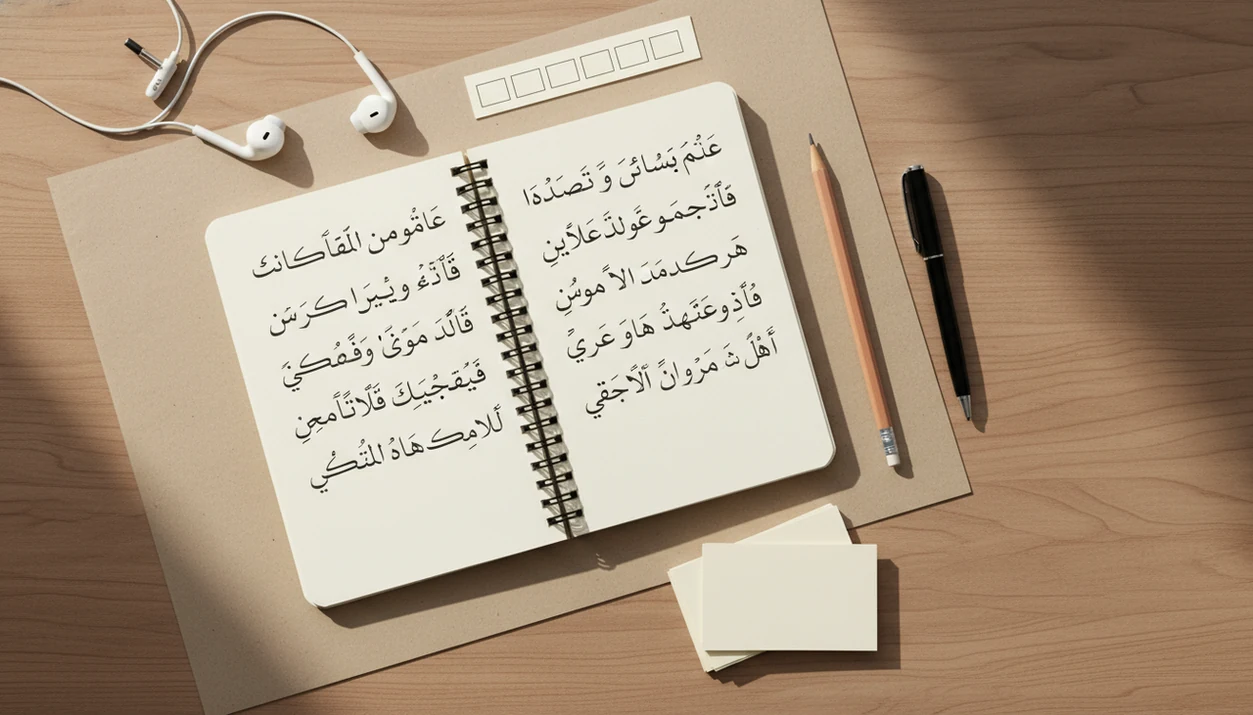
To learn Arabic script and phrases, start with right-to-left reading direction, the 28-letter Arabic alphabet, basic letter shapes, and a small set of everyday greetings you can practice aloud from day one. The fastest beginner path is to connect each script lesson to real Arabic words, transliteration, pronunciation notes, and short review cycles.
> Definition: Arabic script basics are the reading and writing rules for Arabic letters, letter shapes, vowels, direction, and sound patterns used to decode simple words and phrases.
- Arabic is written from right to left, and most letters connect differently at the beginning, middle, and end of words.
- Everyday Arabic often omits short vowels, so beginners need patterns, audio, and context rather than letter-by-letter decoding alone.
- Modern Standard Arabic is useful for reading, but greetings and spoken phrases vary across Egyptian, Levantine, Gulf, and other dialects.
Arabic Script Basics at a Glance
Learning Arabic script is not just memorizing the Arabic alphabet. A useful beginner path connects letter recognition, sound practice, and everyday phrases, so you can read small words and say polite expressions early.
Arabic is written from right to left, with 28 main letters. Most letters connect to nearby letters and change shape by position. Beginners also need to understand short vowels, which are often marked in children’s books, Qur’anic text, and teaching materials, but usually omitted in adult writing.
Arabic is worth the effort because it has wide public use. Arabic is one of the six official languages of the United Nations (UN), and the U.S. Census Bureau’s 2019 American Community Survey language report counted about 1.4 million Arabic speakers at home in the United States (U.S. Census Bureau).
Start small.
Reading and speaking develop together when each new letter appears inside a real word or phrase. A greeting on a phone screenshot is easier to remember than a letter floating alone on a chart.
Five Arabic Alphabet Facts Beginners Must Know
- Arabic has 28 main letters. The Arabic alphabet is conventionally described as a 28-letter right-to-left script (Britannica); shape changes do not create new letters, they show how the same letter connects in a word.
- Arabic is written and read from right to left. Begin at the right edge of a line, then move left through the word and sentence.
- Most letters have isolated, beginning, middle, and final forms. These are often called positional forms, and they matter for quick recognition.
- Short vowels are usually omitted in everyday writing. Long vowels are written as letters, but short vowel marks often disappear outside beginner materials.
- Modern Standard Arabic and dialects share the script. MSA is common in writing, news, and formal study, but Egyptian, Levantine, Gulf, and other spoken varieties differ in daily vocabulary and pronunciation.
The first week feels slower than expected. A learner may recognize ب on a chart, then miss it inside a connected word on a restaurant menu circled in pencil.
How Arabic Script and Phrase Learning Works
Arabic script learning works by mapping four things at once: letter shape, word position, sound, and meaning. A beginner is not only asking “what is this letter?” but also “where is it in the word, how does it sound, and what word did I just read?”
Connected forms make Arabic different from block alphabets. The same letter can look slightly different at the beginning, middle, or end of a word. That visual change is normal writing, not decorative calligraphy. The technical term is positional allography, which simply means one letter has different written forms.
Vowels add another layer. Long vowels appear as letters, while short vowel marks may be written in lessons but left out in normal adult text. Context fills the gap.
For beginners, phrase learning gives the script a job. The phrase شكراً becomes a word you can read, hear, say, and use, not just a handwriting sample.
Arabic Script Practice Setup for Beginners
A beginner setup for Arabic script should include handwriting practice, native-speaker audio, a limited phrase list, and one chosen speech variety. Keep the first set small enough to review without skipping.
Use a notebook, tracing sheet, or printed letter chart for shape practice. Write each letter in isolated, initial, medial, and final form. Leave a notebook margin labeled “formal/informal” for phrases, because Arabic register matters from the start.
Add audio for every phrase. Transliteration helps in the first few days, but it should become a check, not the main text. Read the Arabic first, then glance at the romanized line.
Choose your first phrase set deliberately. MSA fits reading and formal study. Egyptian, Levantine, or Gulf Arabic may fit conversation better, depending on the people or media you care about.
A workable first-week stack is simpler: one letter chart, one audio source, one notebook page, and eight phrases you will actually say. If your desk has three open tabs and no phrase you can read aloud, cut the stack down before adding another resource.
How to Use This Guide to Learn Arabic Script and Phrases
Use this guide as a one-week starter route, not as a pile of disconnected facts. The goal is to choose one Arabic path, read script before romanization, and let review do more work than novelty.
- Skim the at-a-glance section first. Notice the right-to-left direction, connected letters, missing short vowels, and the difference between formal Arabic and dialect speech before you start copying anything.
- Choose MSA or one dialect. Pick MSA if reading, news, or formal study matters most. Pick Egyptian, Levantine, Gulf, or another dialect if your main goal is conversation with specific people.
- Work through Steps 1–5 in order during your first week. Do not jump from alphabet charts to random phrase lists before you have practiced direction, connections, sounds, greetings, dialect choice, and review.
- Read the Arabic line before checking help. Try the script first, then use transliteration and audio to correct your guess, not to replace it.
- Review before adding. Start each session with older letters and phrases, then add a small new item. Use SiftLearn or another app only as a daily repetition tool, not as the whole method.
Step 1: Learn Arabic Reading Direction and Letter Connection
Start Arabic reading from the right side of the line and move left. Then learn how letters connect, because Arabic print is usually joined within words.
- Start at the right edge. Put your finger under the first letter on the right, then move left through the word.
- Name the position. Label each letter as isolated, initial, medial, or final before copying it.
- Trace the connection. Notice where the letter joins the next one; this is normal script, not calligraphy.
- Flag non-connectors. Some letters connect to the previous letter but do not connect forward to the next letter.
- Read before transliteration. Try the Arabic form first, then check the romanized guide.
Useful starter examples include باب bāb “door” and سلام salām “peace/hello.” The first time you copy them, the spacing may look uneven. That is normal. Hand cramp after character practice is a real beginner signal, not failure.
Step 2: Build Arabic Alphabet Sounds With English Comparisons
Arabic pronunciation should be learned with audio first and English comparisons second. English approximations are temporary training wheels, especially for sounds made in the throat or with emphatic tongue position.
| Sound group | Arabic examples | Beginner note |
|---|---|---|
| Familiar sounds | ب، ت، م، ن | Similar enough to English for a first pass, but still check audio. |
| New or less familiar sounds | ع، غ، خ، ح | These need careful listening; text descriptions are not enough. |
| Emphatic sounds | ص، ض، ط، ظ | The tongue and mouth shape change the vowel sound nearby. |
| Deep or variable sounds | ق | Often taught as a deep “q,” but dialect pronunciation varies. |
A learner staring at three browser tabs, a Duolingo lesson, a Wiktionary entry, and a YouTube pronunciation clip, is doing something sensible here. Cross-checking helps.
For adult beginners, listening and repeating one difficult sound in five real words is often better than reciting the whole alphabet without feedback. Some sounds, especially ع and ق, need a native or trained speaker to correct what you cannot hear yet.
Step 3: Practice Arabic Greetings as Translation Pairs
Arabic greetings are useful early because they connect script, sound, meaning, and social use in one short phrase. Read the Arabic script first, then use transliteration as a source check.
| Arabic script | Transliteration | Literal meaning | Natural English | Note |
|---|---|---|---|---|
| مرحباً | marḥaban | welcome/hello | Hello | Broadly understood, fairly neutral |
| السلام عليكم | as-salāmu ʿalaykum | peace be upon you | Hello / peace be upon you | Formal and widely used |
| صباح الخير | ṣabāḥ al-khayr | morning of goodness | Good morning | MSA and broadly understood |
| كيف حالك؟ | kayfa ḥāluka/ḥāluki? | how is your condition? | How are you? | MSA, gendered ending |
| شكراً | shukran | thanks | Thank you | Broadly understood |
| من فضلك | min faḍlik | from your favor | Please | MSA, gendered in full use |
| نعم | naʿam | yes | Yes | MSA, formal |
| لا | lā | no | No | Broadly understood |
Translation pairs prevent a common beginner mistake: treating one English word as one fixed Arabic word. For more practice with meaning shifts, use English to Arabic translation practice after you can read the phrase aloud.
Step 4: Compare MSA Arabic Phrases With Dialect Variants
Modern Standard Arabic is the common written standard used in formal writing, news, education, and many beginner courses. Daily speech varies by region, so a phrase that looks correct in a textbook may sound stiff at a café counter.
MSA Arabic for reading
MSA gives beginners a shared base for reading signs, headlines, forms, and many course materials. It also keeps dictionary lookup easier, because entries are usually organized around standard forms.
Dialect Arabic for conversation
For speaking, choose one dialect based on people, media, or travel plans. A pronoun chart folded into a backpack helps less if the audio you hear every day is Egyptian or Levantine.
| Meaning | MSA | Egyptian | Levantine | Gulf |
|---|---|---|---|---|
| Hello | مرحباً marḥaban | أهلاً ahlan | مرحبا marḥaba | هلا hala |
| How are you? | كيف حالك؟ kayfa ḥāluk? | إزيك؟ izzayyak? | كيفك؟ kīfak? | شلونك؟ shlōnak? |
| Thank you | شكراً shukran | شكراً shukran | شكراً shukran | مشكور mashkūr |
Learn the shared script while choosing one spoken target. No dialect is universally better; it depends on whom you want to understand.
Step 5: Review Arabic Script and Phrases in a 7-Day Cycle
A 7-day Arabic review cycle should mix tracing, reading aloud, audio comparison, and old-item review before adding new letters. Most adult learners do better with 10 to 20 minutes daily than one long weekend session.
The reason to space practice across the week is evidence-based: a major review of spaced learning found that distributed practice improves long-term retention more reliably than cramming (Cepeda et al., Psychological Science).
- Trace three to five letters. Copy each in isolated, initial, medial, and final position.
- Read two short words aloud. Try the Arabic script before checking transliteration.
- Practice four phrases. Use greetings, thanks, yes/no, and one question.
- Record one line. Compare your recording with native-speaker audio, softly if you are on a bus or in a shared room.
- Review yesterday first. Revisit older letters and phrases before adding new ones.
- Reset the set weekly. Keep what you can read quickly, and repeat what still feels slow.
For short phone-based practice, tools like SiftLearn, Duolingo, Memrise, and learner dictionaries can sit in the same routine. If you are comparing options, the best app for Arabic script and phrases guide is better used after you know whether you need script drills, phrase audio, or translation notes.
Common Myths About the Arabic Alphabet and Greetings
- “Every dialect has its own alphabet.” Arabic dialects vary in pronunciation and vocabulary, but they use the same Arabic script in normal writing.
- “You must learn calligraphy first.” Calligraphy is an art form. Beginners need legible letters, clean spacing, and reliable recognition.
- “You cannot learn phrases until the alphabet is finished.” You can learn greetings from day one while building script skill in parallel.
- “Arabic has no vowels.” Arabic has short and long vowels. Short vowels are often unwritten in everyday adult texts.
- “Letter names equal reading fluency.” Knowing that ب is called bāʾ helps, but fluent reading comes from recognizing letters inside words.
The pocket check is real. Many learners can recite the alphabet, then freeze when an airport bathroom sign appears without vowel marks. If you need help identifying unknown script from a photo or sign, a guide on what app identifies Arabic script can help narrow the tool choice.
Limitations
A single beginner guide can show Arabic script basics and useful Arabic greetings, but it cannot replace audio, feedback, grammar study, and repeated review. Use it as a starting map, not the whole course.
- Text cannot fully teach sounds such as ع, ح, غ, and ق; you need native-speaker audio and, ideally, correction.
- Script mastery does not automatically create listening comprehension in fast Egyptian, Levantine, Gulf, or Maghrebi speech.
- Short alphabet memorization methods rarely build fluent reading unless letters appear inside real words.
- Phrase lists can create a false sense of proficiency, especially when learners cannot change pronouns, tense, or politeness level.
- No one guide can cover all regional dialect differences without becoming confusing for beginners.
- Transliteration varies by source, so confirm important words in a learner dictionary or course source.
- Machine translation can be useful, but compare output against a dictionary before adding it to a flashcard deck.
Sift Learn can fit into a broader self-study plan, but any app-style routine still needs listening, handwriting, and spaced review. For meaning checks in the other direction, use Arabic to English translation for learners with a source check mindset.
FAQ
Is Arabic hard to read?
Arabic is challenging at first because it is read right to left, uses connected letter shapes, and often omits short vowels. Beginners can still decode simple words with steady practice and audio support.
How many Arabic letters are there?
The Arabic alphabet has 28 main letters. Isolated, initial, medial, and final shapes are forms of the same letters, not extra alphabet letters.
Why does Arabic read right to left?
Arabic is traditionally written and read from right to left. In practice, beginners should start at the right edge of the line and follow words leftward, while noticing punctuation and mixed numbers.
Does Arabic have vowels?
Arabic has both short and long vowels. Long vowels are written with letters, but short vowel marks are often omitted in normal adult texts.
Which Arabic dialect should I learn first?
The right dialect depends on the people, media, or region you want to understand. MSA remains useful for reading, formal study, and shared vocabulary across regions.
Can I learn Arabic phrases before the alphabet?
Yes, beginners should learn greetings and polite expressions from day one. Pair each phrase with Arabic script, transliteration, audio, and English meaning.
What is the best Arabic greeting for beginners?
As-salāmu ʿalaykum is a widely recognized Arabic greeting, and marḥaban is also broadly understood. Casual alternatives vary by region and dialect.
How long does it take to learn Arabic script?
Many beginners can recognize the main letters after several weeks of short daily practice. Fluent reading takes longer because connected forms, missing short vowels, vocabulary, and speed all need repeated review.