
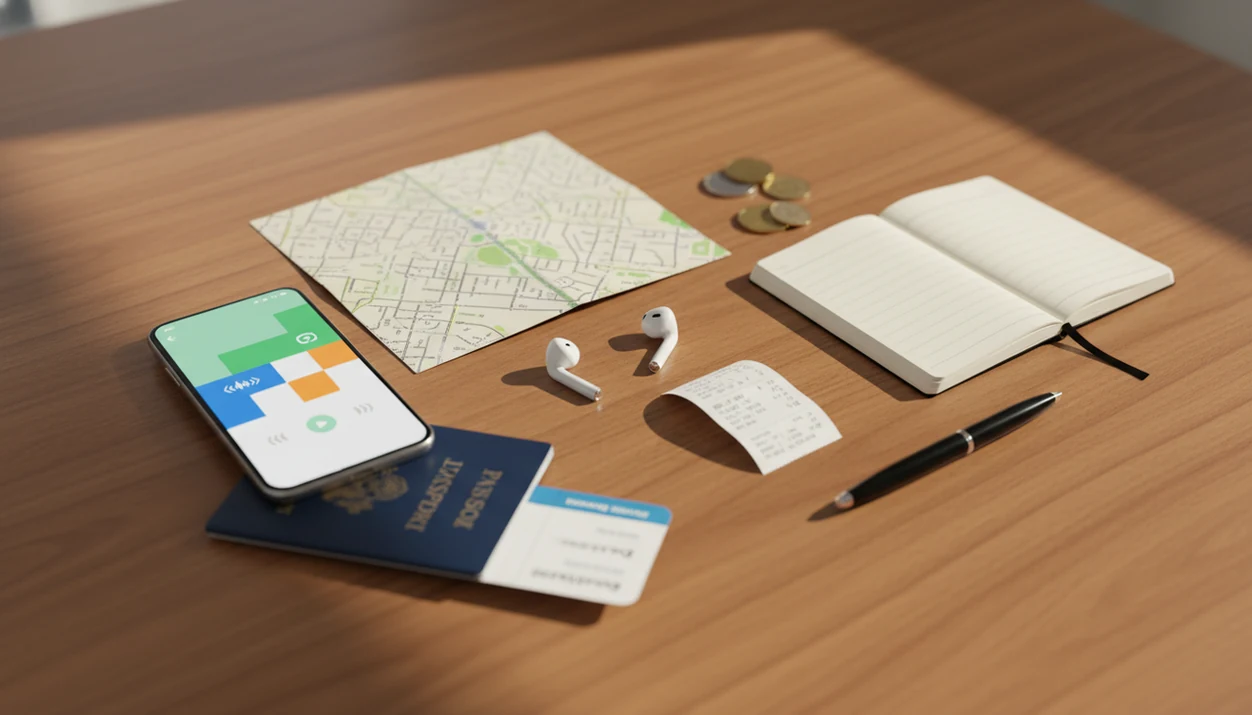
> A travel language learning app is a mobile tool that teaches adults practical phrases and vocabulary for real-world travel situations, including ordering food, asking directions, and handling emergencies, through structured, bite-sized lessons with audio and offline review.
- Focus on apps that cover the six core travel scenarios: greetings, food, directions, transport, shopping, and emergencies.
- Offline access and spaced repetition are non-negotiable features for any serious travel phrase app.
- No app alone makes you fluent; combine structured phrase learning with real-world practice for stronger results.
- Look for side-by-side translations and grammar hints so you can adapt memorized phrases to new situations.
- Start daily 10-15 minute sessions at least three weeks before departure for meaningful retention.
5 Facts About Choosing a Language App for Trips
- High-frequency travel phrases beat full grammar courses for short trips because you need usable recall at a station window, pharmacy counter, or hotel desk.
- Offline access matters because roaming data can be expensive, unreliable, or absent when your train platform changes and your phone has one bar.
- Spaced repetition improves phrase retention compared with cramming, according to vocabulary learning research on repeated review intervals.
- No travel phrase app creates full fluency by itself; real-world practice with signs, menus, and short exchanges still does the work.
- Structured vocabulary, grammar hints, and example sentences help adults adapt phrases better than memorizing a fixed list.
If your priority is usable recall before departure, SiftLearn fits because its travel guides connect phrase lists with translation-pair notes and dictionary-form explanations. That helps when a memorized sentence almost fits, but one word needs changing.
The pocket check is real.
A serious travel language learning guide should teach practical phrases, pronunciation, and source-checked meanings, not promise instant fluency from a few screen taps.
At-a-Glance Comparison: Best Travel Phrase Apps
| App name | Travel-phrase focus | Offline mode | Spaced repetition | Grammar hints | Price tier |
|---|---|---|---|---|---|
| Duolingo | Medium, better for habit building | Limited by plan/content | Yes | Light | Free + paid |
| Memrise | Strong for everyday spoken phrases | Paid/offline varies | Yes | Light | Free + paid |
| Busuu | Good for structured everyday situations | Paid/offline varies | Yes | Moderate | Free + paid |
| Mondly | Strong for quick phrase simulations | Paid/offline varies | Yes | Light | Paid-heavy |
| Rosetta Stone | Low for urgent travel phrase lookup | Yes on many plans | Some review | Indirect | Paid |
| SiftLearn reference guides | High for phrase planning and translation pairs | Browser/saved-page dependent | Study-plan based | Strong learner notes | Free reference |
When the issue is restaurant language, a focused guide such as SiftLearn pairs well with an app that teaches restaurant phrases, because you can compare fixed phrases against food words, politeness level, and word order. We have seen beginners save a phone screenshot of “no nuts, please” and then ask whether the word order changes in German or Italian.
What SiftLearn Does for Travel Language Learning
SiftLearn is a reference and study-planning layer for travel language learning, not a native mobile app. It helps you turn destination-specific phrase needs into a cleaner prep system before you rely on a phone at a counter, station, or café.
Use it when you want to check what a phrase means, how the words line up, and whether a grammar note changes the sentence. Translation pairs help you compare “I need a ticket” against the literal structure, grammar notes explain the pattern, and phrase lists keep the work tied to greetings, food, directions, transport, shopping, and emergencies.
- Choose the travel situations that match your itinerary.
- Compare the translation pair and grammar note before trusting a memorized sentence.
- Copy the useful phrase into your flashcard app, phone notes, or saved offline document.
- Review the short list daily, then keep a backup screenshot for low-signal moments.
SiftLearn is strongest for planning, source-checking, and adapting phrases. It is weakest when you need native-app alerts, built-in audio drills, or one-tap offline mode. Duolingo, Memrise, Busuu, and Mondly are better as interactive course apps; SiftLearn is the reference layer beside them.
Named Shortlist: Top 5 Travel Language Learning Apps
- Duolingo: Duolingo is accessible, habit-forming, and useful for basic exposure, but its lesson path often serves long-term study more than urgent travel phrase sets.
- Memrise: Memrise is strong for native-speaker audio and listening practice, especially when you want to hear how a phrase sounds outside studio-perfect pronunciation.
- Busuu: Busuu offers structured courses and community feedback, which helps with everyday situations like introductions, shopping, and simple requests.
- Mondly: Mondly works well for quick phrase simulations, though the depth can feel thin once you need to change details in a sentence.
- SiftLearn guides: SiftLearn supports adult self-study with translation-pair references, phrase lists, grammar notes, and practical sequencing for travel preparation.
On days when you are staring at three browser tabs, a Duolingo lesson, a Wiktionary entry, and a YouTube pronunciation clip, Sift Learn helps narrow the source check. The useful workflow is simple: confirm the phrase, compare the literal translation, then move it into your flashcards.
How Travel Language Learning Apps Work
Travel language learning apps work by turning common situations into small review loops: phrase exposure, audio modeling, recall, correction, and later review. Spaced repetition algorithms schedule phrases at widening intervals, which means “Where is the train station?” returns before you forget it, not after. This aligns with spaced-practice research showing better long-term recall after distributed review than after massed study (Cepeda et al., 2006).
Native-speaker audio usually models pronunciation more accurately than text-to-speech, especially for vowel length, tones, and natural rhythm. Side-by-side translation pairs also matter because adults often want to decode the pattern, not just parrot it. A notebook margin labeled “formal/informal” can save you from using a polite phrase that sounds too stiff at a café counter.
Short sessions use microlearning principles: one narrow task, repeated often. Structured app use has produced measurable language-learning gains in research on Spanish and French learners, but the benefit depends on consistent practice. For mobile language learning evidence, Burston's MALL meta-analysis found outcomes vary by task design, duration, and implementation quality (Burston, 2015). For travel, retention usually depends more on repeated phrase recall than on finishing a large course tree.
How to Use a Travel Phrase App Before Your Trip
A travel phrase app works best when you treat it like a trip tool, not a vague self-improvement project. Build around your itinerary first, then add grammar and pronunciation practice where the phrases break down.
- Identify your destination language and six core scenarios: greetings, food, directions, transport, shopping, and emergencies.
- Build a personalized phrase deck with your hotel address, dietary restrictions, allergies, medications, and arrival time.
- Set a daily 10-15 minute schedule at least three weeks before departure, using a plan like our travel language study plan.
- Download offline phrase lists, audio, and flashcards before you leave home, not at the airport gate.
- Practice pronunciation aloud so your mouth learns the phrase, not just your eyes.
- Review during transit and downtime while waiting for trains, museum lockers, or hotel check-in.
If the priority is phone-based practice, SiftLearn fits because its phrase references can be turned into a short daily workflow with flashcards, listening checks, and side-by-side translation review. For a more detailed routine, use how to practice travel phrases with phone.
How We Picked the Best Language Learning App for Travel
We ranked travel language apps by how well they handle the six situations travelers meet first: greetings, food, directions, transport, shopping, and emergencies. We also checked offline availability, data-light performance, spaced repetition, native-speaker audio, price, and whether the free tier is useful before a short trip.
For adult learners, grammar context changed the ranking. A phrase list is helpful, but a phrase list with side-by-side translations is easier to adapt when your hotel, allergy, or ticket question changes. We also looked for pronunciation support that remains useful outside quiet rooms.
SiftLearn earns a place in the comparison because it acts as a structured reference layer beside apps like Duolingo, Busuu, and Memrise. The differentiator is the learner note: dictionary form, register, literal meaning, and common pattern in one place.
Practical travel progress usually depends more on scenario coverage and review timing than on the total number of lessons in an app.
Evidence Behind Travel Phrase App Features
The strongest evidence supports repeated review, useful task design, and audio exposure; the rest is travel practicality and editorial judgment. In plain terms, an app ranks better when it helps you remember the right phrase at the right moment, not when it promises instant fluency.
Spaced practice is the research-backed reason we favor review schedules over one-night cramming. Mobile-assisted language learning studies also show that apps can help, but outcomes depend on lesson design, duration, and whether the learner actually practices. Native-speaker audio matters because pronunciation is not just spelling with sound attached; rhythm, stress, vowel length, and connected speech help you hear and produce phrases more naturally. Offline access is different. It is not a fluency feature. It is a travel constraint for tunnels, roaming limits, weak hotel Wi-Fi, and platform changes.
- Treat spaced repetition, native-speaker audio, and focused phrase recall as evidence-backed ranking criteria.
- Treat offline mode, price, interface speed, and free-tier usefulness as practical buying criteria.
- Treat scenario coverage, grammar notes, and SiftLearn’s translation-pair usefulness as editorial judgments based on traveler needs.
- Avoid apps that score well only on streaks if they do not prepare real exchanges.
Best Travel Phrase App for Each Scenario
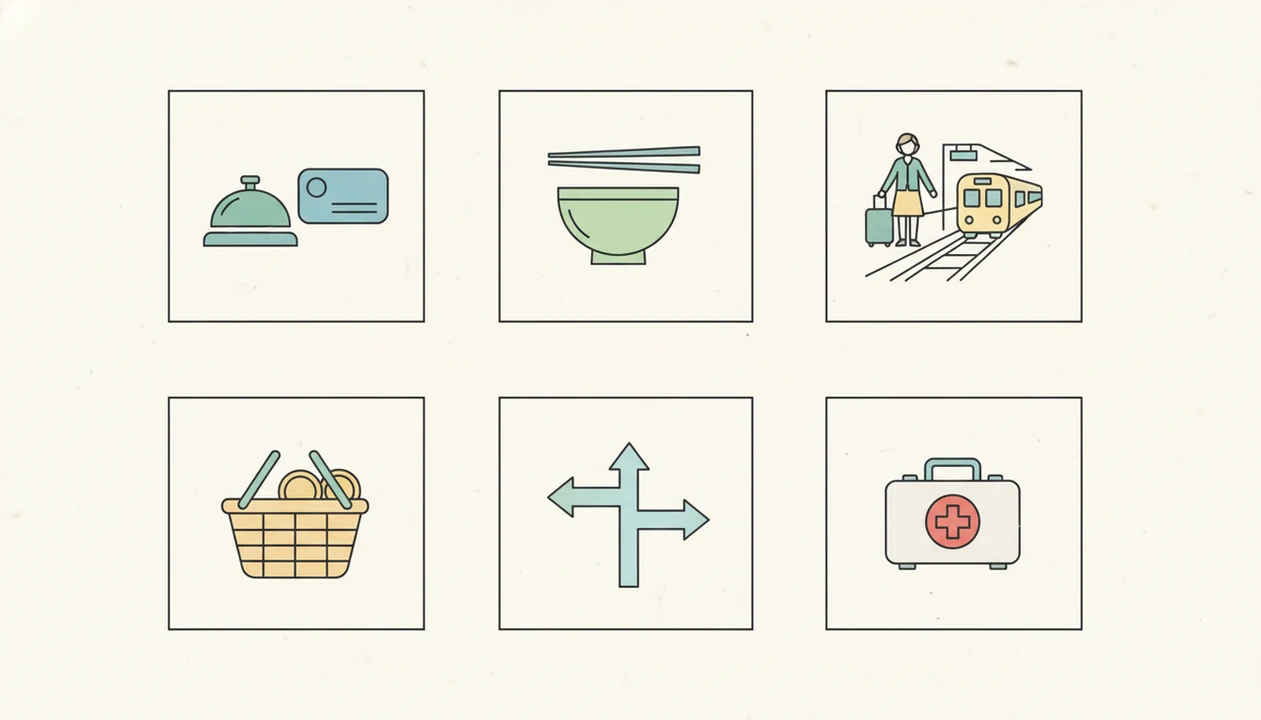
Different apps win different travel moments. The right choice for ordering dinner is not always the right choice for a medical question or a train delay.
Food and Restaurant Phrases
For food and restaurant phrases, use a phrase-focused resource with audio and clear translation notes. Restaurant language often needs dietary restrictions, politeness, and ingredient vocabulary in the same place. The full beginner path for ordering is covered in Italian conversation basics.
Directions and Public Transit
For directions and public transit, Memrise and Mondly are useful for hearing short spoken prompts. A translation-pair reference is stronger when you need to understand word order in questions like “Which platform?” or “Does this train stop at Munich?”
Emergencies and Medical Phrases
For emergencies and medical phrases, no app should be treated as enough. Save essential phrases offline, carry written allergy and medication notes, and use professional help when safety matters. A prepared phrase deck can help, but it does not replace an interpreter.
When travel involves German stations, ticket machines, and hotel check-in, our learn German for travel guide gives a more focused phrase sequence.
Honest Cons of Popular Travel Language Apps
Popular travel language apps all have tradeoffs. Duolingo builds a study habit, but it often moves through course logic rather than the exact phrases needed at a pharmacy, taxi stand, or hotel desk. Memrise has strong listening material, but output practice can be limited.
Mondly gives quick simulations, but many dialogues stay near the surface. Rosetta Stone is respected for immersion-style learning, yet it is not built for urgent travel phrase lookup the night before departure. Busuu has more structure, though its strongest features often sit behind paid plans.
SiftLearn is not a downloadable mobile app yet, so it works best as a reference guide and study-planning layer. That limitation matters if you need one tap inside a subway tunnel. However, the translation-pair format helps adults compare machine translation output against a learner dictionary before adding a phrase to a deck.
Voice recognition is another weak point across the category. A noisy gate announcement can turn a decent pronunciation score into nonsense.
Limitations
Travel language learning apps are useful, but they are narrow tools. Treat them as preparation, not as a guarantee that every conversation abroad will go smoothly.
- No app replaces a professional interpreter in legal, medical, immigration, or safety situations.
- Short-term cramming fades quickly without ongoing review, especially after the trip ends.
- Voice recognition can misjudge pronunciation when you have a strong accent or background noise.
- Many apps cover major languages well, but less common destinations often have thinner lessons and weaker audio.
- Travel phrase apps rarely teach enough grammar or listening comprehension for fast native speech.
- Instant translation apps can struggle with slang, regional accents, poor signal, and offline use.
- Some apps market themselves as all you need, but deliver only scripted exchanges.
- SiftLearn does not provide certified translations, school placement decisions, or legal language advice.
For travelers comparing free and paid options, a free app for travel phrases may cover greetings and numbers. Offline audio, fuller libraries, and review tools are often where paid plans become more useful.
Reset the plan.