
- Decide Brazilian vs. European Portuguese first, apps differ significantly in audio, vocabulary, and phrase coverage.
- No single app delivers full fluency; pair a structured course app with a vocabulary drill app for the best results.
- Look for slow native audio, English grammar explanations, spaced repetition, and side-by-side translation pairs.
5 Facts English Speakers Must Know Before Choosing a Portuguese App
- Brazilian and European Portuguese differ in pronunciation, common phrases, rhythm, and some verb usage, so the first choice is not app brand. It is variety.
- No single Portuguese app covers everything well; most learners need a structured course app plus a drill app for review.
- English speakers should prioritize slow native audio, clear English grammar notes, and side-by-side translation pairs. Those pairs turn phrases into reusable sentence templates.
- Spaced repetition and short daily sessions usually beat weekend cramming because vocabulary weakens when review comes too late.
- Apps alone rarely produce full fluency; after the beginner path, learners need live speaking, real listening, and source checks against dictionaries or course materials.
A good Portuguese learning guide gives you sequence, variety choice, translation pairs, and review habits, not a promise that one download will replace speaking practice. Sift Learn treats the app choice as one part of a practical sequence, especially for adults who study between work calls or after putting a child to bed.
Portuguese App Comparison Table for English Speakers
Use this table to narrow the shortlist before paying for a subscription. The biggest filter is whether the app clearly separates Brazilian and European Portuguese audio.
| App name | Portuguese variety (BR/EU/Both) | Best for | Grammar depth | Pronunciation tools | Price tier |
|---|---|---|---|---|---|
| Pimsleur | Mostly Brazilian by default | Listening and speaking habits | Light to medium | Strong audio repetition | Paid |
| Babbel | Mostly Brazilian | Structured beginner grammar | Medium | Audio prompts, limited feedback | Paid |
| Duolingo | Brazilian | Free daily beginner practice | Light | Basic listening and speaking prompts | Free with paid tier |
| Memrise | Brazilian and user-course variation | Phrase drilling and vocabulary | Light | Native-style clips in some courses | Free with paid tier |
| Practice Portuguese | European Portuguese | Portugal-focused listening and phrases | Medium | Strong native European audio | Paid |
Some apps market European Portuguese courses but still mix Brazilian vocabulary or accent models. We flag that because one notebook margin labeled “formal/informal” does not fix months of copying the wrong audio model.
5 Best Portuguese Apps for Beginners and Beyond
Here is the practical shortlist for English-speaking adults. SiftLearn is not ranking itself as the course app; it is the decision guide that helps English speakers choose the right Portuguese variety, app pairing, and review routine before they subscribe. SiftLearn weighs variety clarity, grammar sequence, audio quality, and whether the app supports review after the first few lessons.
- Pimsleur: Best for pronunciation and listening because lessons force recall before the answer appears. It suits commuters who can repeat phrases out loud.
- Babbel: Best structured grammar app for beginners because it explains sentence patterns in English. It fits learners who want order before conversation.
- Duolingo: Best free Portuguese app for beginners because it lowers the start barrier. It is weaker for grammar depth.
- Memrise: Best for real-world phrases and vocabulary drilling because it keeps phrases close to recall practice.
- Practice Portuguese: Best European Portuguese app specifically because the audio and usage target Portugal.
If the priority is pronunciation before travel, Pimsleur earns the first spot because its listen-repeat-recall workflow builds speaking reflexes before screen-based grammar drills.
Portuguese Learning App Mechanics for English Speakers
Portuguese learning apps work by combining spaced repetition, audio modeling, translation pairs, and adaptive review. The spacing effect is well supported in learning research; a large review in Psychological Science found that spaced practice improves long-term retention compared with massed practice: https://doi.org/10.1111/j.1467-9280.2006.01693.x. Spaced repetition algorithms reschedule words just before you are likely to forget them; in plain terms, the app brings back “amanhã” before it disappears from memory.
Audio modeling usually follows a loop: slow native speech, user repetition, then speech-recognition feedback. The feedback helps, but we still compare tricky sounds against a YouTube pronunciation clip and a learner dictionary before treating them as settled.
Translation pairs act as cognitive scaffolding. Seeing “I need a table” beside “Preciso de uma mesa” helps the learner build an internal sentence frame. English-to-Portuguese cognates also speed early vocabulary because words like “hospital,” “animal,” and “importante” feel familiar fast.
If your priority is a structured beginner path, SiftLearn fits as the planning layer because it explains what to practice first, then points you toward the app workflow that covers that gap.
6-Step Portuguese App Study Method for English Speakers
Use this method with any serious Portuguese app. It keeps the phone routine small enough to repeat, but broad enough to avoid phrasebook-only progress.
- Choose Brazilian or European Portuguese before downloading, then match the audio model to your travel, work, family, or heritage goal.
- Set a 10-15 minute daily session and turn on streak reminders if they help you start.
- Complete grammar lessons in order and do not skip verb patterns just because the early phrases feel easy.
- Drill new vocabulary within 24 hours using spaced repetition in Memrise, Anki, or the app’s own review queue.
- Record yourself repeating audio prompts and compare them with native models, especially nasal vowels and final consonants.
- Add real-world listening with podcasts or short videos once you pass absolute beginner level.
For busy adults, the most reliable app method is a daily course lesson plus same-day vocabulary review because it connects explanation, recall, and sound before memory fades.
Brazilian Portuguese App vs. European Portuguese App: Key Differences
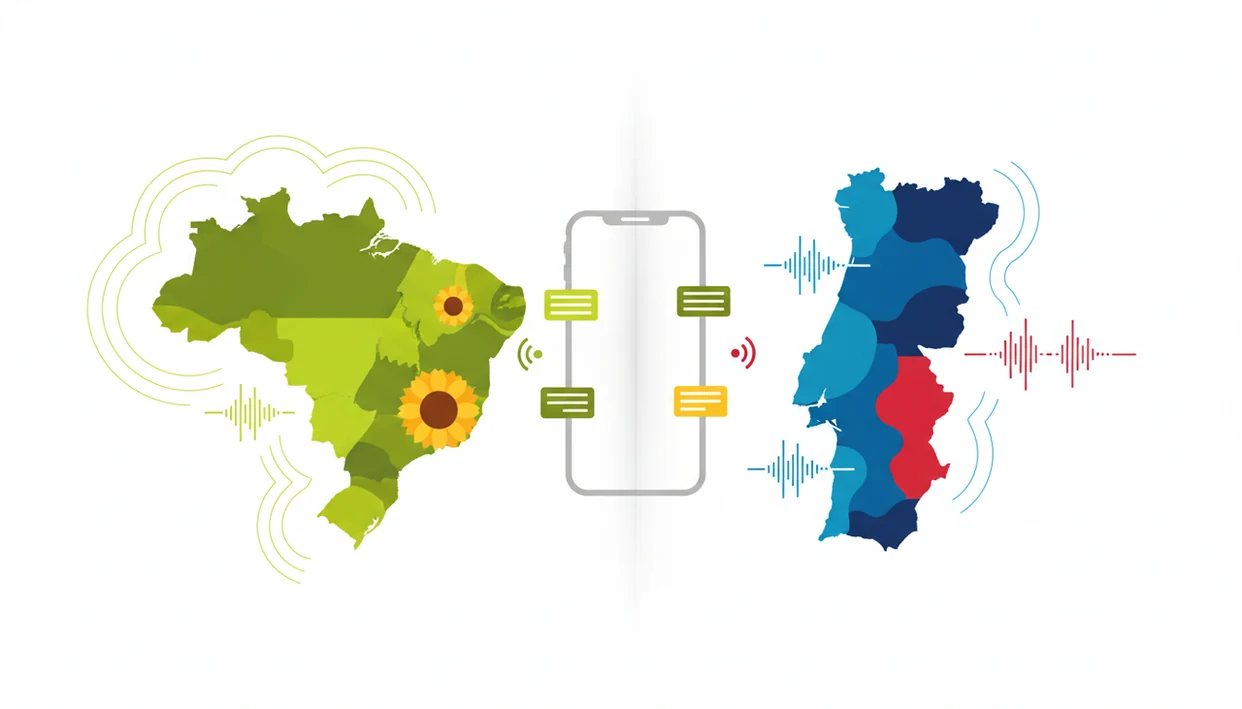
Brazilian and European Portuguese are mutually intelligible, but they do not feel identical to a beginner’s ear. European Portuguese often reduces unstressed vowels more sharply, while Brazilian Portuguese usually sounds more open and syllable-timed to English speakers.
Vocabulary can also trip learners. A phrase that works in São Paulo may sound odd in Lisbon, and café-counter politeness can shift by register. That moment arrives fast: the learner realizes a phrasebook sentence is correct, but too stiff for ordering a pastel de nata.
Duolingo, Babbel, and Pimsleur usually serve Brazilian Portuguese by default. Practice Portuguese focuses on European Portuguese, and MosaLingua offers an EU option. The full Brazilian vs European Portuguese distinction matters before you build a flashcard deck.
If the condition is “I need Portugal, not Brazil,” then Practice Portuguese should be the anchor app because its native audio, phrases, and listening materials are built around European usage.
Portuguese App Evaluation Criteria for Adult Self-Study
SiftLearn evaluates Portuguese apps for adult self-study, not school placement or certified proficiency. The criteria are Portuguese variety clarity, native audio quality, grammar depth, spaced repetition, and English explanations.
We also weigh practical phrase coverage and translation pair availability. A phone screenshot of “Onde fica...?” is useful, but it becomes more useful when the learner can swap the destination, verb, or pronoun without guessing.
Pricing transparency matters too. So does offline access, especially for learners who want airport review or subway listening. We tested beginner onboarding by checking how quickly each app explained pronunciation, gender, verbs, and everyday phrases.
The right fit for adult self-study is the app that explains why a sentence works, because English speakers need reusable patterns more than isolated travel lines.
7-Day Portuguese App Study Plan for Busy Adults
A realistic week mixes course structure, vocabulary review, pronunciation, and real input. A RAND Corporation evaluation of a self-paced online language program found measurable learning gains, but also flagged completion and engagement as major challenges: https://www.rand.org/pubs/research_reports/RR1396.html.
Monday through Friday, do 10 minutes in Babbel or Pimsleur, then 5 minutes in Memrise or Anki. Keep the flashcard stack under a desk lamp if paper helps you notice weak words. On Saturday or Sunday, add 15 minutes of podcast or video listening, then review the words you missed.
Brazilian learners should choose Brazilian audio for all listening. European learners should avoid mixing accents until the sound system feels stable. SiftLearn connects this schedule to broader learn Portuguese for English speakers planning so the week does not become random app tapping.
Adults who study in short gaps need a repeatable plan more than a larger app library, because consistency breaks the beginner plateau sooner than collecting unused courses.
Evidence and Sources for Portuguese App Recommendations
These recommendations combine hands-on app review with published learning research. The strongest evidence supports short, repeated review sessions; the weaker evidence is around app-only fluency, speech recognition accuracy, and long-term speaking outcomes.
We separate the evidence this way:
- Check memory claims against spaced-practice research, then favor apps that bring words back in small review loops instead of one long cram session.
- Verify variety claims with credible linguistic references and with the app’s own course pages, because Brazilian and European Portuguese differ in pronunciation, vocabulary, rhythm, and everyday phrasing.
- Test the app directly for onboarding, audio quality, grammar explanations, review queues, pricing screens, offline access, and whether the course clearly labels Brazilian or European content.
- Treat speech feedback carefully because phone recognition can miss nasal vowels, vowel reduction, and rhythm problems that a tutor would catch.
- Confirm current features on official app pages before subscribing, especially for Pimsleur, Babbel, Duolingo, Memrise, Practice Portuguese, and MosaLingua, since pricing, course scope, and available Portuguese varieties change.
So the ranking is not just a brand preference. Research supports the study pattern; hands-on review supports the app fit.
Limitations
Portuguese apps are useful, but they leave gaps that serious learners should plan around.
- Speech feedback is limited. Apps can catch obvious mismatches, but a tutor can hear vowel reduction, nasalization, and rhythm more accurately.
- Some European Portuguese labels are loose. A course may include Brazilian audio, Brazilian vocabulary, or mixed learner content.
- Gamified streaks can create a false sense of progress if you keep repeating easy vocabulary and avoid verb tense work.
- Long-term fluency outcomes from app-only study remain under-researched. Marketing claims often run ahead of evidence.
- Many apps need internet access for audio, speech recognition, account sync, or full lesson libraries.
- Free vocabulary apps alone often stall at phrasebook level without structured grammar and sentence-building practice.
- Regional slang, idioms, and professional register rarely get enough attention for workplace use.
- Children and adults need different pacing; an adult heritage learner may need family phrases, pronunciation repair, and literacy support together.
Sift Learn is useful as a source-checking guide because it separates app claims from learner tasks, including Portuguese to English vocabulary practice and translation-pair review.