
Learn Spanish For Beginners With A Clear First Path
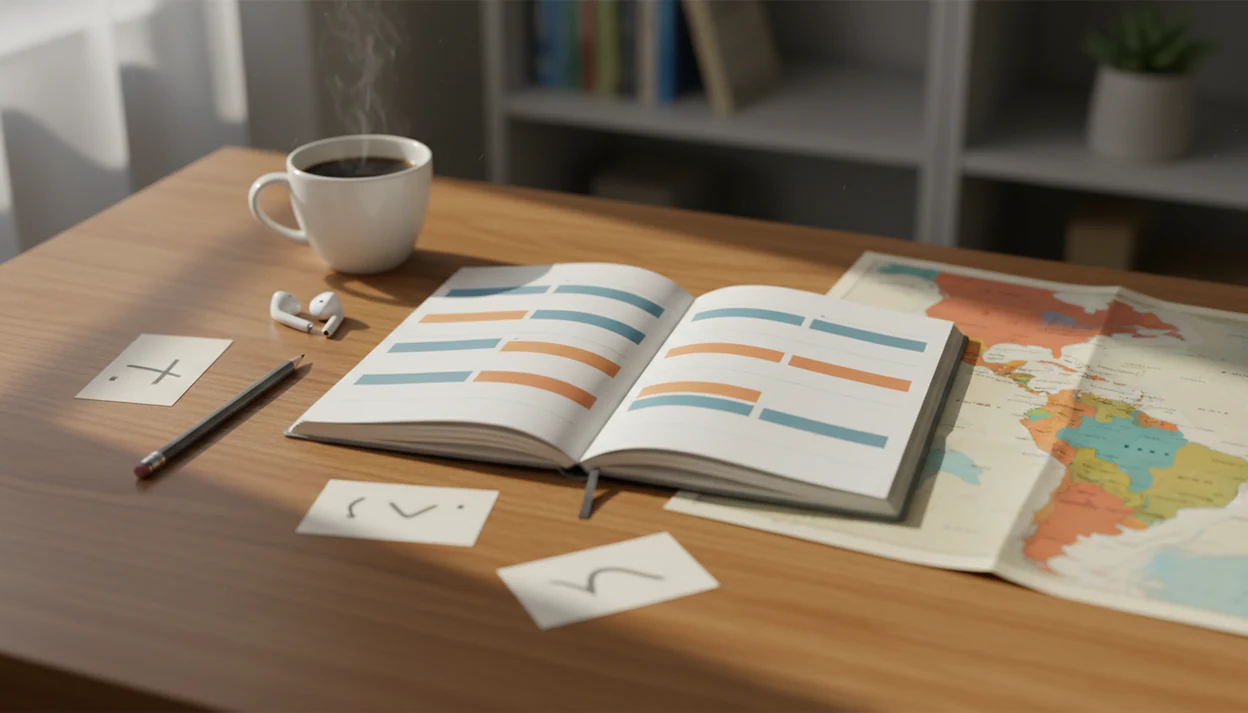
To learn Spanish for beginners, start with pronunciation, high-frequency words, basic present-tense grammar, and short daily translation-pair practice before trying harder conversations. A clear first path keeps adult learners from jumping between random apps, phrase lists, and grammar rules.
> Definition: A Spanish beginner guide is a structured sequence that teaches pronunciation, core vocabulary, simple grammar, and practical Spanish-English sentence patterns for first-stage learners.
TL;DR
- Start with sounds, the alphabet, greetings, numbers, question words, and polite phrases.
- Learn Spanish grammar basics through short sentence patterns, not isolated rules.
- Practice 10-30 minutes daily with listening, speaking, reading, writing, and translation pairs.
Spanish Beginner Guide At A Glance
- A beginner path starts with sound. Learn vowels, stress, and spelling patterns before packing your notebook with nouns.
- Survival phrases come early. Greetings, polite requests, numbers, and question words help you speak before you know much grammar.
- Core words beat random lists. A few common verbs like quiero, tengo, and necesito carry many first conversations.
- Translation pairs reveal patterns. Yo quiero agua / I want water shows word order and meaning at the same time.
- Spanish is widely used. In the United States, about 41.8 million people age 5 and older speak Spanish at home, according to the U.S. Census Bureau source.
This page is for adult self-study beginners. It is not an advanced grammar reference, and it is not just travel phrase memorization.
Spanish Learning Mechanics For Adult Beginners
Adult beginners learn Spanish by connecting sound, meaning, grammar pattern, and active recall in small repeated cycles.
That means you hear gracias, know it means “thank you,” notice how it sounds, and later produce it without looking. High-frequency phrases work better at the start because they combine vocabulary with usable grammar. A long list of restaurant nouns does less if you cannot say Quiero una mesa, por favor.
Distributed practice matters. A 2013 meta-analysis found that spaced practice supports stronger long-term retention than cramming for vocabulary and grammar learning source. Ten focused minutes today and tomorrow usually beats one tired hour on Sunday.
Tools like SiftLearn can help adults compare vocabulary, grammar, and translation pair references in a practical sequence, not a pile of disconnected tips.
Spanish Vocabulary And Pronunciation Setup Before Lesson 1
Before lesson 1, set up one place to store words, one audio source, one pronunciation model, and one daily time block. Keep it small enough to repeat when work runs late.
Use a notebook or spaced-repetition app for Spanish vocabulary. Add an audio course, beginner podcast, or dictionary audio for pronunciation. A 10-30 minute daily block is enough for a real start if you speak aloud, not just tap answers.
The notebook margin gets crowded fast.
Avoid beginning with advanced verb charts, slang compilations, or random YouTube playlists. They create noise before you have a base. Apps can help, especially a free Spanish vocabulary app, but pair them with speaking, listening, and simple real input.
Good language learning guides help adults learn vocabulary, grammar, and practical phrases across popular languages with structured lessons and translation pair references, not vague promises of instant fluency.
5 Steps To Start Beginner Spanish Study
Use this five-step routine for your first two weeks. It gives you a repeatable loop instead of a new decision every day.
- Set a daily 15-20 minute study window. Put it on your calendar like a short meeting, not a hopeful plan.
- Listen to Spanish sounds and repeat aloud. Use one short clip, then shadow it until the rhythm feels less foreign.
- Learn 20-30 high-frequency words and phrases. Start with hola, gracias, por favor, quiero, tengo, and necesito.
- Build simple sentences with translation pairs. Write Necesito ayuda / I need help and change one word at a time.
- Review mistakes and speak one short answer daily. Say where you are from, what you want, or what you need.
For busy adults, a fixed 15-20 minute Spanish routine is often easier than long weekend study because it reduces setup friction.
Step 1: Spanish Pronunciation And Alphabet Basics
“Should I learn Spanish pronunciation before vocabulary?” Yes, because Spanish spelling is more consistent than English, and early sound habits affect every word you learn later.
Start with the five vowel sounds, word stress, ñ, ll, silent h, and the tapped or rolled r. Compare pero and perro slowly. Treat año and ano carefully, since the missing ñ changes the word completely. Short contrasts like these teach your ear to notice meaning, not just accent.
Shadow one clean audio line at a time. Read it aloud after listening. A replayed audio clip at midnight is not glamorous, but it is often where pronunciation starts to settle.
A perfect accent is not required. Intelligible pronunciation prevents fossilized habits.
Step 2: Core Spanish Vocabulary For First Conversations
Beginner Spanish vocabulary should prioritize words that help you greet, ask, request, count, and connect ideas. A few hundred high-frequency words are more useful than thousands of memorized nouns you cannot place in a sentence.
- Greetings and polite expressions: hola, buenos días, gracias, por favor, perdón.
- Question words: dónde, cuándo, qué, quién, por qué.
- Common verbs: quiero, tengo, necesito, voy, puedo.
- Pronouns and connectors: yo, tú, él, ella, y, pero, porque.
Learn words inside mini-sentences. Write Quiero café or Necesito agua, not just café and agua. One learner we reviewed had grocery labels matched to notebook words, then added verbs beside them. That second step mattered.
If you also study another Romance language, the sequence for learn French vocabulary and grammar will feel familiar, but the sounds and articles need separate attention.
Step 3: Spanish Grammar Basics In Simple Sentences
Spanish grammar basics make more sense when learned through sentence pairs. Start with articles, noun gender, adjective agreement, word order, regular present-tense verbs, and dropped subject pronouns.
| Pattern | Spanish | English | Learner note |
|---|---|---|---|
| Basic need | Necesito ayuda. | I need help. | No extra subject is required. |
| Basic want | Yo quiero agua. | I want water. | Yo can appear for clarity or emphasis. |
| Article and gender | una mesa | a table | Many nouns use la/una or el/un. |
| Adjective agreement | una casa pequeña | a small house | The adjective often changes to match the noun. |
| Regular verb | Hablo español. | I speak Spanish. | The verb ending shows “I.” |
Practice grammar by building sentences, not by staring at rules alone. Article endings circled in red help, but only if you use them in new sentences. A focused app that teaches Spanish grammar with translations can support this pattern-based work.
4 Common Myths About Beginner Spanish Study
- Myth 1: You must memorize thousands of words before speaking. False. A small base of high-frequency words can support basic requests and answers.
- Myth 2: Spanish grammar basics are too hard for adults. Adults can learn regular patterns when examples are sequenced and compared.
- Myth 3: Duolingo, Babbel, or Rosetta Stone alone will make you fluent. These apps can help with recognition and habit-building, but speaking, listening, feedback, and real input carry the learner further.
- Myth 4: You should wait until your Spanish feels flawless. Waiting delays the feedback loop that shows what you actually can produce.
- Fact: Imperfect early practice exposes gaps. A short answer with mistakes gives you something specific to repair.
For most beginners, speaking early in low-pressure situations works better than silent study because it turns passive knowledge into usable recall.
4-Week Beginner Spanish Practice Plan With Translation Pairs
Use this four-week path as a starter plan, then repeat the loop with new words and patterns.
- Study week 1 sounds and greetings. Listen, repeat, and write translation pairs like Hola / Hello and Gracias / Thank you.
- Add week 2 core verbs and phrases. Practice quiero, tengo, necesito, and short polite requests.
- Build week 3 noun and adjective patterns. Compare un libro rojo and una casa roja until agreement feels visible.
- Practice week 4 question-answer exchanges. Ask ¿Dónde está...? and answer with one short sentence.
Use the loop: listen, repeat, translate, build your own sentence, get feedback. A university effectiveness study of Duolingo reported measurable Spanish learning gains after regular use, but app practice still needs feedback and speaking practice to prevent fossilized mistakes source. Tutors, partners, or learner communities help prevent fossilized mistakes.
A full first-month sequence is mapped in Spanish learning month 1.
Common Beginner Spanish Mistakes And How To Fix Them
Most beginner Spanish mistakes come from practicing recognition without enough production. Fix them by making sound, verbs, articles, and context part of the daily routine from the first week.
- Contrast tricky sounds aloud. Say pero and perro slowly, then record one sentence with each word. Your ear needs repeated contrast before your mouth can trust the difference.
- Attach verbs to new nouns. Do not stop at café, agua, or mesa. Add quiero, tengo, or necesito so the word can become a real first sentence.
- Mark articles immediately. Learn el libro and la casa, not just libro and casa. Early attention to gender prevents automatic habits that take longer to unwind.
- Speak beyond app choices. Multiple-choice drills are useful, but say one answer aloud every day without seeing the options.
- Check translated phrases before using them. Machine translation can miss tone, region, or setting. A phrase that works in a textbook may sound stiff, too intimate, or odd at a café counter.
Small repairs now save weeks of unlearning later.
Limitations
A beginner guide can organize your first path, but it cannot do the learning for you. Spanish still needs repetition, correction, and real use.
- No guide can guarantee fluency by itself.
- Self-study can stall without feedback on pronunciation and grammar.
- Apps may overemphasize multiple-choice recognition instead of active speaking.
- Fast-learning promises often understate the time required.
- Motivation, time management, and speaking opportunities remain learner-dependent.
- Regional Spanish differences affect vocabulary, pronunciation, and informal usage.
- Machine translation can mislead beginners if they copy phrases without a dictionary check.
- A phrase may be correct but too formal for a café counter.
Sift Learn treats beginner Spanish as a structured self-study project. It can point to sequence and learner notes, but it cannot replace conversation practice.
FAQ
How do beginners learn Spanish from zero?
Beginners learn Spanish from zero by starting with pronunciation, high-frequency words, simple present-tense sentences, and daily review. The first goal is basic comprehension and short answers, not full conversation speed.
What Spanish words should I learn first?
Learn greetings, polite phrases, numbers, days, question words, common verbs, pronouns, and connectors first. Useful examples include hola, gracias, por favor, quiero, tengo, necesito, dónde, cuándo, and porque.
Is Spanish grammar hard for adult beginners?
Spanish grammar basics are manageable for adult beginners when taught through sentence patterns. Start with articles, gender, adjective agreement, regular verbs, and simple word order.
How long does it take to learn basic Spanish?
Basic Spanish usually takes months of consistent practice, depending on your time, feedback, and goals. Short daily sessions work better than occasional cramming for most learners.
Can I learn Spanish alone at home?
Yes, you can learn beginner Spanish alone at home with audio, reading, flashcards, writing, and translation pairs. Speaking partners or tutors help correct pronunciation and grammar gaps.
Are Spanish learning apps enough for beginners?
Spanish learning apps are useful for vocabulary, review, and grammar recognition. They are not enough by themselves if you want speaking confidence and real listening ability.
Should I start speaking Spanish before I feel ready?
Yes, beginners should start with low-pressure speaking before they feel fully ready. Short imperfect answers build recall and reveal what to practice next.
What should my first Spanish lesson include?
A first Spanish lesson should include vowel sounds, greetings, polite phrases, and one or two simple sentence patterns. It should also include listening and speaking aloud, not only reading.