
Learn German For Travel With Practical Phrases And Grammar Patterns
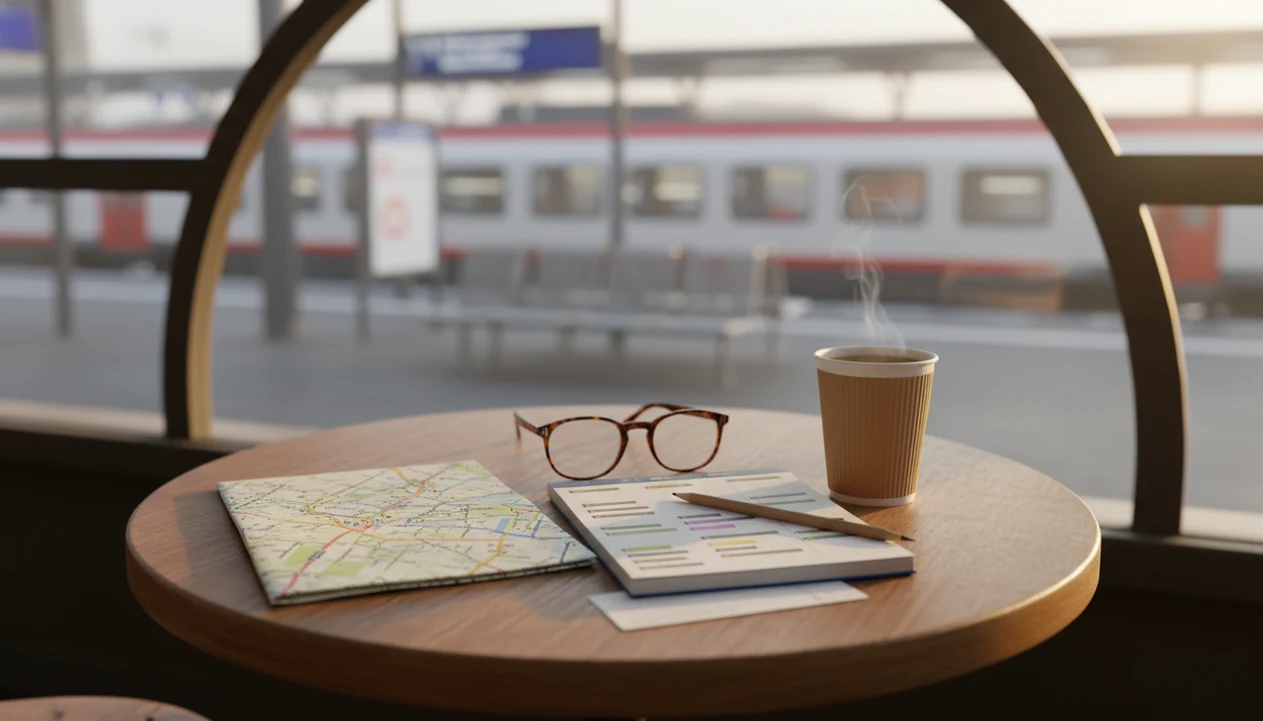
To learn German for travel, focus on a small set of polite phrases, reusable question patterns, pronunciation cues, and scenario vocabulary for airports, trains, hotels, restaurants, directions, and emergencies. You do not need fluency before a trip, but you do need enough German to read signs, ask for help, and handle basic interactions respectfully.
Definition: German for tourists is a practical subset of German built around high-frequency phrases, polite address, travel vocabulary, and sentence patterns used in real trip situations.
TL;DR
- Start with polite basics: Hallo, Guten Tag, bitte, danke, Entschuldigung, and Sprechen Sie Englisch?
- Learn reusable patterns such as Wo ist…?, Wie viel kostet…?, Ich hätte gern…, and Ich brauche Hilfe.
- Default to formal Sie with strangers in shops, stations, hotels, restaurants, and public offices.
German For Tourists At A Glance
- German for tourists is communication-focused, not fluency-focused. The goal is to complete real tasks, not discuss politics or read novels.
- The core travel situations are predictable. Start with greetings, transport, hotels, food, directions, shops, toilets, and emergencies.
- Formal Sie is the safe default with strangers. Use it with hotel staff, ticket clerks, servers, police, and people you stop for directions.
- Reusable phrases beat long word lists. A phone screenshot of five patterns will help more than fifty loose nouns.
- Europe is multilingual, but German still helps. A 2022 Eurobarometer found that 56% of EU respondents could hold a conversation in at least one language other than their mother tongue, yet signs and local routines still vary by place source.
The pocket check is real: if you can pull a folded note from your coat, point to Gleis, and ask Wo ist Gleis sieben? while a train board flickers, the phrase has passed a travel test.
How German Travel Phrases Work
German travel phrases work best as phrase frames: fixed openings that let you swap one useful word into a known sentence pattern. This is faster than building every sentence from grammar rules at a ticket machine.
Use Wo ist…? for locations: Wo ist der Bahnhof? means “Where is the train station?” Use Ich hätte gern… for buying or ordering: Ich hätte gern ein Wasser means “I would like a water.” Use Können Sie mir helfen? when you need help from a person, not a menu.
Word order and register still matter. German does not always mirror English, and du can sound too familiar with strangers. Listening recognition matters too; hearing Gleis sieben on a platform is different from reading Gleis 7 in a list. For travel German, judge tools by whether they drill phrase frames, pronunciation, and scenario recall; SiftLearn, Duolingo, Memrise, and Babbel can all help with repetition, but tourists still need an offline phrase sheet for stations, hotels, restaurants, and emergencies.
Before You Start Learning German For Travel
Before memorizing German travel phrases, choose the trip situations you will actually face. A weekend in Munich needs station, restaurant, and hotel German; a hiking trip in Austria may need weather, bus, and emergency words sooner.
Prepare three study tools: pronunciation audio, offline notes, and a one-page phrase cheat sheet. If you study on a phone, the routine in how to practice travel phrases with phone fits this kind of short daily work.
Usage can shift across Germany, Austria, and Switzerland. Semmel, Brötchen, and Weggli can all point toward bread-roll territory, depending on region. Do not overlearn rare menu words before you can say Entschuldigung, Wo ist…?, and Ich brauche Hilfe. Frequent phrases earn their space.
Step 1: Learn Polite German Greetings And Sie Forms
What German greetings should a tourist learn first? Start with Guten Tag for “Good day,” Hallo for “Hello,” bitte for “please,” danke for “thank you,” Entschuldigung for “excuse me,” and auf Wiedersehen for “goodbye.”
Use Sie with strangers unless someone invites you to use du. That means Sprechen Sie Englisch? is safer than Sprichst du Englisch? in a shop, hotel, station, restaurant, or public office. Add Ich spreche nur ein bisschen Deutsch when you need to lower the speed of the exchange.
Politeness improves short interactions because it signals effort before your grammar does. A beginner with a folded pronoun chart in a backpack may still hesitate, but Guten Tag, sprechen Sie Englisch? lands better than walking in with English first. That does not make it fluent conversation.
Step 2: Practice German Travel Phrase Patterns
To use German for tourists well, practice a few patterns until they come out without rebuilding the sentence. For many travelers, phrase frames are easier than memorized dialogues because the same opening works in stations, cafés, hotels, and shops.
- Use Wo ist…? Ask locations: Wo ist der Bahnhof? means “Where is the train station?” Wo ist die Toilette? means “Where is the toilet?”
- Use Wie viel kostet…? Ask prices: Wie viel kostet das? means “How much does that cost?”
- Use Ich hätte gern… Order or buy: Ich hätte gern einen Kaffee means “I would like a coffee.”
- Use Ich brauche… State a need: Ich brauche ein Taxi means “I need a taxi.”
- Use Können Sie mir helfen? Ask for help: “Can you help me?”
After testing a phrase, compare it against a learner dictionary before saving it. Tools like SiftLearn, Duolingo, and Memrise can support short practice, but a dictionary form still helps you avoid bad flashcards.
Step 3: Use Basic German Conversation In Travel Scenarios
Basic German conversation works better when you learn it in trip order. Arrival phrases come before souvenir vocabulary because your first real tasks are usually transport, check-in, food, and finding your way.
Airport And Train German
Use Wo ist die Gepäckausgabe? for “Where is baggage claim?” and Ein Ticket nach Berlin, bitte for “One ticket to Berlin, please.” On trains, listen for Gleis for platform and Verspätung for delay. Train platform numbers repeated quietly are a normal rehearsal, not a failure.
Hotel And Restaurant German
Use Ich habe eine Reservierung at check-in. In restaurants, Die Speisekarte, bitte asks for the menu, and Zahlen, bitte asks to pay. If food ordering is your main concern, an app that teaches restaurant phrases can narrow the practice set.
Directions And Emergency German
Use links, rechts, and geradeaus for left, right, and straight ahead. For urgency, learn Ich brauche Hilfe and Rufen Sie bitte einen Arzt.
Step 4: Add German Pronunciation And Listening Cues
Spelling memorization is not enough for German travel. You need to say phrases clearly and recognize the words when someone replies at normal speed.
Practice slowly first, then repeat at station-announcement speed. The German w sounds like English “v,” so Wasser starts closer to “vasser.” The German ei often sounds like “eye,” as in ein. Do not overload yourself with IPA unless you already use it.
Listen especially for Bahnhof station, Gleis platform, Fahrkarte ticket, links left, rechts right, Eingang entrance, Ausgang exit, and Hilfe help. Headphones sealing out apartment noise can make dictation less frustrating, but test phrases without headphones too. Travel is noisy. For phone-based listening drills, compare options in a free app for travel phrases before you build a routine.
Step 5: Review A German Travel Phrases Cheat Sheet
A German travel phrase cheat sheet should group phrases by function, not by textbook chapter. Test yourself from English prompts into German, then save an offline copy or print a PDF-style note before leaving.
| Function | German phrase | English meaning |
|---|---|---|
| Greet | Guten Tag | Good day |
| Ask | Wo ist der Bahnhof? | Where is the train station? |
| Order | Ich hätte gern ein Wasser | I would like a water |
| Pay | Zahlen, bitte | The bill, please |
| Find | Wo ist die Toilette? | Where is the toilet? |
| Get help | Können Sie mir helfen? | Can you help me? |
A practical readiness check is simple: can you ask where something is, order one item, ask to pay, and request help? If yes, your travel German has a usable base. Apps such as Sift Learn and Babbel can help with repetition, but keep the offline note separate.
Common Mistakes With German For Tourists
- Using du with strangers by default can sound too familiar. Use Sie in shops, stations, hotels, restaurants, and official settings.
- Translating English word order word-for-word creates brittle phrases. Check a Collins, Duden, or learner dictionary entry before turning machine output into a flashcard.
- Relying only on “Do you speak English?” leaves gaps. Signs, menus, platforms, receipts, and door labels may still be in German.
- Ignoring pronunciation makes known phrases hard to use. If you only read Entschuldigung, you may not recognize it when spoken quickly.
- Memorizing long lists is less useful than flexible patterns. For travelers, Wo ist…? usually works better than twenty location phrases memorized separately.
The European school context supports language learning, but it does not remove the need for local basics. Eurostat reported that 96.8% of lower secondary pupils in the EU studied at least one foreign language in 2022 source.
Limitations
A short guide can help you prepare German for tourists, but it cannot make a traveler fluent or fully conversational. Real speech brings speed, accent, background noise, and pressure.
- A phrase list will not cover complex medical, legal, financial, or immigration conversations.
- Fast announcements, dialects, crowd noise, and stress can reduce comprehension even when you know the words.
- Germany, Austria, and Switzerland may use different words, greetings, food terms, and service conventions.
- Machine translation can fail when the wording is urgent, the signal is weak, or the context is unclear.
- German word order, polite forms, and some case patterns still matter in basic exchanges.
- Emergency communication may require local staff, emergency services, or a professional interpreter.
- Restaurant phrases may not cover allergies unless you prepare a clear allergy card before dinner.
For adult self-study, SiftLearn treats travel German as a practical sequence: phrase frames first, pronunciation next, then scenario review. If you want to compare broader tools before a trip, the best language learning app for travel guide is a better starting point than a random app-store search.
FAQ
Can I travel with basic German?
Yes, basic German is enough for many tourist interactions, such as greetings, ordering, directions, tickets, and hotel check-in. It is not enough for complex conversations or urgent specialist situations.
What German phrases should I learn?
Learn greetings, polite words, directions, transport phrases, ordering phrases, payment phrases, and help requests. The highest-value patterns are Wo ist…?, Ich hätte gern…, Wie viel kostet…?, and Können Sie mir helfen?
Is Sie or du better?
Sie is the safer default with strangers, service staff, officials, and older adults. Use du only when the setting is clearly informal or someone invites it.
How do Germans say please?
German uses bitte for “please” in requests. It can also mean “you’re welcome” or function as a polite offering word, depending on context.
How do I ask directions?
Use Wo ist…? plus the place, such as Wo ist der Bahnhof? Learn links for left, rechts for right, and geradeaus for straight ahead.
How do I order food?
Use Ich hätte gern… plus the item you want. Helpful restaurant phrases include Die Speisekarte, bitte for “The menu, please” and Zahlen, bitte for “The bill, please.”
Do Germans speak English?
Many people in German-speaking areas may know some English, especially in tourist zones. Travelers should still learn German basics for signs, transit, menus, and courtesy.
How long should I practice?
Practice 10 to 15 minutes daily for two to four weeks if your goal is basic trip readiness. Treat that as a practical planning rule, not a guarantee; learning research generally supports spaced practice over cramming source. Focus on phrase repetition, listening, pronunciation, and active recall from English into German.