
How to Practice Travel Phrases With Phone Audio
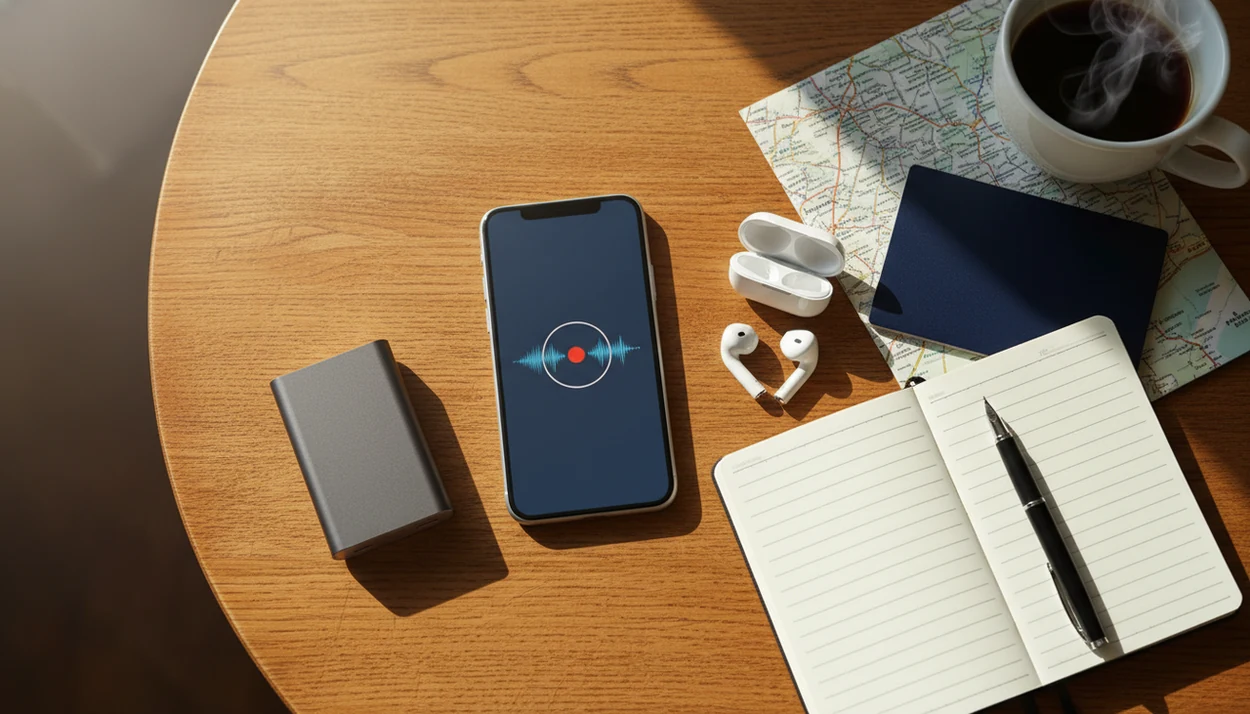
The fastest way to use your phone as a travel phrase coach is to save the phrases you will actually need, listen to native-style audio, repeat aloud, record yourself, and review offline before each real situation. If you want to know how to practice travel phrases with phone tools, build a small routine around audio, notes, translation pairs, and quick recall instead of memorizing a long random list.
Phone travel phrase practice is a short, repeatable routine that uses mobile audio, translation pairs, voice recording, offline packs, and real-situation review to prepare travelers for common conversations.
- Practice high-frequency travel phrases first: greetings, directions, food ordering, hotels, transport, shopping, and help requests.
- Use phone audio actively: listen, shadow, record yourself, then self-test without looking.
- Download offline phrase, translation, and camera translation tools before the trip so practice still works without data.
Travel phrase audio essentials before you start
A useful phone setup for travel phrases needs six parts: a small phrase set, native-style audio, translation pairs, notes, voice recording, and offline access. Without those pieces, practice often turns into passive scrolling.
Start with situations, not languages in the abstract. Build folders for airport, taxi, hotel, restaurant, pharmacy, shopping, and emergency help. A boarding pass tucked beside phrase cards is old-fashioned, but the logic still works on a phone: place the phrase near the moment you will need it.
Compare specific tools such as Google Translate, Apple Translate, Microsoft Translator, Memrise, Duolingo, and any phrasebook app you already use; the better choice is the one with clear audio and offline access for your route. If a German phrase plays clearly in headphones but disappears without Wi-Fi, it is not trip-ready. For a broader app comparison, our best language learning app for travel guide separates phrase practice from general course study.
Phone language practice loop for travel phrases
Phone language practice works when it creates a listen-repeat-recall loop: hear the phrase, say it aloud, check the meaning, then retrieve it later without looking. The mechanism is simple spaced retrieval, with audio feedback added.
This routine is grounded in retrieval practice and spaced review: testing yourself from memory usually improves later recall more than rereading alone, and spacing practice sessions helps memory last longer. Sources: https://www.apa.org/science/about/psa/2016/06/learning-memory and https://www.ncbi.nlm.nih.gov/pmc/articles/PMC5126970/.
- Audio trains recognition. Travel phrase audio helps with pronunciation, rhythm, stress, and hearing words when a local speaks faster than a lesson voice.
- Speaking makes the phrase usable. Silent reading does not prepare your mouth for unfamiliar sounds.
- Translation pairs anchor meaning. Adults often learn faster when the English phrase and target phrase sit side by side.
- Recall beats rereading. Hiding the translation forces memory to work.
- Likely conversations matter most. Phone practice is strongest when it trains airport counters, hotel desks, restaurants, and transport questions, not isolated vocabulary.
For adult travelers, phrase recall on a phone is often easier than open conversation practice because the situation and wording are already narrowed.
6-step phone workflow for travel phrases
Use this phone workflow when you have ten minutes, or less, before a real travel situation. Keep the session narrow enough that you can finish it standing in a hotel hallway.
- Choose one trip situation, such as ordering coffee, asking for directions, or checking into a hotel.
- Save 5 to 10 phrases with the English phrase, target-language phrase, and audio if available.
- Listen and shadow each phrase three times before reading it closely.
- Record your own voice and compare rhythm, stress, and unclear sounds against the audio.
- Hide the translation and self-test from memory until you can say the phrase without the screen.
- Tag weak phrases for quick review before the real interaction.
The pocket check is real.
A phone routine usually works best when each session has one social task, while broad vocabulary review fits people preparing months ahead.
Step 1: Choose high-frequency travel phrases on your phone
Choose the phrases you expect to say in the first 48 hours of travel. Complete phrases are easier to use under stress than single words because they already include politeness, word order, and the request.
- Arrival phrases: greetings, “I have a reservation,” passport questions, baggage, and airport directions.
- Movement phrases: taxi, train platform, ticket, address, “near here,” and “how much?”
- Lodging phrases: check-in, key card, Wi-Fi, breakfast time, and room problems.
- Food phrases: ordering, allergies, water, bill, and basic substitutions.
- Help phrases: bathroom, pharmacy, police, “please write it down,” and “can you speak slowly?”
SiftLearn is most useful here when you use it as a structured place for vocabulary, grammar notes, and translation pairs, then move only the phrases you can actually say into your trip list. Treat it as organized practice support, not a promise of instant fluency.
Step 2: Practice travel phrase audio with shadowing
How do you practice travel phrase audio on a phone? Shadowing means repeating immediately after the audio while copying the speaker’s rhythm, stress, and pauses.
Use short loops. Listen once with the screen visible. Whisper once, so your mouth maps the sound without pressure. Speak normally once. Then turn the screen away and say the phrase from memory. If playback speed is available, slow it briefly, but return to normal speed before the trip.
Pronunciation practice should be audible. Reading “dov’è la stazione?” silently will not prepare you for saying it with someone waiting at a ticket window. If restaurant talk is your main use case, an app that teaches restaurant phrases is often more useful than a broad beginner course for that week.
Step 3: Build translation pairs and phone notes
A good phone note makes each phrase searchable, checkable, and usable. Use this format: situation, English phrase, target-language phrase, literal meaning, and audio link or app location.
Example: Restaurant | Could I have the bill, please? | target phrase | literally “the bill, please” | Memrise list 2, audio 04. Add pronunciation hints only when they help you remember a sound. Do not invent a new spelling system that becomes harder than the phrase.
Group notes by task, not alphabetically. Airport phrases belong together. Pharmacy phrases belong together. A notebook margin labeled “formal/informal” is still useful here, even if the notebook is now a pinned phone note.
Before putting a machine translation into a flashcard deck, cross-check it against a learner dictionary when possible. That source check catches register problems and word choices that look fine in isolation.
Step 4: Use offline translation apps during phone practice
Offline translation apps help only if you prepare them before the trip. Download the correct language packs, saved notes, and phrase audio while you still have reliable Wi-Fi at home.
Check the offline rules for the exact tool you plan to use; Google Translate, Apple Translate, and Microsoft Translator all require language downloads before offline use. Sources: https://support.google.com/translate/answer/6142473, https://support.apple.com/guide/translate/download-languages-for-offline-translation-trns1159/ios, and https://support.microsoft.com/translator.
- Offline packs are preparation, not rescue. Install and test them before leaving.
- Taxis expose weak setups fast. Background noise and no data can make live translation harder.
- Train stations need visual tools. Camera translation can help with signs, ticket machines, and platform notices.
- Menus need checking. Camera translation helps with labels and dishes, but handwriting and unusual layouts can confuse it.
- Offline tools may be smaller. They can be less complete than online translation, especially for slang or regional wording.
For language-specific planning, a route like learn German for travel pairs well with offline phrase storage because grammar and phrase order can differ from English.
Step 5: Run two-minute travel phrase review drills
A two-minute drill keeps phone practice usable during travel. It is short enough for a gate, lobby, or train platform, but active enough to test recall.
- Listen for 30 seconds to three to five phrases in one situation.
- Shadow for 30 seconds by repeating immediately after the audio.
- Recall for 30 seconds by hiding the target phrase and saying it from English.
- Record or rehearse for 30 seconds with your phone voice recorder or a real-use line.
Do one drill in the morning and one before a real interaction. Repeat weak phrases more often than phrases you already know. Pin the note, add a lock-screen widget, or keep a screenshot of the phrase list in your favorites folder.
Train platform numbers repeated quietly feel awkward once. Then the announcement starts, and it feels practical.
Common phone language practice mistakes with travel phrases
The main mistake is treating the phone like a phrase warehouse instead of a practice tool. A saved list helps only when you speak, recall, and verify the phrases before using them.
| Mistake | Why it fails | Better phone habit |
|---|---|---|
| Memorizing long lists silently | The phrase may look familiar but remain hard to say | Practice 5 to 10 phrases aloud |
| Relying only on live translation | Apps can fail under noise, accents, or no data | Prepare key phrases before travel |
| Practicing random vocabulary | It may not match the next conversation | Group by airport, hotel, food, transport, and help |
| Forgetting offline downloads | Notes and audio may vanish when data fails | Test airplane mode before leaving |
| Trusting any audio lesson | Some lessons teach general topics, not travel tasks | Choose situation-specific travel phrase audio |
For restaurant-heavy trips, Italian conversation basics can be more useful than a broad vocabulary list because the setting repeats.
Evidence Behind Phone Travel Phrase Practice
Evidence supports phone phrase practice as preparation: hide the translation, test yourself aloud, and repeat short sessions over time. It does not guarantee that every real speaker, accent, or noisy counter exchange will be easy.
- Test yourself from memory after listening instead of rereading the same line; retrieval practice research shows that recalling information strengthens later memory more than passive review in many learning tasks source.
- Space your reviews across mornings, transit waits, and pre-conversation checks; spaced practice is one reason two-minute drills can beat one long cramming session.
- Use audio as a guide, not a verdict. It can train rhythm, stress, and a clearer mouth position, but it cannot prove that a local will understand you in traffic noise or that you will understand every reply.
- Download offline tools early and test them in airplane mode. Major providers require language downloads before offline use, including Google Translate’s offline language instructions source.
- Treat success as readiness, not fluency. The point is to make likely phrases easier to say under pressure.
Trip-ready travel phrase verification checklist
A phrase is trip-ready when you can hear the English cue, say the target phrase, check the audio, and repeat it once without looking. That self-test matters more than how many phrases are saved.
Test under mild pressure. Stand up. Walk across the room. Put headphones on with apartment noise leaking through, or play low background sound while practicing. Neighbor’s footsteps during speaking practice are not a problem; they are a small rehearsal for a real lobby.
Ask four questions before trusting a phrase: Is it short? Is it polite? Is it situation-specific? Can I pronounce it clearly enough to be understood? Add fallback phrases next to every set: “Please write it down,” “Can you speak slowly?” and “I don’t understand.”
Sift Learn fits this kind of source-check mindset when learners want structured language notes, but the final test is still whether the phrase works aloud.
Limitations
Phone phrase practice is practical, but it has clear limits. Treat it as travel preparation, not a substitute for broad language ability.
- Phone practice does not replace real conversation with people.
- Translation apps can fail with accents, slang, background noise, regional wording, and unclear speech.
- Offline tools work only if the correct packs, saved notes, and phrase audio are downloaded in advance.
- Audio repetition helps recognition, but it does not guarantee sentence-building ability.
- Basic phrasebook apps may not cover complex medical, legal, immigration, or emergency needs.
- Reading from a phone can be slow or awkward when a cashier, driver, or hotel clerk is waiting.
- Some phrases are polite but too formal for a café counter, especially when copied from older phrasebooks.
- A one-word translation should be checked in a dictionary, such as Collins, Larousse, Duden, or RAE, before it becomes a flashcard.
Keep fallback phrases ready. They carry more weight than a large list you cannot say.
FAQ
Can I learn travel phrases on my phone?
Yes. A phone can support travel phrase learning when you practice audio, aloud repetition, recall, and phrases tied to real situations.
What travel phrases should I learn first?
Learn greetings, politeness phrases, directions, transport, hotel check-in, food ordering, prices, bathroom, allergies, and help requests first. These cover many early travel exchanges.
Is travel phrase audio necessary for pronunciation?
Travel phrase audio is strongly recommended because it trains pronunciation, rhythm, stress, and listening recognition. Silent reading is usually not enough for speaking practice.
How long should I practice travel phrases each day?
Practice 5 to 10 minutes daily before travel, then add short reviews before real interactions. Short frequent sessions are usually easier to maintain than long phrase-list study.
Do translation apps work offline while traveling?
Many translation apps work offline only after you download the correct language packs. Test offline mode before the trip.
Can camera translation help me read menus?
Camera translation can help with menus, signs, labels, and ticket machines. It may misread handwriting, unusual fonts, or crowded layouts.
Should I memorize full travel sentences or single words?
Short full phrases are usually more useful than isolated words for stressful travel situations. They include word order and politeness that single words often miss.
Will practicing travel phrases on my phone make me fluent?
No. Phone practice helps with practical travel exchanges, but it does not create full fluency by itself.