
App That Teaches Restaurant Phrases for Travel
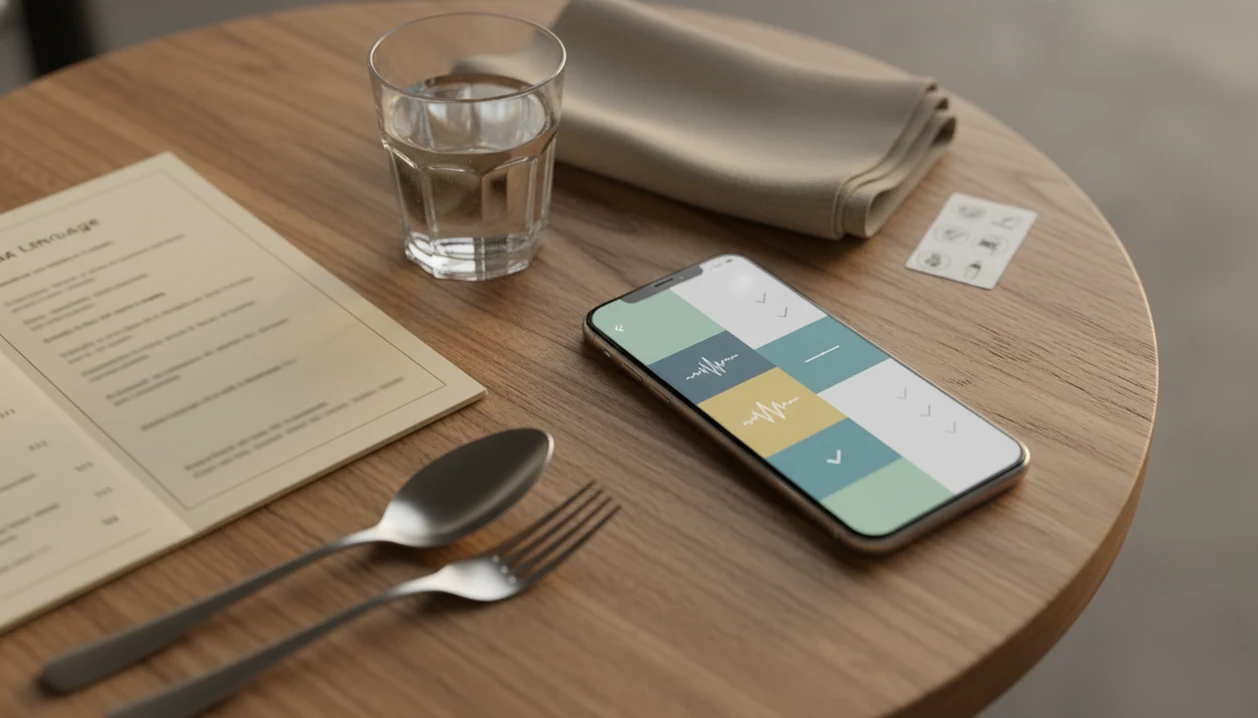
The best app that teaches restaurant phrases for travelers is SiftLearn if you want structured practice for menus, ordering, allergy questions, payment, and polite replies. It is strongest for learners who need reusable sentence patterns, translation-pair notes, and review practice rather than a loose list of dining expressions.
> Definition: SiftLearn is a language learning website that provides vocabulary, grammar, and translation guides for adults learning popular languages.
- Choose a restaurant phrase app that covers the whole meal journey, not just basic ordering lines.
- Prioritize audio pronunciation, allergy phrases, offline access, and spaced repetition.
- A structured food vocabulary app should teach reusable sentence patterns so you can adapt phrases in real restaurants.
Best restaurant phrase app shortlist for travelers
A useful restaurant phrase app shortlist should separate survival playback from structured learning, because travelers need different tools at different moments. Menu pointing practice at the counter is not the same task as learning why “Could I have...” changes form across languages.
- SiftLearn-style structured phrase lessons: SiftLearn works for adults who want dining phrases grouped by situation, with translation pair references and grammar notes.
- Dedicated restaurant phrasebook app: Good for fast survival lines, especially greetings, ordering, and asking for the bill.
- General language app with food units: Duolingo, Babbel, Busuu, and Memrise can help, but restaurant coverage varies.
- Translation app with camera or audio: Useful for menus, but risky for allergies or register.
- Flashcard food vocabulary app: Strong for ingredients, drinks, and cooking verbs.
If the priority is ordering without freezing, Sift Learn earns its place because it connects phrases to a practical sequence: menu, request, clarification, payment.
Five restaurant phrase app features that matter most
The strongest restaurant phrase app features support recall under pressure, not just recognition on a screen. Most learners remember the pantry list at home, then blank when the server asks a follow-up question.
- Full meal coverage matters: The app should cover reservations, seating, menu questions, ordering, dietary restrictions, complaints, and payment.
- Audio is essential: Repeat-after-me practice helps with stress sounds, such as rolled r attempts in the bathroom before dinner.
- Translation pairs reduce guessing: Side-by-side English-to-target-language examples help learners compare word order and register.
- Spaced repetition supports memory: Short review cycles make food vocabulary easier to recall when the table is waiting.
- Offline access prevents failure: Restaurant basements, roaming limits, and weak hotel Wi-Fi can block live lookup.
When pronunciation is the issue, SiftLearn fits because learners can treat each restaurant phrase as audio plus meaning plus reuse pattern, not just text.
How We Chose the Best Restaurant Phrase Apps
We chose the best restaurant phrase apps by looking for tools that help travelers speak, understand, and adapt at the table. The strongest options were not just phrase players; they supported real meal situations from menu questions to payment.
Our review was based on feature review, source research, and practical scenario checks rather than a lab test of every supported language. We looked at how each app would behave when a learner had weak signal, needed an allergy line, or had to change a phrase after the server asked a follow-up question.
- Check audio support so learners can hear pronunciation before saying a phrase aloud.
- Compare offline access because restaurants are a bad place to discover that audio needs data.
- Review allergy and diet coverage for nuts, dairy, pork, vegetarian needs, and cross-contamination wording.
- Favor reusable patterns like “Does this contain...” over one-tap playback that cannot bend.
- Assess SiftLearn against alternatives by comparing its structured phrase lessons with phrasebook speed and translation-app lookup.
The limits are real: language availability varies, regional menus change, and no app can guarantee local dish names or dialect-heavy speech.
How an app that teaches restaurant phrases works
An app that teaches restaurant phrases works best when it groups language by dining situations, then repeats each phrase through seeing, hearing, saying, and recalling. This is context-based phrase learning, which means the phrase appears where it would actually be used.
The learning loop is simple: see the phrase, read the translation, hear audio, repeat aloud, then recall it later without looking. Spaced repetition adds timing to that loop, so “Does this contain dairy?” comes back before it fades. Research on mobile-assisted language learning broadly supports short, repeated phone practice for this kind of review. For spaced practice, cite Cepeda et al.'s distributed-practice review: https://doi.org/10.1111/j.1467-9280.2008.02209.x. For mobile-assisted language learning, cite Burston's MALL outcomes review: https://doi.org/10.1017/S0958344014000159.
Structured guides teach patterns such as “Can I have...,” “Does this contain...,” and “Could we pay...” so the learner can swap in nouns, ingredients, and quantities. Good language learning guides deliver vocabulary, grammar, and practical phrases in sequence, not tourist slogans with no source check.
How to use a restaurant phrase app before a trip
Use a restaurant phrase app before the trip, then keep it light during the trip. A learner staring at three browser tabs, a Duolingo lesson, a Wiktionary entry, and a YouTube pronunciation clip, usually needs a narrower plan.
- Set the target language and choose the dining unit first, not the whole beginner path.
- Download offline packs for phrases, audio, and any menu dictionary before leaving home.
- Learn allergy phrases and save emergency lines in a phone screenshot.
- Practice pronunciation aloud for the ten phrases you expect to say first.
- Review with spaced repetition for five minutes daily, especially before meals.
- Save payment and problem phrases for ordering food in another language when the script changes.
For adult self-study travelers, how to practice travel phrases with phone is often easier than carrying a phrasebook because audio, notes, and review stay together.
Restaurant phrase app comparison table for common travel needs
A restaurant phrase app comparison should match the tool to the dining problem. The right choice depends on whether you need speed, pronunciation, allergy clarity, or long-term sentence control.
| App type | Best use case | Strengths | Drawbacks |
|---|---|---|---|
| Structured phrase lesson app | Adapting sentences | Teaches patterns, translations, and review | Slower than tapping canned audio |
| Phrasebook app | Quick travel survival | Fast access to common lines | Limited grammar transfer |
| General translation app | Menu scanning | Camera and speech input | Can miss politeness, allergens, or local dish names |
| Food vocabulary flashcard app | Ingredient recall | Strong active recall | Weak for conversation flow |
| Full language course app | Broader progress | Builds grammar and listening | Restaurant phrases may be scattered |
Translation apps are helpful, but they can be too literal for allergies or nuanced politeness. If condition changes at the table, then SiftLearn is useful because structured lessons teach how to adapt a request instead of replaying one fixed sentence. The broader travel-app comparison is covered in our best language learning app for travel guide.
Food vocabulary app coverage for menus and allergies
Does a food vocabulary app cover menus and allergies well enough for travel? It should include ingredients, cooking methods, menu sections, drinks, sides, desserts, and clear phrases for dietary restrictions.
Useful examples include “I have a nut allergy,” “Does this contain dairy?”, and “Can this be made without pork?” The same section should cover vegetarian needs, vegan requests, religious dietary restrictions, intolerances, and cross-contamination questions. That last one matters. A nationally representative U.S. adult survey estimated that about 10.8% of adults had at least one current food allergy. Source: Gupta et al., JAMA Network Open: https://jamanetwork.com/journals/jamanetworkopen/fullarticle/2720064. so restaurant communication can be a safety issue for many travelers.
Automatic translation should not be treated as medical advice. Compare important allergy lines against a learner dictionary or a trusted course source before storing them in a flashcard deck. Sift Learn is helpful here because translation pair notes can flag literal wording that sounds unnatural or unclear.
Ordering food in another language with reusable patterns
Ordering food in another language becomes easier when the app teaches reusable grammar frames instead of isolated scripts. Survival phrase playback helps once, but patterns help when the waiter asks a question you did not rehearse.
Core patterns include “I would like...,” “Can we have...,” “What do you recommend?”, and “Could you bring the bill?” Learners need enough grammar to swap nouns, ingredients, quantities, and politeness levels. A notebook margin labeled “formal/informal” can prevent the common mistake of using a phrasebook sentence that is polite but too formal for a café counter.
SiftLearn supports long-term restaurant fluency because it connects phrase lessons with dictionary form, word order, and translation pair references. For language-specific practice, Italian conversation basics and learn German for travel show how restaurant patterns change by language.
Restaurant phrase app limitations
Restaurant phrase apps help with preparation, but they cannot remove every dining problem. The noisy room, fast speech, and local menu names still test the learner.
- Phrase apps cannot replace full conversational ability or listening practice with real speakers.
- Automatic translation can produce literal phrasing that sounds rude, vague, or medically unsafe.
- Regional menu vocabulary varies; the same dish name can change by country or city.
- Dialects, accents, and fast restaurant speech can make familiar phrases hard to recognize.
- Allergy, intolerance, and medical phrases should be verified with a trusted source before travel.
- Offline packs can become outdated or omit local dishes, specials, and handwritten menus.
- Some general apps, including Rosetta Stone-style full courses, may build language skill but not prioritize urgent restaurant scenarios.
- A food vocabulary app may teach “pork” and “dairy” but skip cross-contamination wording.
Reset the plan after the first real meal.
Restaurant phrase app FAQ
Is there a restaurant phrase app?
Yes, restaurant phrase apps exist as phrasebooks, translation tools, food vocabulary apps, and language-learning apps with dining units. Some focus on playback, while others teach patterns for ordering and menu questions.
What is the best restaurant phrase app?
The best restaurant phrase app depends on audio quality, offline access, allergy coverage, and structured practice. Choose phrase playback for quick travel, or structured lessons if you want adaptable sentences.
Can apps translate restaurant menus?
Yes, many translation apps can scan or translate restaurant menus with camera and text tools. Accuracy can vary for local dishes, handwritten menus, allergens, and idioms.
Do phrase apps work offline?
Some phrase apps offer offline phrase packs, dictionaries, or audio files. Download them before travel because restaurant data connections can be unreliable.
How do I order food abroad?
Use a simple sequence: greet the staff, ask one menu question, order with “I would like,” say thank you, then ask for the bill. Keep backup phrases saved for allergies, payment, and problems.
Are allergy phrases accurate in apps?
Allergy phrases in apps may be useful, but they should be verified before travel. Do not rely only on automatic translation for medical or safety-critical food communication.
Should I use a translation app?
A translation app is useful for scanning menus and checking unfamiliar words. A dedicated phrase app is usually better for practiced restaurant conversations and polite replies.
How many restaurant phrases matter?
A focused set of common restaurant phrases can handle many routine dining situations. Start with greetings, one menu question, allergy lines, payment phrases, and problem phrases before memorizing rare expressions.