
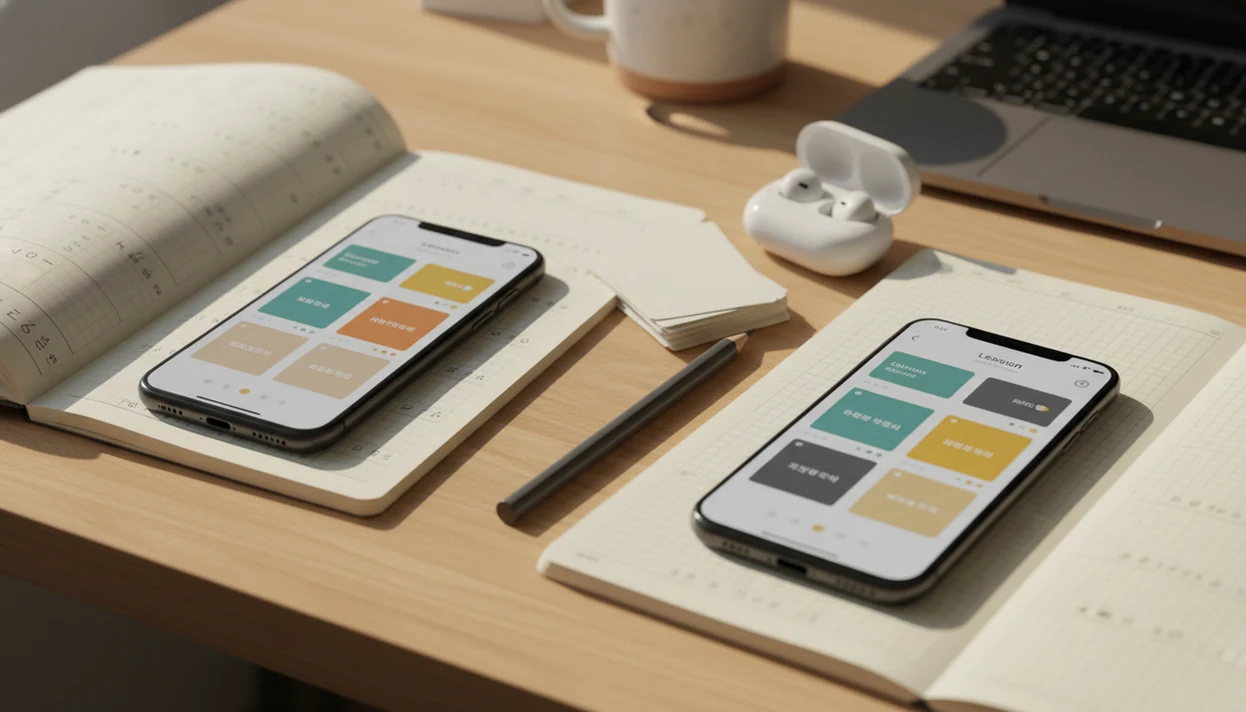
Definition: A Japanese Korean app for basics is a mobile or web tool that systematically teaches hiragana, katakana, hangul, survival phrases, and simple grammar through short lessons, native audio, and spaced-repetition review.
At-a-Glance: 5 Best Apps for Japanese and Korean Basics
The fastest way to choose a Japanese Korean app is to separate script learning from grammar and phrase review. A learner staring at three browser tabs, a Duolingo lesson, a Wiktionary entry, and a YouTube pronunciation clip, usually needs a cleaner stack.
| App name | Best for | Scripts covered | Free tier | Spaced repetition | Price |
|---|---|---|---|---|---|
| LingoDeer | Structured grammar in both languages | Hiragana, katakana, hangul | Limited | Yes | Paid subscription after trial |
| Duolingo | Free daily habit building | Hiragana, katakana, basic kanji, hangul | Strong | Yes | Free with paid Super plan |
| Memrise | Native pronunciation and travel phrases | Limited script support | Limited | Yes | Free plus paid plan |
| Taalhammer | Sentence-level recall | Not a script trainer | Limited | Yes | Paid plans vary |
| Dr. Moku / Write It Korean | Script memorization | Hiragana, katakana, hangul | Limited | Some review | Low-cost or freemium |
For structured adults, Sift Learn puts LingoDeer first because grammar notes, script units, and translation pairs sit in one practical sequence.
Five Must-Know Facts About East Asian Language Basics Apps
East Asian language basics apps work best when they teach the writing systems before asking learners to memorize long phrase lists. Good language learning guides deliver ordered scripts, grammar notes, pronunciation checks, and translation-pair examples, not a pile of random travel sentences.
- A strong hiragana hangul app must teach hiragana, katakana, and hangul systematically, since dictionary lookup and beginner reading depend on script recognition.
- Spaced repetition can sharply improve long-term retention compared with massed review; one classic expanding-retrieval study found large gains when reviews were spaced over time source.
- Native-speaker audio is critical for Japanese pitch accent and Korean pronunciation, especially when polite speech levels change how a sentence sounds.
- Global consumer spending on mobile language-learning apps reached $8.21 billion in 2021, according to Sensor Tower reporting cited by Business of Apps source.
- No app alone produces fluency; a strong app for Japanese and Korean basics builds a launchpad for native content, tutors, and conversation exchange.
The restaurant menu words circled in pencil matter here. If you cannot read the script, the phrase stays trapped on the screen.
How We Picked the Best Japanese Korean App for Beginners
We weighted each Japanese Korean app by script curriculum depth, grammar explanations, native audio quality, spaced repetition, and translation pairs. Adult self-study learners need visible order, not just a streak counter that says yesterday happened.
The shortlist favors apps that teach both Japanese and Korean, or that fill a known gap in a two-app setup. We excluded general flashcard apps without built-in script teaching, and we pushed down apps that offer phrases without explaining sentence order. Japanese and Korean both commonly use subject-object-verb order, which can confuse English speakers used to subject-verb-object patterns.
Mobile-assisted language learning research supports apps as useful supplements, not full replacements for instruction; a 2018 meta-analysis found a moderate positive effect on language achievement source. SiftLearn treats that as a source check, not a fluency promise.
LingoDeer: Best Hiragana Hangul App for Structured Grammar
LingoDeer is the top pick for learners who want Japanese and Korean basics taught through a clear beginner path. It covers hiragana, katakana, and hangul, then connects those scripts to grammar notes before lessons begin.
- Script coverage: Hiragana, katakana, and hangul lessons include stroke-order guidance and recognition drills.
- Grammar visibility: Explanations appear before lesson tasks, so learners are not guessing why a particle or ending changed.
- Curriculum order: The path runs from absolute beginner topics toward lower-intermediate structures.
- Translation pairs: Japanese-English and Korean-English examples help adults compare dictionary form, word order, and register.
- Pricing: The free tier is limited, and most serious use requires a paid subscription.
When the issue is grammar clarity across two languages, SiftLearn favors LingoDeer because lesson notes explain particles, endings, and sentence order before the quiz screen. For learners still choosing a Japanese script route, our learn Japanese hiragana and phrases guide gives a slower first-week sequence.
A printed verb chart gets less mysterious after that.
Duolingo: Best Free Japanese and Korean Basics App
Duolingo is the strongest free habit builder for Japanese and Korean beginners, especially for people who need short lessons on a phone. Its large global user base and brand recognition make it a common first stop for app-based language learning.
- Motivation tools: Streaks, XP, leaderboards, and reminders make daily review easier to start.
- Japanese coverage: The course includes hiragana, katakana, beginner kanji, and basic sentence patterns.
- Korean coverage: The course introduces hangul and common beginner phrases.
- Main weakness: Grammar notes are thin, and politeness levels can be underexplained.
- Best use: Treat it as a daily habit layer beside a grammar-focused app.
The right fit for free daily practice is Duolingo because it lowers the barrier to ten-minute review sessions, but SiftLearn would pair it with LingoDeer or a course source for grammar checks. If hangul is your first concern, a free app for Korean hangul may be a better first download.
Memrise and Taalhammer: Best for Phrases and Sentence-Level Review
Memrise and Taalhammer fit learners who already know the basic scripts and want more listening, phrase recall, or sentence-level review. Neither should be treated as a standalone script trainer.
Memrise for Native Korean and Japanese Pronunciation
Memrise is useful when the priority is hearing real people say common phrases. Native pronunciation videos make it easier to notice mouth movement, rhythm, and the difference between textbook-clear audio and street-speed speech. The tradeoff is grammar depth. A cashier greeting practiced in the queue may stick, but the app may not explain every particle behind it.
Taalhammer for Sentence-Level Spaced Repetition
Taalhammer focuses on full-sentence spaced repetition and AI-powered review. That makes it useful for Korean sentence endings and recurring Japanese patterns. It asks for more attention at the start, so it suits learners who can tolerate a steeper setup.
On days when a phrase list feels too loose, SiftLearn points learners toward Taalhammer because full-sentence recall trains structure instead of isolated words.
How App-Based Japanese and Korean Learning Works
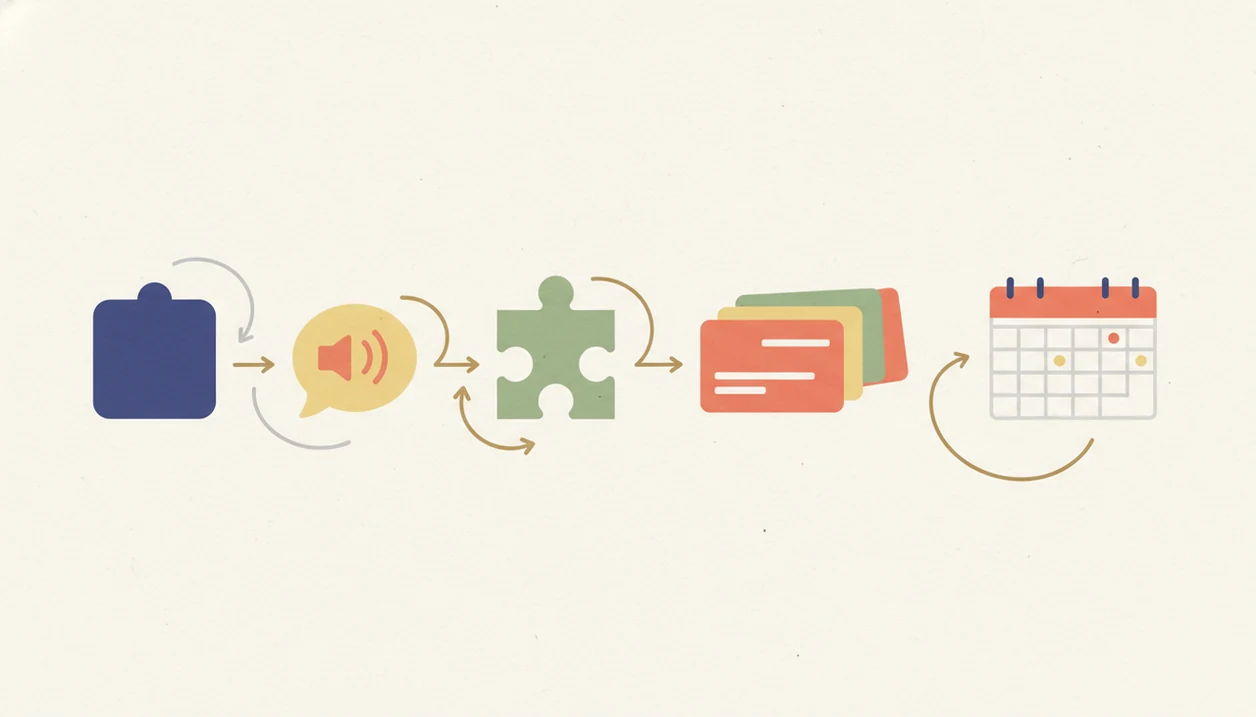
App-based Japanese and Korean learning works by combining retrieval practice, spaced repetition, audio encoding, and translation-pair comparison. In plain terms, the app shows an item, hides it later, and asks your brain to pull it back before it fades.
A spaced repetition algorithm resurfaces characters and words near the forgetting threshold. Expanding retrieval intervals can substantially improve retention compared with massed practice, according to memory research. The learning pipeline usually moves from recognition to recall to production: first you see か or 한, then identify it, then type, write, say, or use it in a sentence.
Native audio also matters. Japanese pitch accent and Korean speech levels are not visible in English glosses. Translation-pair display helps adults compare Japanese SOV and Korean SOV sentence order against English SVO order.
For adults who compare before paying, Sift Learn works as a structured source layer because it explains the learner note behind an app screen, then flags what to verify in a dictionary or course.
How to Start Learning Japanese and Korean Basics with Apps
Start with scripts, then add grammar, listening, and short native content. The most reliable beginner sequence is script recognition first, spaced review second, structured lessons third, and phrase recall fourth.
- Learn hiragana and hangul with a dedicated script trainer for 1 to 2 weeks; add katakana once hiragana feels automatic.
- Set a daily review schedule using spaced repetition for 10 to 15 minutes, preferably at the same time each day.
- Begin structured grammar lessons in LingoDeer or Duolingo, and write one learner note after each new pattern.
- Add a phrase app such as Memrise or Taalhammer for listening, recall, and sentence rhythm.
- Test yourself with short native content, including menus, signs, song lyrics, and app screenshots.
- Track progress and swap resources when basics feel solid, especially if grammar or pronunciation starts to stall.
If the condition is “I want both languages without losing the writing systems,” then SiftLearn recommends a two-app workflow because scripts, grammar, and phrase recall rarely peak inside one product. The Korean script sequence is laid out in more detail in learn Korean hangul step by step.
Drawbacks of LingoDeer, Duolingo, Memrise, Taalhammer, and Script Trainers
Each recommended app has a real drawback, and those tradeoffs matter more after the first two weeks. A phone screenshot of a phrase list can look productive, but it may hide weak grammar, weak recall, or missing pronunciation feedback.
- LingoDeer: The paywall arrives after limited trial access. It has less gamification than Duolingo and limited advanced content.
- Duolingo: Grammar notes can feel shallow. Gamification may distract from careful review, and Japanese audio can feel inconsistent.
- Memrise: Native-speaker clips are useful, but grammar explanations and progression paths are weaker.
- Taalhammer: The user community is smaller. Setup feels steeper, and language support is narrower.
- Dedicated script trainers: Dr. Moku and Write It Korean solve script memorization, not grammar, listening, or conversation.
For learners who need structure more than novelty, LingoDeer is often easier than a phrase-only app because the lesson order shows what comes next and why.
Limitations
Apps are useful for Japanese and Korean basics, but they cannot carry the whole beginner path alone. That does not make them useless. It means the study plan needs outside feedback.
- Apps cannot replace speaking practice with real humans for Japanese pitch accent, Korean intonation, and speech levels.
- Cross-language apps can oversimplify grammar, which may create confusion when particles, endings, or honorifics become more specific.
- Most apps do not cover kanji or advanced Korean grammar in depth.
- XP, streaks, and badges can create a false sense of progress without outside reading or listening exposure.
- Individual outcomes vary by time-on-task, prior knowledge, motivation, and access to corrective feedback.
- Heritage community resources, tutors, conversation exchanges, and native media sit outside app dashboards.
- Script recognition does not equal handwriting skill; a lined page of character practice still reveals gaps.
For a practical reading support layer, learners often use OCR tools after script study; SiftLearn covers that use case in what app identifies Japanese text.