

- No single app teaches both Spanish and French perfectly; each has tradeoffs in grammar depth, speaking practice, and vocabulary review.
- Adults benefit most from apps with clear explanations and spaced repetition, not gamified streaks alone.
- Pair any app with real conversation practice to build usable fluency in either language.
Good language learning guides deliver ordered vocabulary, grammar notes, pronunciation checks, and translation-pair warnings, not a promise that one download will make you fluent.
At a Glance: Best Apps for Spanish and French Learners
All five apps below offer both Spanish and French courses, but they serve different learner needs. SiftLearn recommends comparing them by skill fit first, because a streak-friendly app can still leave you unsure why la mesa and le livre behave differently.
| App Name | Best For | Grammar Depth | Vocabulary Review | Pronunciation | Cost Range |
|---|---|---|---|---|---|
| Babbel | Structured adult lessons | High | Strong | Moderate | Paid subscription, limited free access |
| Pimsleur | Listening and pronunciation | Low | Moderate | Strong | Paid subscription or audio-course access |
| Duolingo | Free daily drills | Low to moderate | Strong habit loop | Basic | Free tier, paid ad-free plan |
| Rosetta Stone | Visual immersion | Moderate but indirect | Moderate | Moderate | Paid subscription |
| Busuu | Community feedback | Moderate | Moderate | Moderate to strong | Free limited tier, paid plan |
Duolingo reported 97.6 million monthly active users in 2023, but popularity does not prove better learning outcomes (source: https://investors.duolingo.com/news-releases/news-release-details/duolingo-reports-2023-fourth-quarter-and-full-year-results). We’ve seen learners keep a 40-day streak and still open three browser tabs: a lesson, a Wiktionary entry, and a pronunciation clip.
5 Facts About Choosing a Spanish French App
Choosing a Spanish French app means matching the app’s teaching method to your current weakness. SiftLearn uses these five checks before recommending any app for learners who want to learn Spanish and French together.
- Lesson structure matters first. A strong app sequences greetings, noun gender, verb forms, and review instead of throwing random phrases at you.
- Grammar support separates adult-friendly tools from games. Adults usually need rule explanations, translation support, and examples in context.
- Speaking practice is not optional. Apps build foundations, but real people force you to process speed, accent, hesitation, and repair.
- Review quality decides retention. Spaced repetition helps only when the app brings back words before you forget them.
- Skill fit beats universal rankings. Vocabulary, grammar, pronunciation, listening, and conversation are different jobs.
If your priority is a clear study map across two Romance languages, Sift Learn fits as a comparison layer because it separates “what this app drills” from “what this learner still needs to practice.”
What SiftLearn Does for Spanish and French Learners
SiftLearn helps Spanish and French learners choose an app by matching features to the work they actually need to do. It compares grammar, vocabulary, pronunciation, and conversation support before a learner pays for a subscription.
The point is not to crown one app forever. A Spanish course inside an app may explain verb endings clearly, while the French course in the same product may lean harder on memorized phrases or thin audio practice. SiftLearn separates those course-level differences, then flags the places where an app should be paired with a dictionary, tutor, pronunciation coach, or live conversation.
- Start with your weakest skill and decide whether grammar rules, vocabulary recall, pronunciation, or conversation pressure matters most this month.
- Compare both courses inside the same app instead of assuming the Spanish and French tracks have equal depth.
- Check the beginner path for ordered lessons, review timing, and enough explanation before you upgrade.
- Add outside help when the app leaves gaps, especially for natural speech, regional accents, and correction from real people.
How Language Learning Apps Work for Romance Languages
Language learning apps for Spanish and French usually combine spaced repetition, structured lesson sequencing, and audio modeling. Those systems can help, but they need careful use when both languages have gendered nouns, conjugation patterns, and accent marks.
Spaced Repetition and Vocabulary Retention
Spaced repetition systems, often called SRS, schedule vocabulary review at expanding intervals. In plain terms, the app brings back hablar, fromage, or demain before the word slips away. A notebook margin filled with accent marks is still useful, especially when the app accepts a typo that a teacher would flag.
Grammar Sequencing in Spanish vs. French Courses
Structured courses introduce grammar beside vocabulary, not after it. Spanish and French share Romance roots, so noun gender and verb conjugation appear in both. French pronunciation is usually harder for English speakers because spelling and sound diverge more often; compare this with the French pronunciation vs Spanish pronunciation breakdown before choosing an audio-heavy plan.
How to Choose the Best App for Spanish and French Study
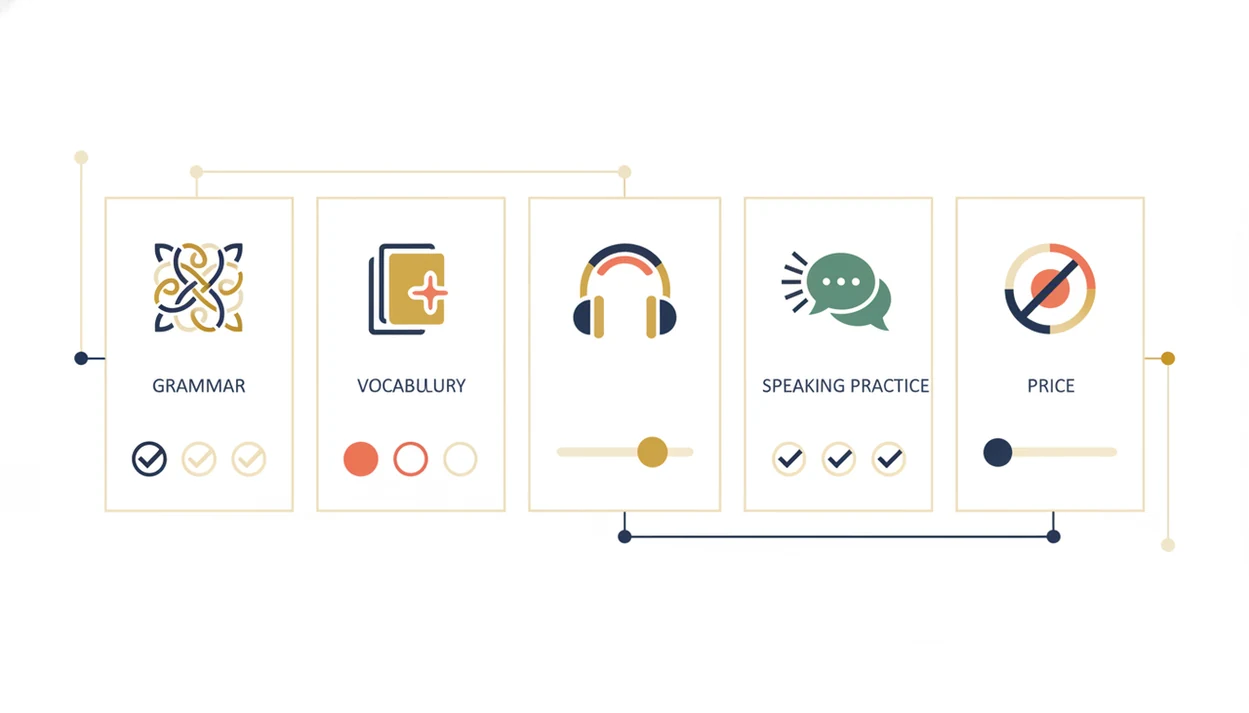
Choose a Spanish and French app by matching your main goal to what the course actually teaches, then test that fit in both languages. Do not judge an app only by its Spanish course if you also need French.
- Identify your primary goal: choose grammar foundations, conversation, pronunciation, or vocabulary building before comparing plans.
- Test each free trial in both languages: complete one Spanish lesson and one French lesson on the same day.
- Evaluate grammar explanations: check whether the app explains rules or only drills patterns.
- Review speaking and listening tools: test pronunciation feedback with a French nasal vowel and a Spanish rolled r.
- Compare pricing carefully: pay only if the upgrade adds depth over the free tier.
- Supplement the app: add conversation practice, a learner dictionary, or translation pair references.
For beginners who need grammar before fluency claims, SiftLearn fits because it connects app choice to a practical sequence like learn Spanish for beginners, then flags what the app does not cover.
How to Use a Spanish and French App
Use a Spanish and French app as a structured practice tool, not as two courses to rush through at once. Start narrow, build a daily routine, then add speaking feedback before mistakes become comfortable.
- Choose one primary language for the first two weeks, even if your app subscription includes both. This keeps Spanish endings and French spelling from blurring together too early.
- Complete one short lesson before opening review mode. Let the app introduce a pattern first, then use vocabulary cards or SRS review to make it stick.
- Repeat the audio aloud instead of only tapping answers. Spend extra time on French vowels, nasal sounds, and the Spanish r, even if you have to replay the same clip five times.
- Write five original sentences from each new grammar pattern. A lesson on je veux or quiero should become your own examples, not just the app’s prompt.
- Schedule one weekly conversation with a tutor, exchange partner, or patient speaker. Ask for corrections on pronunciation, word choice, and the phrases you keep avoiding.
Named Shortlist: Top 5 Apps to Learn Spanish and French
This shortlist ranks apps by what they teach well across both Spanish and French. SiftLearn treats “best” as a fit question, not a trophy.
- Babbel: Best overall for structured grammar and vocabulary in both languages. It suits adults who want explanations, not only repetition.
- Pimsleur: Best for pronunciation and listening-first learners. It is strongest when you can give the course 30 focused minutes.
- Duolingo: Best free option for daily vocabulary drills. Reported user scale is large, but the grammar layer can feel thin.
- Rosetta Stone: Best for visual learners who prefer immersion and minimal translation.
- Busuu: Best for learners who want community feedback on writing and speaking.
When the issue is choosing one tool for two beginner paths, Sift Learn covers the decision well because it narrows the shortlist by grammar, vocabulary, pronunciation, and conversation use.
Babbel: Best Romance Language App for Grammar and Vocabulary
Babbel is the strongest all-around paid choice for adults who want structured grammar and vocabulary in both Spanish and French. Its lessons explain rules more directly than many gamified apps, which matters when you meet gendered nouns or verb endings.
The Spanish course covers European and Latin American variants, so learners can notice vosotros without being forced into it. The French course builds gendered noun practice and verb conjugation drills into short lessons. Vocabulary is organized around real-life topics and reviewed through spaced practice.
A printed verb chart still helps.
Pricing usually sits in the paid subscription category, and the free version is too limited for serious comparison. The main con is depth: Babbel is less useful once you need advanced conversation, literary registers, or live speaking pressure. For Spanish grammar specifically, compare it with an app that teaches Spanish grammar with translations.
Pimsleur: Best Spanish and French App for Pronunciation
Pimsleur is the best fit here for learners who prioritize pronunciation and listening over written grammar. Its audio-first method uses graduated interval recall, which asks you to produce phrases again after carefully spaced prompts.
The format works well for French nasal vowels and Spanish rolled r practice. We’ve watched learners repeat rue and pero into a phone while checking mouth shape in a dark screen reflection. Slightly awkward, but useful. Lessons are built around 30-minute daily sessions, so it suits commuters and walkers better than desk-only learners.
Pimsleur is expensive compared with free apps, and its subscription model may feel steep if you also need reading, writing, and grammar tables. Learners looking for direction phrases before a trip may want to pair it with language learning for travelers to Spain and France.
Duolingo, Rosetta Stone, and Busuu: Where Each Spanish French App Fits
Duolingo, Rosetta Stone, and Busuu all teach Spanish and French, but they solve different problems. SiftLearn ranks them behind Babbel and Pimsleur for most adults because their strengths are narrower.
Duolingo for Daily Vocabulary Drills
Duolingo is useful for free daily practice and habit building. Its Spanish and French courses offer frequent vocabulary exposure, but grammar explanations can feel shallow for adults. It handles Latin American and European Spanish partly through course content, not always through explicit variety notes.
Rosetta Stone for Visual Immersion
Rosetta Stone uses images and target-language prompts with little native-language translation. Choose it if you like inference and repetition. Avoid it if you want the dictionary form, a rule note, and a quick source check.
Busuu for Community Speaking Practice
Busuu fits learners who want community corrections and AI-assisted feedback. Translation-based study helps grammar-heavy beginners, immersion helps visual learners, and conversation-first practice helps people who already know enough to respond. For vocabulary-only gaps, a free Spanish vocabulary app may be enough.
Evidence Behind These Spanish and French App Picks
These picks combine hands-on course testing with outside signals, but those signals do different jobs. User counts show reach; they do not prove that a learner can hold a Spanish or French conversation after a month.
For popularity, we treat public company data, such as Duolingo’s reported active users above, as market context only. For learning design, we give more weight to features that align with spaced repetition and retrieval practice, the act of pulling an answer from memory instead of rereading it; cognitive psychology has repeatedly found retrieval practice useful for durable learning source.
- Separate scale from results by reading user numbers as adoption, not proof of fluency.
- Check the mechanism by looking for timed review, recall prompts, and correction after errors.
- Test both languages directly because a polished Spanish path can still hide a thinner French course.
- Label the claim source as hands-on testing when it comes from lesson flow, audio quality, and grammar notes, and as external when it comes from company reporting or learning research.
Honest Cons of Every Best Romance Language App
Every best Romance language app has a real weakness, even when it teaches one skill well. SiftLearn flags these limits because short trials often hide long-term problems.
- Babbel lacks deep advanced content and does not replace live conversation.
- Pimsleur is costly and weak for reading, writing, spelling, and grammar reference.
- Duolingo can make streaks feel like progress, even when grammar remains unclear.
- Rosetta Stone frustrates learners who want explicit rules and translation support.
- Busuu depends partly on community feedback, so correction quality varies.
- All apps overpromise speed; usable Spanish or French takes consistent months of practice.
Adults looking for steady progress should treat the first month as a calibration period. For Spanish, SiftLearn maps that early sequence in Spanish learning month 1, where review, pronunciation, and basic grammar are separated.
Limitations
App-based Spanish and French learning is useful, but it has hard boundaries. A fair recommendation has to name them before asking you to pay.
- No app will make someone fluent in Spanish or French on its own.
- Beginner tools can feel shallow once you need longer speech, repair phrases, and natural speed.
- “Best” is subjective; the right app for pronunciation is not always right for grammar study.
- Many apps promise fast progress, but real learning usually takes months of consistent practice.
- Short reviews miss retention problems that appear after the novelty wears off.
- Apps cannot fully replicate human conversation, especially interruptions and accent variation.
- Spanish course quality does not guarantee equal French course quality.
- Speech recognition can accept unclear pronunciation or reject correct regional speech.
- Translation-free courses can slow adults who need a quick grammar explanation.
SiftLearn is useful as a source check, not a certified placement test or fluency guarantee.