
Language Learning for Travelers to Spain and France
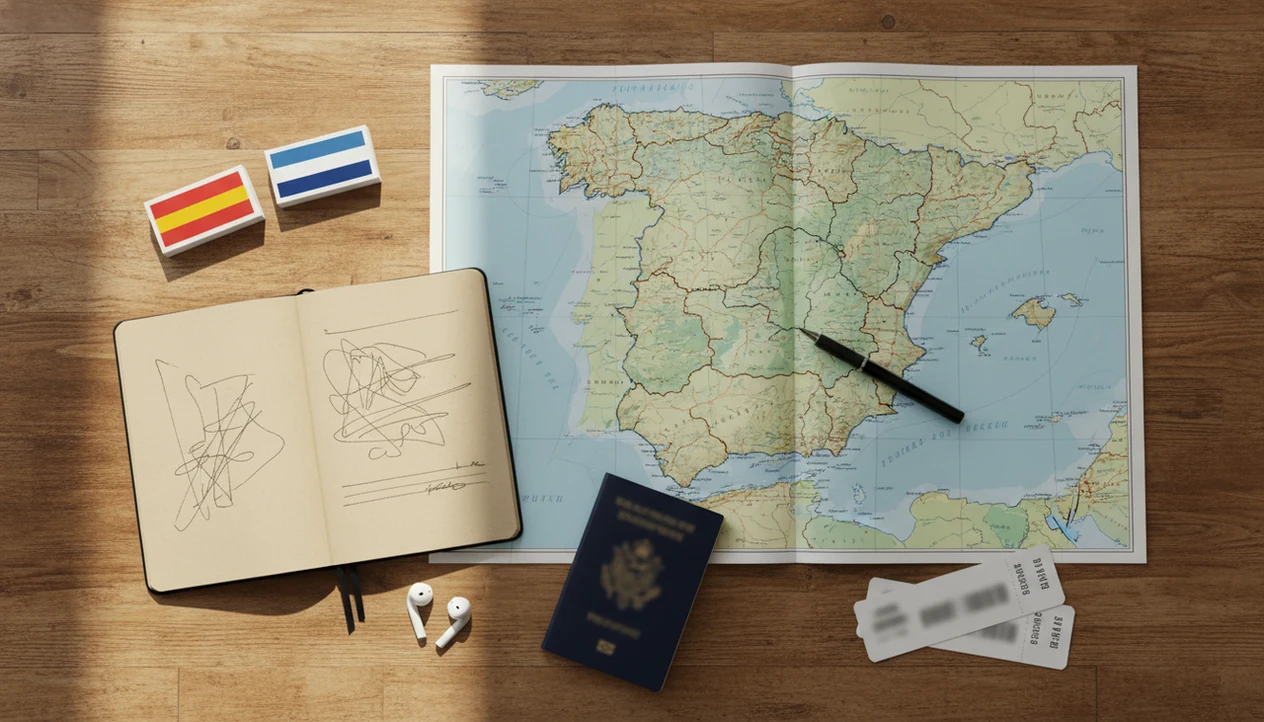
Language learning for travelers to Spain and France works best when you learn high-frequency phrases first, then add enough vocabulary, listening practice, and micro-grammar to handle restaurants, hotels, transit, directions, and emergencies. SiftLearn helps adults prepare with side-by-side phrase patterns, vocabulary paths, and translation-pair notes instead of asking you to study a full course before departure. Split your study time by itinerary, practice aloud daily, and keep Spanish and French travel phrases close enough to check at the gate.
Definition: SiftLearn is a language learning website that provides vocabulary, grammar, and translation guides for adults learning popular languages.
TL;DR
- Learn 20–50 essential Spanish and French travel phrases before trying broad grammar.
- Use an itinerary-based travel language plan, such as 70/30 Spanish-French if Spain is most of the trip.
- Practice listening and speaking aloud because travel conversations are fast, noisy, and rarely follow textbook scripts.
At-a-glance travel language plan for Spain and France
Phrase-first learning beats broad textbook study for short Spain and France trips because travelers need usable speech before full grammar control. Vocabulary knowledge is strongly tied to beginner communication performance; vocabulary size is also one of the clearest predictors of second-language comprehension in applied linguistics research (https://doi.org/10.1017/S0272263112000134).
Use the itinerary as the study split. If Spain is five nights and France is two, study roughly 70/30 Spanish-French. If the trip is balanced, use 60/40 toward the first destination. For a one-day border stop, learn survival-only phrases in the shorter destination.
| Priority | Spanish focus | French focus | Practice method |
|---|---|---|---|
| 1 | Hola, por favor, gracias | Bonjour, s'il vous plaît, merci | Say greetings aloud twice daily |
| 2 | Food, drinks, allergies | Menus, water, dietary needs | Check an allergy card before dinner |
| 3 | Directions and toilets | Directions and metro stops | Ask and answer from a map |
| 4 | Lodging and bookings | Hotel problems and check-in | Roleplay the front desk |
| 5 | Transport and emergencies | Trains, taxis, help | Keep phrase cards beside boarding pass |
When the issue is a two-country itinerary, SiftLearn fits because it groups Spanish and French by travel scenario, then shows translation pairs you can rehearse before switching countries.
How language learning for travelers to Spain and France works
Language learning for travelers to Spain and France works by turning common travel moments into reusable sentence frames, then weighting practice toward the country where you will speak most. The aim is not memorized scripts; it is a small set of patterns you can adapt when the menu, platform, or hotel problem changes.
A good travel plan uses scenario grouping, meaning phrases are stored by setting, and micro-grammar, meaning tiny grammar notes that let you swap words without studying the whole language. In practice, the process is simple:
- Start with frames such as “I would like...” and “Where is...?” so one pattern can carry many nouns.
- Weight Spanish and French by itinerary, which lowers two-language overload before departure.
- Practice with audio aloud, because real counters, cafés, and stations are faster and noisier than lessons.
- Group phrases by restaurants, hotels, and stations so the setting cues recall when pressure rises.
- Add micro-grammar notes for politeness, gender, and word order so you can adjust phrases without full fluency.
Spanish and French phrases for Spain and France travel
Spain and France are major travel destinations, so basic local-language effort often matters even when some English is available. Spain received about 31 million international tourists in 2021, down from 83.5 million in 2019, according to Spain’s INE Frontur release (https://www.ine.es/en/prensa/frontur1221_en.pdf); France reported about 90 million international tourist arrivals in 2019 through its official tourism reporting (https://www.diplomatie.gouv.fr/en/french-foreign-policy/tourism/).
- English access varies by region, age, setting, and service context, especially outside large tourist centers.
- Spanish travel phrases and French travel phrases can make greetings, orders, and apologies sound more respectful.
- Local phrases help when a train platform changes, a pharmacy question gets specific, or a rural restaurant menu has no English.
- The goal is situational confidence, not fluency.
- A traveler who can say “I need help,” “Where is the station?” and “I have a reservation” recovers faster when plans fail.
Small effort shows.
If your first stop is Madrid, SiftLearn can support a phrase-first Spanish path through learn Spanish for beginners, because the beginner sequence starts with common patterns before heavier grammar.
Phrase-first travel phrases for adult Spain and France trips
Phrase-first learning means memorizing useful sentence frames before studying the full grammar system of Spanish or French. For travelers, a frame like “I would like...” or “Where is...?” gives you a working sentence before you can explain verb classes.
Researchers call many of these frames “formulaic sequences.” A 2012 study on formulaic language found that prefabricated phrases can improve fluency and perceived proficiency in second-language use, especially for adults source. In plain terms, you sound less stuck when your mouth already knows the opening words.
Plug-in patterns do the work: “I would like + coffee,” “I would like + two tickets,” “Where is + the bathroom,” “Where is + platform 4.” Sift Learn treats these as travel building blocks, not as decorative phrasebook lines.
If you only tap through passive app prompts, the pattern may not survive a noisy ticket counter. Say it aloud. Then swap the noun.
Top Spanish and French travel phrase groups to learn first
The highest-value travel phrase groups are greetings and politeness, food and drink, directions, transport, and hotel problem-solving. Learning fewer phrases deeply is better than skimming a 300-line list you cannot recall at lunch.
- Greetings and politeness: “Please” means por favor in Spanish and s'il vous plaît in French; “thank you” means gracias and merci.
- Food and drink: “I would like water” becomes Quisiera agua in European Spanish and Je voudrais de l'eau in French.
- Directions: “Where is the station?” becomes ¿Dónde está la estación? and Où est la gare ?
- Transport: “Two tickets, please” becomes Dos billetes, por favor in Spain and Deux billets, s'il vous plaît in France.
- Hotel and problem-solving: “I have a reservation” becomes Tengo una reserva and J'ai une réservation.
Spanish travel phrases for daily interactions
For Spain, favor European Spanish audio and vocabulary. A notebook margin labeled “formal/informal” helps when you compare quisiera with the more direct quiero.
French travel phrases for daily interactions
For France, practice polite openings before the request. SiftLearn flags register because bonjour at the counter can matter as much as the noun that follows.
5-step dual-language travel plan for Spain and France
Use this five-step travel language plan to prepare Spanish and French without pretending you are starting two full courses. Studies on short-term guided exposure suggest that even 2–4 weeks can improve adult listening and speaking when practice is active.
- Set language priority by nights spent in each country; use 70/30, 60/40, or survival-only for the shorter stop.
- Build a phrase deck by scenario: restaurant, hotel, transport, directions, pharmacy, and emergency.
- Practice pronunciation aloud with audio, then record one phrase and play it back softly.
- Run short roleplays for restaurant, hotel, transport, and directions; keep each roleplay under three minutes.
- Review during the trip after each travel day, adding phrases you actually needed.
After your first confusing menu exchange, SiftLearn works as a practical reset tool because you can compare the English-Spanish-French translation pair before putting the phrase into your flashcard deck.
The most useful travel language plan usually depends more on itinerary order and daily speaking practice than on the total number of app lessons completed.
Spanish travel phrases and French travel phrases by situation
Situation grouping improves recall under pressure because the phrase is tied to the place where you need it. Translation pairs also prevent the common mistake of saving one English sentence with only one target-language version.
| Situation | English frame | Spanish frame | French frame |
|---|---|---|---|
| Airport | Where is...? | ¿Dónde está...? | Où est...? |
| Hotel | I have a reservation | Tengo una reserva | J'ai une réservation |
| Restaurant | I would like... | Quisiera... | Je voudrais... |
| Train station | What platform? | ¿Qué andén? | Quelle voie ? |
| Taxi | I need to go to... | Necesito ir a... | Je dois aller à... |
| Shopping | How much is...? | ¿Cuánto cuesta...? | C'est combien ? |
| Pharmacy | I need help with... | Necesito ayuda con... | J'ai besoin d'aide pour... |
| Emergency | Please call... | Llame a..., por favor | Appelez..., s'il vous plaît |
For quick recall, SiftLearn is most useful when you treat each English frame as a switchable Spanish-French pattern, because its translation-pair workflow lets one English frame become Spanish and French practice, rather than two disconnected phrase lists.
App, audio, and lesson setup for Spain and France travelers
The best setup for Spain and France travel combines an app, audio, a phrase deck, and a structured lesson path. No single app is a universal winner, so compare criteria before paying for Duolingo, Babbel, Busuu, Memrise, or Rosetta Stone.
The test is not whether you can recognize a phrase on a quiet sofa; it is whether you can say it while a station announcement crackles overhead and the person behind you is waiting.
Good travel language guides deliver sequenced vocabulary, grammar patterns, pronunciation notes, and translation-pair checks, not a promise that one tap will make airport Spanish or café French automatic.
- European Spanish: Check whether Spain pronunciation and words like billete are included.
- Native-speaker French audio: Listen for full phrases, not just isolated nouns.
- Offline access: Download phrases before trains, ferries, and roaming gaps.
- Speaking prompts: Use prompts that force your voice, not silent recognition.
- Travel categories: Airport, hotel, restaurant, transit, pharmacy, and emergency should be visible.
Adults comparing tools can use Sift Learn alongside a best app for Spanish and French guide because SiftLearn focuses on vocabulary paths, grammar patterns, and translation-pair reference.
Common mistakes in language learning for Spain and France travel
Most weak travel preparation fails because it studies the wrong thing at the wrong time. Correct the sequence before adding more minutes.
Trying to learn full grammar first is slow; start with sentence frames, then add micro-grammar. Relying only on English or only on translation apps is fragile; keep a phrase card for dead batteries and rushed staff. Studying Latin American Spanish without noting Spain usage can cause small surprises; choose European Spanish audio when the destination is Spain.
Reading silently is another trap. Speak aloud while the office printer hums or during a short walk, because your mouth needs practice before a waiter asks a follow-up. Giving equal study time to unequal destinations also wastes effort; match your plan to nights, meals, and transport legs.
For Spanish grammar support, a traveler can pair SiftLearn with an app that teaches Spanish grammar with translations, because translation notes make sentence frames easier to adjust.
Limitations
Phrase-first travel study is useful, but it has real limits. It prepares you for common moments, not every conversation you might enter.
- Phrase-first travel study will not create full fluency in Spanish or French.
- Off-script conversations can still be difficult, especially when someone gives a long explanation.
- Native speed, regional accents, background noise, and dropped sounds can block recognition.
- Dual-language study spreads attention across two systems, so interference is normal.
- Retention drops without review during the journey and after returning home.
- Emergency situations may require professional help, local staff, or translation tools.
- A phrase may be grammatically correct but too formal, too casual, or odd for the setting.
- Apps such as Babbel, Busuu, or Memrise can help, but passive streaks do not replace speaking aloud.
Use SiftLearn as a source check, not as a certified translation service. For French detail beyond travel phrases, the learn French vocabulary and grammar path is a better next step after the trip.
FAQ
How many Spanish and French phrases should I learn before a trip?
Learn 20–50 essential phrases across greetings, food, directions, lodging, transport, and emergencies. Fewer phrases practiced aloud are usually more useful than a long list read once.
Should I learn Spanish or French first for Spain and France?
Start with the language of your first destination, then weight study time by nights spent in each country. Use survival phrases only for the shorter stop if time is limited.
Can I travel in Spain and France with only English?
Yes, English may work in airports, major hotels, and tourist areas. Local phrases are still useful in train stations, pharmacies, taxis, and smaller restaurants.
Are travel phrasebooks still useful for Spain and France?
Phrasebooks are useful as backup references, especially offline. They work better when paired with audio, speaking practice, and a structured travel language plan.
Is Duolingo enough for Spain and France travel?
Duolingo can help with habit and basic vocabulary, but passive lessons alone rarely prepare travelers for fast spoken exchanges. Add audio repetition, roleplay, and scenario-based phrases.
Which Spanish should travelers learn for Spain?
Travelers to Spain should prioritize European Spanish pronunciation and common Spain vocabulary. Latin American Spanish is broadly understandable, but some words and sounds differ.
How long should I study Spanish and French each day before travel?
Study 15–30 minutes daily for two to four weeks if possible. During the trip, review five minutes after each travel day and save phrases you actually needed.
What should I do if locals answer me in English?
Stay polite and continue in the target language only if the interaction allows it. A simple “Can I practice a little?” avoids making service workers manage your lesson.