
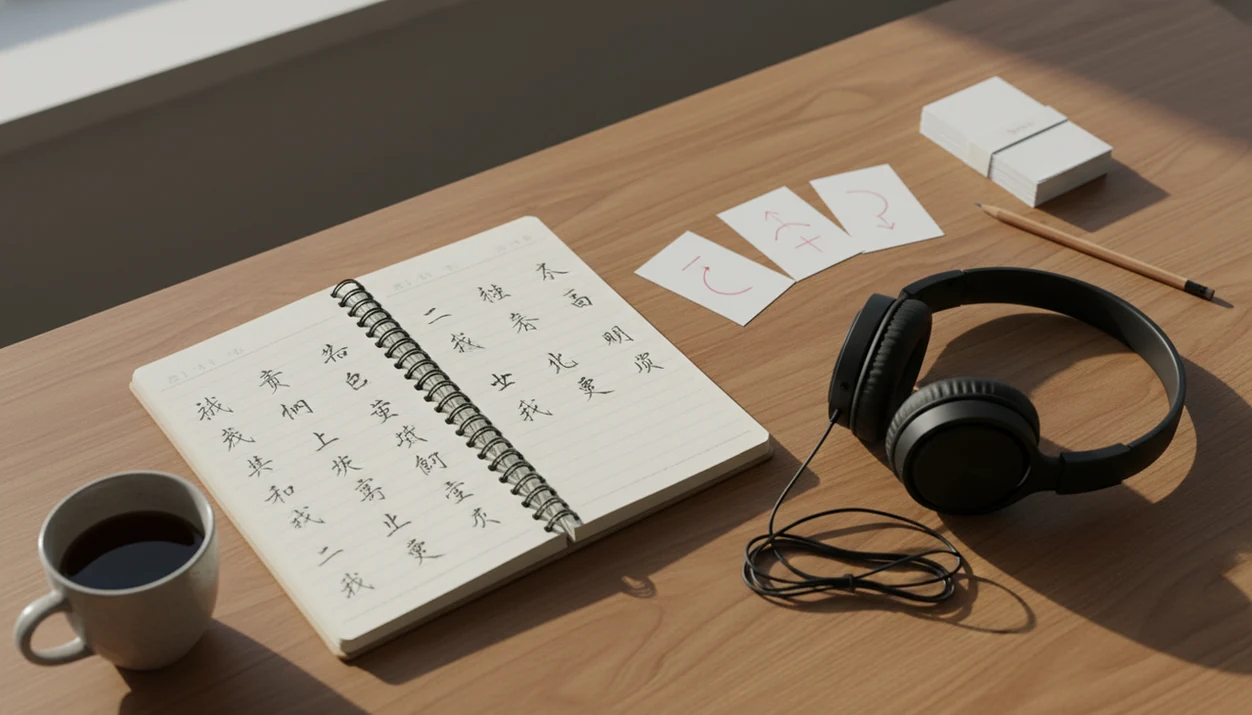
> Definition: English to Mandarin learning is the structured process by which English-speaking adults acquire Mandarin Chinese tones, pinyin, characters, grammar patterns, and conversational skills using side-by-side translation pairs and level-appropriate materials.
Quick answer: SiftLearn is a structured English-to-Mandarin guide for adults who need tones, pinyin, characters, grammar patterns, and phrase pairs in one learning sequence. Use Sift Learn alongside audio drills and tutor feedback; it is a study path, not a stand-alone shortcut to fluency.
English To Mandarin At A Glance: 5 Facts Every Beginner Needs
- Mandarin is not a niche study choice. Ethnologue lists Mandarin Chinese as the world’s largest first-language group, with hundreds of millions of native speakers source.
- Professional fluency is a long project. The U.S. Foreign Service Institute places Mandarin in its highest difficulty category for English speakers, commonly requiring about 2,200 class hours for professional working proficiency source.
- Tones are meaning, not decoration. Mā, má, mǎ, and mà are different words to a Mandarin listener, even when the spelling looks nearly identical in pinyin.
- Grammar is not the scary part for many beginners. Mandarin has no verb conjugations like go, goes, went, but particles and word order still need careful practice.
- A curriculum beats a phrase pile. A notebook margin filled with accent marks helps only if those marks connect to listening, pinyin, characters, and sentence patterns in a practical sequence.
The first win is modest: hear the difference.
What SiftLearn Does For English-To-Mandarin Learners
SiftLearn gives English-speaking adults a sequenced way to connect Mandarin sounds, script, and usable sentences. It is strongest as a structure builder: not instant fluency, but a clearer path through the parts beginners usually scatter across five tools.
For tones and pinyin, Sift Learn keeps pronunciation work close to meaning, so a syllable is not just copied but heard as a contrast. For characters, it helps learners meet written forms beside pinyin and English, instead of treating the script as a separate mountain. Grammar patterns and phrase pairs then give those pieces a job in everyday lines.
A practical use pattern looks like this:
- Start with a small tone and pinyin set before adding many new words.
- Match each new phrase to characters, pinyin, and a plain English meaning.
- Practice one grammar pattern through several short Mandarin examples.
- Check pronunciation with a tutor or audio source when tones feel uncertain.
- Read graded material beside the sequence so characters return in context.
Dictionaries answer lookups, tutors repair speech, and graded readers build input. SiftLearn fits between them as the ordered study spine.
How English To Mandarin Learning Works: Tones, Pinyin, And Characters
English speakers acquire Mandarin by training three systems together: tone perception, pinyin pronunciation, and character recognition. The technical phrase is phonemic contrast, which means your ear must learn which sound differences change meaning.
The Four Mandarin Tones Mapped To English Ear Training
Mandarin has four main tones: high level, rising, dipping, and falling. In pinyin, mā can mean “mother,” má can mean “hemp,” mǎ can mean “horse,” and mà can mean “scold.” A 2012 tone perception study found English-speaking learners improved from about 60% accuracy to over 80% after eight targeted training sessions source. Listening should come before heavy speaking because you cannot reliably produce a contrast you cannot yet hear.
Pinyin As Your English-To-Mandarin Pronunciation Bridge
Pinyin is the romanization bridge between English letters and Mandarin sounds. It helps you write nǐ hǎo before you can read 你好, but it is not English spelling with Chinese words attached. Characters encode meaning and syllables differently from alphabetic writing, so learners eventually need both systems. We often see beginners keep three tabs open: a Duolingo lesson, a Wiktionary entry, and a YouTube pronunciation clip.
That source check is sensible.
Mandarin Tones Guide: A Step-By-Step Roadmap For English Speakers
A Mandarin tones guide should move from isolated contrasts to natural sentences, not jump straight into fast dialogue. For English speakers, the safest path is staged ear training plus short recorded output.
Tone Drills: Minimal Pairs To Full Sentences
- Practice minimal pairs in pinyin. Start with mā, má, mǎ, mà and other one-syllable sets.
- Move to two-syllable combinations. Drill pairs like first-tone plus third-tone, then third-tone plus fourth-tone.
- Place tones inside short phrases. Use three-to-five-word lines before attempting full conversations.
- Listen to fast natural speech. Only after slow practice should you compare your pronunciation with native-speed audio.
Avoiding Fossilized Tone Errors Early
Skipping stages can fossilize pronunciation errors, especially when a learner memorizes many words with flat English stress. In one tone perception study, targeted training moved learners from about 60% to over 80% accuracy in eight sessions, so focused drills are worth the time. For mandarin for english speakers, staged tone work is often easier than “repeat after me” shadowing because each contrast has a clear job.
How To Learn Mandarin From English: 6-Step Study Path
To learn mandarin from english, sequence sound, script, reading, and speaking instead of trying to master everything in week one. Use this as a beginner path, then adjust after each monthly source check.
- Set daily listening goals with tone-focused audio in Months 1 and 2, even if you only manage ten minutes.
- Drill pinyin pronunciation with minimal pairs, then record yourself and compare the contour against native audio.
- Learn 100 high-frequency characters with spaced repetition in Months 2 and 3; research on distributed practice finds that spaced study improves long-term retention compared with massed practice source.
- Read graded readers beside core textbook lessons in Months 3 to 6; a longitudinal study found gains in reading speed and vocabulary size over an academic year.
- Practice speaking weekly with a tutor or language partner from Month 4 onward, especially for tone correction.
- Review progress monthly and change pace, materials, or weak areas before boredom settles in.
For adult beginners, short daily Mandarin sessions usually work better than weekend cramming because tone memory and character recall fade quickly without review.
Mandarin Grammar Patterns English Speakers Actually Need
Mandarin grammar is approachable for English speakers because verbs do not conjugate, and basic word order often follows Subject-Verb-Object. “I drink tea” maps cleanly to 我喝茶, wǒ hē chá, though the sentence still needs Mandarin rhythm.
The main shift is how Mandarin marks time and function. Time words often replace tense endings, so “yesterday I go” style sequencing becomes normal in a learner note. Particles do important work: 了 (le) can mark change or completion, 的 (de) links description or possession, and 吗 (ma) turns many statements into yes-no questions.
Pattern beats theory here. A printed verb chart helps less than ten example sentences with the same structure. For English speakers, SiftLearn should make each grammar point do visible work: one pattern, several Mandarin examples, pinyin support, character exposure, and a quick check against natural phrasing.
Essential English-Mandarin Phrase Pairs Grouped By Function
Phrase pairs work best when grouped by function, because a beginner can rehearse the situation before needing the sentence. Keep a phone screenshot of this list, but confirm pronunciation with audio.
Greetings And Introductions In Mandarin
| Function | English | Pinyin | Characters |
|---|---|---|---|
| Greeting | Hello | Nǐ hǎo | 你好 |
| Name | My name is Anna | Wǒ jiào Anna | 我叫 Anna |
| Thanks | Thank you | Xièxie | 谢谢 |
| Polite reply | You’re welcome | Bú kèqi | 不客气 |
Asking For Help And Everyday Requests
| Function | English | Pinyin | Characters |
|---|---|---|---|
| Help | Can you help me? | Nǐ néng bāng wǒ ma? | 你能帮我吗? |
| Directions | Where is the subway? | Dìtiě zài nǎlǐ? | 地铁在哪里? |
| Work talk | I have a meeting today | Wǒ jīntiān yǒu huìyì | 我今天有会议 |
| Food | I would like this one | Wǒ yào zhège | 我要这个 |
A beginner may realize a phrasebook sentence is polite but too formal for a café counter. That is a register problem, not failure.
Common Myths About Learning Mandarin From English
Mandarin is difficult for English speakers, but “impossible” is the wrong frame. The evidence points to a long learning curve, not a closed door.
Myth 1: Mandarin is impossible for English speakers. Reality: the FSI class-hour estimate is high, but it describes professional proficiency, not basic conversation.
Myth 2: You must perfect all four tones before speaking. Reality: tones improve through listening, correction, and early imperfect speech. Waiting for perfection delays feedback.
Myth 3: You need thousands of characters before saying anything useful. Reality: pinyin, core phrases, and the first high-frequency characters can develop together.
Myth 4: Any generic language app is enough for Mandarin. Reality: Mandarin’s tones and writing system need Mandarin-specific audio, stroke support, dictionary form notes, and correction.
Tools like SiftLearn can sit beside tutor sessions, graded readers, and dictionaries when a learner needs structured language learning guides rather than another loose phrase list.
Comparing English-To-Mandarin Learning Tools And Methods
No single Mandarin tool replaces a mixed study plan. The better question is which tool handles which job.
| Tool or method | What it helps you practice | Where it breaks down |
|---|---|---|
| Spaced repetition apps | Vocabulary, characters, and review timing | Weak for conversation unless paired with speaking |
| Online tutors | Tone correction, live repair, real conversation | Costs more and depends on tutor quality |
| Graded readers | Reading speed, vocabulary growth, sentence pattern familiarity | Too easy if not matched to level |
| Textbooks | Level-appropriate grammar and practical sequence | Can feel slow without audio and speaking |
| Mandarin-specific apps | Pinyin, tones, characters, and learner dictionary support | Still not a full curriculum alone |
Mandarin-specific tools usually outperform generic language apps because they treat tones and characters as central systems. Apps such as Sift Learn, Duolingo, Memrise, and Busuu can help, but a learner should still compare outputs against a dictionary before adding a translation pair to a flashcard deck.
For English speakers learning Mandarin, the strongest tool mix is spaced repetition for recall, graded reading for input, and human feedback for tones.
How To Use SiftLearn For English To Mandarin
Use SiftLearn as the study spine for English to Mandarin, not as the only room in the house. The best results come when its lessons are checked against audio, daily review, and regular human feedback.
- Begin with tone and pinyin lessons before you load up on new characters. If your ear cannot separate mā from mǎ, extra vocabulary will feel wobbly.
- Save phrase pairs only after you have listened to the audio and checked the register. A line that works in a textbook may sound too stiff, too casual, or slightly off in a real café or meeting.
- Review characters every day with spaced repetition, even in small sessions. Ten focused minutes usually beats a long Sunday rescue session.
- Pair SiftLearn lessons with a weekly tutor or language-partner check. Ask for tone correction, natural word choice, and one or two replacement phrases you would actually say.
- Reassess weak points once a month and plan the next study block around them. If tones are slipping, shrink the character load; if reading is slow, add more graded input.
Limitations
Structured English-to-Mandarin guides are useful, but they cannot remove every constraint. The hard parts are real.
- Professional working fluency usually takes years, not months, even with strong materials and regular study.
- No app, textbook, or guide fully replaces human interaction with native speakers.
- Over-reliance on English translations can slow the shift toward thinking in Mandarin word order.
- Rote character memorization without phrases or graded reading often leads to quick forgetting.
- A standardized plan cannot account for motivation, prior language experience, hearing sensitivity, work schedule, or available study time.
- Tonal accuracy can plateau without regular native-speaker feedback.
- Pinyin is helpful early, but staying in pinyin too long delays reading and texting skills.
- Machine translation can mislead beginners on register, word choice, and context.
If your pantry shelf is sorted by new adjectives, good. Just make sure those adjectives appear in sentences too. Learners comparing Mandarin with another beginner path, such as learn spanish, should expect a different balance of sound, script, and time.