
Learn Mandarin Tones for Beginners With Pinyin and Listening Drills
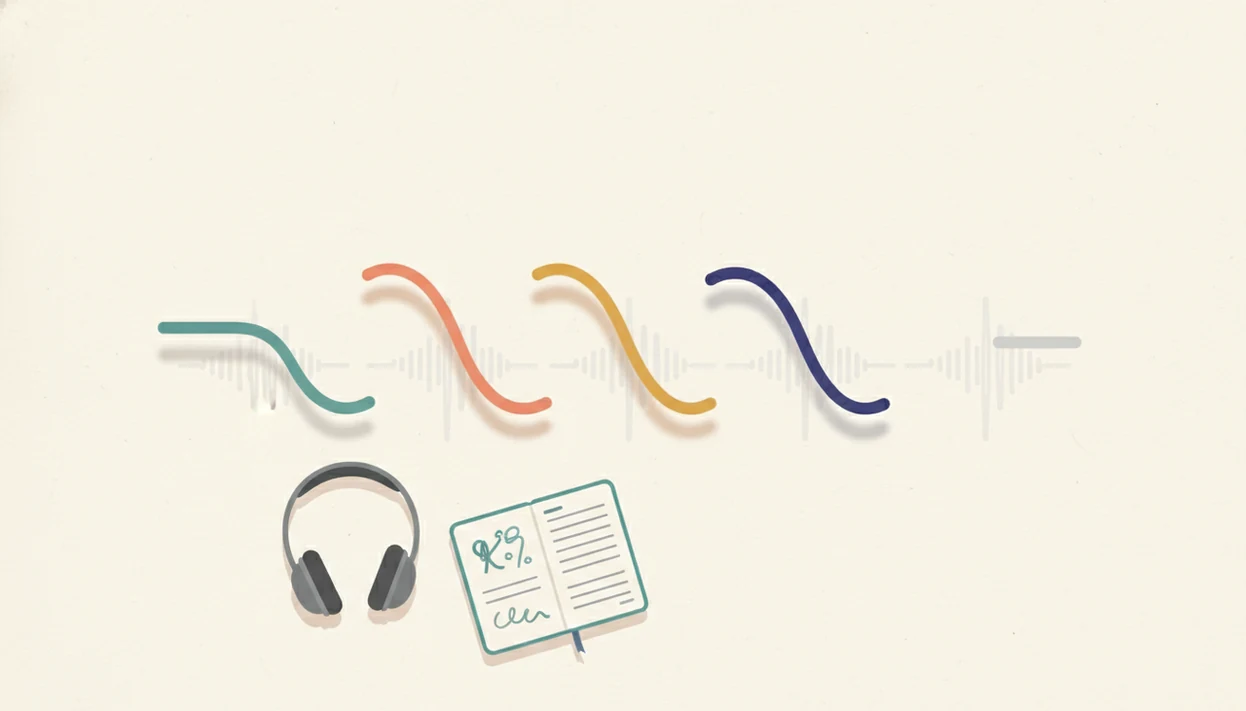
To learn Mandarin tones for beginners, start by hearing the four main pitch shapes and neutral tone, then copy them aloud with pinyin, single syllables, tone pairs, and short phrases. Mandarin tones are part of word identity, so train your ear before trying to speak quickly.
> Definition: Mandarin tones are pitch patterns attached to syllables in spoken Chinese, commonly taught as four main tones plus a neutral tone in pinyin-based beginner pronunciation.
TL;DR
- Mandarin is usually taught with four main tones plus a neutral tone: level, rising, dipping, falling, and light/unstressed.
- Pinyin tone marks help you read tones, but listening and imitation are what build accurate pronunciation.
- Beginners should move from single syllables to tone pairs and short phrases because tones change feel in real speech.
Mandarin tones at a glance for beginners
Mandarin tones are pitch movements that help identify words, not decorative accent marks. Beginners usually learn four main tone shapes, level, rising, dipping, and falling, plus a lighter neutral tone.
In pinyin, these tones are shown above vowels, as in mā, má, mǎ, and mà. The neutral tone is often left unmarked, as in some uses of ma. A wrong tone can change the word a listener hears, so tone errors are not only accent errors. They can become meaning errors.
Mandarin is widely spoken worldwide, with commonly cited estimates placing native speakers at about 1.1 billion, according to Ethnologue’s 2025 overview source. That scale is one reason beginner materials vary, but the tone foundation stays similar.
Start with listening.
This guide uses a listening-first path: hear the contrast, copy it slowly, record yourself, then move into tone pairs and short phrases.
Five facts about pinyin tones every beginner should know
- Mandarin commonly uses four main tones plus one neutral tone. Beginner courses usually teach high level, rising, low or dipping, falling, and light unstressed pronunciation.
- Pinyin tone marks are reading aids, not pronunciation training by themselves. A printed verb chart or phone screenshot can remind you of the tone, but audio teaches the pitch.
- Tones belong to syllables and can distinguish words. The syllable spelling may look similar while the tone changes the word a listener understands.
- Tone pairs are necessary because two-syllable words feel different from isolated syllables. A learner can say mǎ correctly alone, then lose the contour inside a word.
- Slow repetition with correction beats fast, unfocused practice. Five careful recordings often reveal more than twenty rushed readings from a phrase list.
For beginners, pinyin tone marks work best as labels for sounds you have already heard, not as a substitute for hearing the sound itself.
How Mandarin tones work in Chinese pronunciation basics
Mandarin tones are pitch contours carried by syllables, so learners must hear both pitch direction and relative pitch height. In plain terms, you are listening for whether the voice stays level, rises, drops low, falls, or becomes light.
The usual classroom example is ma: mā, má, mǎ, mà, and neutral ma. The spelling gives the syllable frame, but the tone gives crucial pronunciation information. A beginner staring at three browser tabs, a Duolingo lesson, a Wiktionary entry, and a YouTube pronunciation clip, is often trying to connect those two systems.
Tone shape is not the same as emotional intonation. English speakers raise pitch to ask a question or show surprise, but Mandarin tones are tied to syllables. Natural speech can still soften or reshape textbook diagrams because neighboring tones, speed, and sentence rhythm affect realization.
That does not make tones random.
The learner task is to recognize the intended contour, then produce it clearly enough in real words.
Pinyin tone marks and the five Mandarin tone patterns
Pinyin tone marks show how a Mandarin syllable should move in pitch. Pinyin spelling plus a tone mark is pronunciation guidance, not English-like spelling.
| Tone pattern | Pinyin mark | Basic sound | Beginner note |
|---|---|---|---|
| First tone | mā | High and level | Hold it steady, without sliding upward. |
| Second tone | má | Rising | Start mid and rise, like a clear upward movement. |
| Third tone | mǎ | Low or dipping | Keep it low; do not force a theatrical dip every time. |
| Fourth tone | mà | Sharp falling | Start high and drop quickly. |
| Neutral tone | ma | Light, short, usually unmarked | Let it be brief and unstressed. |
A common teaching model uses four main tones plus one neutral tone, and many beginner materials describe the four main shapes as level, rising, dipping, and falling, as summarized in Hacking Chinese’s tone guide source.
Single-syllable tone examples
Practice ma, ba, da, and shi in all four marked tones before adding meaning.
Neutral tone examples
Listen for neutral tone in common words and particles, where the syllable becomes lighter and shorter.
Before you start Mandarin tone practice
Before daily tone practice, set up a small routine with reliable audio, pinyin, and a way to record yourself. Silent reading is useful for review, but it does not build tone control.
Use native-speaker audio or a trustworthy course recording. Practice aloud in short sessions, even if you only have six minutes before work. A replayed audio clip at midnight can still be useful if you pause, repeat, and compare carefully.
Record yourself and check pitch direction, not whether you “sound Chinese” in some vague way. Use pinyin with tone marks at first, then test yourself with the marks hidden. If you are planning a full beginner sequence, place tones early in an English to Mandarin learning path, beside basic syllables and survival vocabulary.
Do not race. Speed comes later.
How to use pinyin tones for daily Mandarin drills
Use pinyin tones as a daily drill map: listen first, speak second, record third, and review the hardest contrasts the next day. Short, repeated sessions usually work better than one long pronunciation push.
- Listen to one tone set without speaking. Play mā, má, mǎ, mà, and neutral ma several times, and label only the pitch direction.
- Copy the tone contour aloud with one simple syllable. Use ma first, then repeat with ba, da, or shi.
- Record and compare your pitch direction. Check whether your voice stays level, rises, stays low, falls, or turns light.
- Practice tone pairs with two-syllable words. Keep both syllables slow enough that each tone remains recognizable.
- Add short phrases only after the tones are recognizable. Mark each syllable, then listen once without reading.
- Review difficult pairs the next day. Save them in a small note labeled “tone repair,” not in a giant mixed deck.
Tools like SiftLearn, Duolingo, Memrise, and course audio can support this workflow, but the key is still careful listening and comparison.
Evidence Behind Listening-First Mandarin Tone Practice
Listening-first tone practice works because adults need a clear sound target before the mouth can reliably copy it. Pronunciation teachers and second-language speech research commonly separate perception, hearing the contrast, from production, making the contrast aloud.
- Train your ear before speed. Start with the listening step because fast speaking can hide whether you actually hear first, second, third, fourth, and neutral tone as different patterns.
- Copy only after the contour is audible. Adult learners can improve pronunciation, but they usually need focused attention on pitch direction, not just more vocabulary or louder repetition.
- Record yourself to expose silent-reading errors. Pinyin marks may look correct in a notebook while your voice flattens every syllable into the same melody. A recording turns that invisible habit into something you can compare.
- Ask for feedback when comparison is not enough. A tutor, exchange partner, or speech tool can catch a too-high third tone or weak fourth tone that sounds acceptable to you.
- Move to tone pairs and phrases after repair. Research-informed practice favors building from controlled contrasts to real speech, so the daily drill saves connected phrases until the tones are recognizable.
Step 1: Train your ear for Mandarin tones before speaking
Should you listen to Mandarin tones before trying to say them? Yes. Beginners should first hear the contrast among flat, rising, low or dipping, falling, and light syllables.
Start with a minimal set such as ma in all tones. Do not translate during this drill. Your only job is to decide what the pitch is doing. Use call-and-response audio, pause after each syllable, and mark what you heard before checking the answer.
Silent pinyin study creates weak tone habits because the eye starts guessing faster than the ear can verify. We see this when a learner copies tone marks neatly into a notebook, then says every syllable with the same English sentence melody.
Keep the drill narrow. One syllable, five tone patterns, many careful listens.
For English-speaking beginners, listening-first tone practice is often easier than rule-first memorization because pitch direction has to become audible before it becomes speakable.
Step 2: Say pinyin tones slowly with single syllables
Once you can hear the main contrasts, say pinyin tones slowly with simple syllables. Use ma, ba, da, and shi, then run each one through the four main tones.
Exaggerate the contour at first. Make first tone steady, second tone clearly rising, third tone low, and fourth tone sharply falling. Then reduce the exaggeration so the sound becomes usable in speech. Keep the initial and final stable, so tone is the only changing variable.
The third tone needs special care. In connected speech, it is often realized as a low tone rather than a full deep dip, so beginners should not over-dip every third tone. AllSet Learning’s third-tone sandhi guide also notes that third tones often change in connected speech rather than staying as the full textbook dip source. A printed alphabet chart on the fridge helps with symbols, but it cannot tell you when your third tone has become too dramatic.
Use short sets of 5 to 10 repetitions. Stop before your ear goes numb.
Step 3: Practice Mandarin tone pairs for real words
Tone pairs are two-syllable tone combinations used to train the rhythm of real Mandarin words. They matter because a tone that sounds clear alone can blur when another tone comes before or after it.
Many Mandarin tone-pair drills start with the 16 combinations of the four main tones, then add neutral-tone patterns separately so beginners do not mix two practice grids. AllSet Learning’s tone-pair overview uses this main-tone combination approach source.
| Pair type | What to listen for | Practice goal |
|---|---|---|
| 1-1 | Two steady high syllables | Avoid sliding on the second syllable. |
| 1-2 | Level then rising | Keep the first tone flat before the rise. |
| 2-3 | Rising then low | Do not let both syllables become vague mid pitch. |
| 3-4 | Low then falling | Keep the third tone low before the sharp fall. |
| 4-4 | Two falling syllables | Make both drops controlled, not shouted. |
Tone pairs reveal problems hidden by single-syllable practice. Practice recognition first, then production. If you want app-style options, compare them in a free app for Mandarin tones guide before building your routine.
Easy tone-pair starter set
Begin with 1-1, 1-2, 2-4, and 4-4 because the pitch directions are easier to hear.
Hard tone pairs for English speakers
Many English speakers struggle with 2-3, 3-2, and 3-3 because low pitch and rising movement get tangled.
Step 4: Add Mandarin phrases after tone pairs feel clear
Add Mandarin phrases only after single tones and tone pairs feel recognizable at slow speed. Phrase practice should connect tones to meaning without flattening everything into English intonation.
- nǐ hǎo, 你好, hello. Practice both third-tone syllables slowly, then listen for how they sound in natural greeting speed.
- xièxie, 谢谢, thanks. Notice the falling fourth tone followed by a lighter second syllable in common speech.
- wǒ yào, 我要, I want. Keep wǒ low and yào falling before using it in a café or shop sentence.
- duìbuqǐ, 对不起, sorry. Mark each syllable, then listen without reading so the rhythm does not become mechanical.
A beginner often realizes a phrasebook sentence is polite but too formal for a café counter. Tone practice has a similar lesson: correct marks help, but real audio tells you how the phrase actually lands.
Good language learning guides help adults compare vocabulary, grammar, practical phrases, and translation pair references in a structured sequence, not chase instant fluency claims.
Common Mandarin tones mistakes beginners make
The most common Mandarin tone mistakes come from treating tones as optional, visual, or emotional. Beginners need habits that force sound, feedback, and slow correction into the routine.
One mistake is treating tones like English emphasis. A fourth tone is not just “sounding firm,” and a second tone is not just “asking a question.” Another mistake is memorizing pinyin marks without listening. The mark names the contour, but the ear still has to recognize it.
Speed causes trouble too. Learners often speak quickly because they want the sentence to feel real, but fast speech hides unstable tones. Third tone creates another trap; over-dipping every third tone can make connected speech sound strained. Neutral tone also gets ignored, especially in common words where rhythm matters.
Feedback can feel uncomfortable. Still, a tutor, exchange partner, or speech tool may catch errors your own recording misses.
For most beginners, corrected slow practice is more useful than fast phrase repetition because tones must stay recognizable before speed has value.
Common myths about learning Mandarin tones
Several myths make Mandarin tones feel more mysterious than they are. Tone learning is gradual ear training plus correction, not a talent test.
- Myth: Adults cannot learn Mandarin tones. Adults may need deliberate practice, but perception and production can improve with repeated listening and feedback.
- Myth: Tone marks are enough. Pinyin marks help you read pronunciation, but they do not replace native-speaker audio.
- Myth: Tones can wait until after vocabulary. Early vocabulary learned with flat intonation can become harder to repair later.
- Myth: Every tone sounds identical in every sentence. Natural speech, speed, and neighboring tones can shift how a tone is realized.
- Myth: Perfect accent is required before speaking. Recognizable tones matter more at the beginner stage than an imitation of a specific native accent.
Tools such as Sift Learn can help organize learner notes, but no tool removes the need to listen, speak, and get corrections.
Mandarin tone self-check for beginner pronunciation
A Mandarin tone self-check should test recognition, recording accuracy, tone pairs, and outside understanding. Progress means better recognizability, not an instant native-like accent.
First, play tones in random order and check whether you can identify them without looking at pinyin. If you only recognize tones in the same fixed order, the pattern is doing too much work. Next, record your voice and compare pitch direction. Do not judge personality, confidence, or “foreignness.” Check the contour.
Then test tone pairs at slow speed. If 1-2 and 2-1 sound the same in your mouth, return to pair drills. Finally, ask a tutor, exchange partner, or speech tool whether target words are understandable. A polite email opener drafted twice can wait; pronunciation repair needs the actual sound.
If character lookup is part of your study routine, pair tone notes with resources that explain what app identifies Chinese characters, since characters alone will not show spoken tone reliably.
Limitations
Mandarin tone charts are useful, but they are not enough to teach accurate pronunciation. Self-study works better when learners know where charts, apps, and recordings break down.
- Tone charts alone do not train the ear or mouth; they only label pitch patterns.
- Audio without feedback may let repeated mistakes persist for weeks.
- There is no shortcut to instant tone mastery, even with daily drills.
- Natural speech can differ from textbook tone diagrams, especially at normal speed.
- Speaker variation, neighboring tones, and sentence rhythm affect tone realization.
- Focusing too much on a native-like accent can slow useful communication and make beginners avoid speaking.
- Fossilized errors may need tutor correction, especially third-tone and tone-pair problems.
- Pinyin can guide pronunciation, but it can also tempt learners to read instead of listen.
For phone-based self-study, a practical routine matters more than collecting resources. The broader workflow is covered in our guide on how to learn Mandarin with phone.
FAQ
How many Mandarin tones are there?
Mandarin is commonly taught with four main tones plus a neutral tone. The main beginner shapes are level, rising, low or dipping, and falling.
What are pinyin tone marks?
Pinyin tone marks show the pitch pattern attached to a Mandarin syllable. They guide pronunciation, but they do not replace listening practice.
Are Mandarin tones hard?
Mandarin tones can feel unfamiliar for English speakers, but they are trainable. Listening, slow repetition, and correction make them more recognizable over time.
Can adults learn Mandarin tones?
Yes, adults can improve both tone perception and tone production. Deliberate practice matters more than age alone.
Should I learn tones first?
Learn tones early alongside basic syllables and beginner vocabulary. Waiting too long can build flat pronunciation habits that are harder to fix.
What are tone pairs?
Tone pairs are two-syllable tone combinations used to practice real Mandarin rhythm. They help learners move beyond isolated syllables.
Does pinyin replace listening practice?
No, pinyin supports reading pronunciation but cannot replace audio imitation. SiftLearn may help structure learner notes, but the tone still has to be heard and spoken.
How do I practice neutral tone?
Practice neutral tone through common words and phrases where the syllable is short, light, and unstressed. Listen first, then repeat the full word or phrase instead of drilling the neutral syllable by itself.