
Learn Korean Hangul Step by Step Before Beginner Phrases
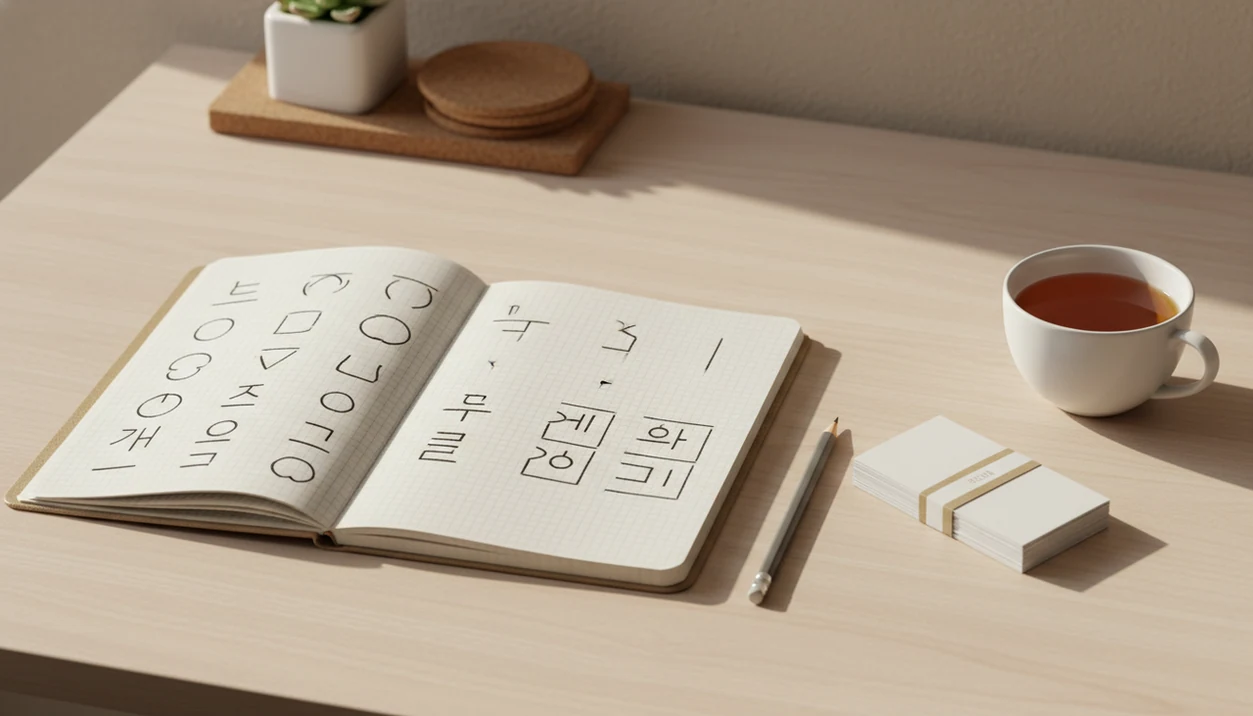
To learn Korean hangul step by step, start with the basic consonants and vowels, combine them into syllable blocks, practice pronunciation and stroke order, then move into short beginner phrases. This order helps you read real Korean script before relying on Romanization or memorized phrases.
> Definition: Hangul is the Korean alphabet, a phonetic writing system that uses consonant and vowel letters arranged into square syllable blocks.
TL;DR
- Hangul has 14 basic consonants and 10 basic vowels before double consonants and compound vowels.
- Korean words are written in syllable blocks, not as separate letters in a straight line like English.
- The fastest practical path is letters, blocks, pronunciation, reading drills, real words, then beginner phrases.
Hangul Basics at a Glance for Korean Alphabet Beginners
Hangul is the Korean alphabet, not a set of word symbols. Beginners first learn 14 basic consonants and 10 basic vowels, then combine them into syllable blocks before reading words and beginner phrases. For a reference overview of Hangul’s basic letter system, see Britannica’s summary of the Korean alphabet: source.
A useful first goal is simple decoding. You see 가, 나, 고, or 한 and know how the letters fit together. That can happen quickly with focused study, but comfortable reading, listening, and grammar take longer.
Global interest is real. The National Institute of Korean Language reported that over 70% of Korean learners cited Hallyu, including K-pop and K-drama, as a primary motivation for starting Korean source. Many learners first want to read lyrics, actor names, captions, or menu words.
The first win is small: a word stops looking like decoration.
Five Korean Script Facts Before You Learn Hangul Step by Step
- Hangul was created in the 15th century under King Sejong. UNESCO recognizes a King Sejong Literacy Prize connected to mother-tongue literacy and language development source.
- Hangul represents sounds, not meanings. A block like 한 is a syllable, not a whole idea by itself.
- Letters combine into square syllable blocks. Korean looks compact because each syllable is arranged inside a block.
- Many words can be sounded out after the letters and common pronunciation rules. That does not mean you know the meaning yet.
- Stroke order and real-word practice improve retention. Script strokes traced on grid paper stick better than a letter chart glanced at once.
Good language learning guides that help adults learn vocabulary, grammar, and practical phrases across popular languages with structured lessons and translation pair references deliver sequence and source checks, not instant fluency claims.
Before You Start: Materials and Pronunciation Checks
Before you start Hangul, set up a small study kit: square writing space, one trusted audio source, and a learner dictionary. The goal is to make decoding clean before phrases start competing for attention.
- Prepare grid paper or a notebook with visible spacing so each syllable block has a square home. This keeps 가, 문, and 한 from stretching into loose alphabet strings.
- Choose one native-audio source for first pronunciation checks, then treat Romanization as a hint rather than a final answer. Too many sound references at once can make ㄱ, ㅋ, and ㄲ feel more confusing than they are.
- Keep a learner dictionary open for meanings only after you have tried to read the Hangul aloud. Decoding first protects the script habit.
- Set a short daily review window, even ten focused minutes, instead of saving everything for one long cram session.
- Avoid memorizing full phrases too early. Wait until consonants, vowels, and block shapes feel familiar enough that a phrase reinforces the writing system instead of hiding it.
How the Korean Alphabet Works in Hangul Syllable Blocks
Hangul syllable blocks are square written units built from smaller alphabet letters. Each block usually contains an initial consonant, a vowel, and sometimes a final consonant, so the shape reflects syllable structure.
This is the mechanism behind Korean script. Hangul uses phonemic letters, meaning the written parts broadly represent speech sounds. The blocks are syllabic grouping, meaning letters are arranged together by syllable. They are not Chinese-style ideograms, and a single block does not automatically carry one independent meaning.
Initial consonant, vowel, and final consonant pattern
A simple pattern is initial consonant plus vowel: ㄱ + ㅏ becomes 가. Add a final consonant, also called batchim, and the block becomes closed, as in 한.
Horizontal and vertical vowel placement
Vertical vowels such as ㅏ and ㅓ sit to the right of the consonant. Horizontal vowels such as ㅗ and ㅜ sit below it. The square shape comes from that placement rule.
How to Use This Korean Script Guide for Adult Self-Study
Use this Korean script guide as a practical sequence, not a page to skim once. A notebook margin labeled “formal/informal” can wait; first make the letters automatic.
- Study one letter group at a time, beginning with basic consonants before vowels.
- Say each sound aloud, then check a pronunciation clip before writing it into a flashcard.
- Write syllable blocks by hand, keeping the initial consonant, vowel, and final consonant positions clear.
- Cover Romanization after the first sound check, then read the Hangul again without help.
- Review with short phrases only after you can decode the syllables inside them.
Tools like SiftLearn, Duolingo, Memrise, and paper drills can all fit here, but the study order matters more than the platform. If you compare phone-based options, a free app for Korean hangul can support short review sessions.
Step 1: Learn Korean Hangul Consonants by Sound and Shape
Learn the 14 basic Hangul consonants by sound, shape, and writing direction. Some Korean sounds only approximate English sounds, so treat Roman letters as clues, not exact matches.
Do not treat the English clues in the chart as exact pronunciations. Use them only to start the sound, then confirm with native audio because Korean plain, tense, and aspirated consonants do not map cleanly onto English spelling.
Basic consonant chart with sound clues
| Hangul | Common sound clue | Learner note |
|---|---|---|
| ㄱ | g/k | Softer than many English “g” sounds |
| ㄴ | n | Stable beginner sound |
| ㄷ | d/t | Plain stop, not strongly puffed |
| ㄹ | r/l | Between English r and l |
| ㅁ | m | Stable beginner sound |
| ㅂ | b/p | Plain stop |
| ㅅ | s | Changes before some vowels |
| ㅇ | silent/ng | Silent initially, “ng” finally |
| ㅈ | j | Plain affricate |
| ㅊ | ch | Aspirated, with air |
| ㅋ | k | Aspirated |
| ㅌ | t | Aspirated |
| ㅍ | p | Aspirated |
| ㅎ | h | Often light in speech |
Stroke order for Korean consonants
Write top to bottom and left to right where the shape allows. The tongue pressed behind front teeth during ㄴ and ㄷ practice feels minor, but it helps you hear cleaner differences.
For beginners, consonants are easier to retain when sound, shape, and hand movement are learned together because each cue reinforces the others.
Step 2: Learn Korean Hangul Vowels Without English Guesswork
Learn the 10 basic Hangul vowels as Korean sounds, not as English spelling equivalents. English spelling is too inconsistent to be the main guide for Korean pronunciation.
Basic vowel chart with pronunciation cues
| Hangul | Approximate Romanization | Placement type |
|---|---|---|
| ㅏ | a | Vertical |
| ㅑ | ya | Vertical |
| ㅓ | eo | Vertical |
| ㅕ | yeo | Vertical |
| ㅗ | o | Horizontal |
| ㅛ | yo | Horizontal |
| ㅜ | u | Horizontal |
| ㅠ | yu | Horizontal |
| ㅡ | eu | Horizontal |
| ㅣ | i | Vertical |
Why Romanization is temporary
Romanization can help you check a first sound, but it should disappear quickly from daily reading drills. A learner staring at three browser tabs, a Duolingo lesson, a Wiktionary entry, and a YouTube pronunciation clip, should still return to the Hangul.
Keep the Korean script in front.
If you already study another script, the sequencing will feel familiar; compare it with how learners learn Japanese hiragana and phrases after first separating sound practice from phrase memorization.
Step 3: Build Hangul Syllable Blocks from Letters
Build Hangul syllable blocks by placing letters into fixed positions. Every written syllable needs an initial consonant position, even when the syllable begins with a vowel sound.
- Choose an initial consonant, such as ㄱ, ㄴ, ㅁ, or ㅎ.
- Add a vowel to the right or below, depending on its shape.
- Use ㅇ as a silent initial placeholder before vowel-starting syllables.
- Add an optional final consonant at the bottom when the syllable closes.
- Read the whole block as one syllable, not as a separate spelling chain.
Open syllables without final consonants
가 sounds like ga or ka depending on context. 나 is na. 고 is go. These are open syllables because they end in a vowel.
Batchim syllables with final consonants
문 and 한 include final consonants, called batchim. Batchim changes how the block ends, and later it affects connected speech.
Step 4: Read Korean Words with Hangul Pronunciation Drills
Read real Korean words after you can form blocks. Say the Hangul first, then check Romanization, because the goal is Korean script recognition rather than English-letter memory.
Hangul word drills with English meanings
| Hangul | Romanization | English |
|---|---|---|
| 물 | mul | water |
| 문 | mun | door |
| 한국 | Hanguk | Korea |
| 사람 | saram | person |
| 이름 | ireum | name |
| 학교 | hakgyo | school |
Listening checks for pronunciation
Batchim and sound changes can affect real pronunciation, especially when words connect in speech. Read aloud, listen once, then read again without looking at Romanization.
The neighbor's footsteps during speaking practice are oddly useful. You notice whether you are whispering sounds or actually producing them.
For learners using camera tools or screenshots, a separate what app identifies Korean hangul workflow can help verify printed text before it enters a deck.
Step 5: Move from Hangul Basics into Korean Beginner Phrases
Move into Korean beginner phrases after you can decode the syllables inside them. Phrases should reinforce Hangul, not replace alphabet study with memorized sound strings.
Greeting phrases for Hangul reading practice
| Hangul | Romanization | English |
|---|---|---|
| 안녕하세요 | annyeonghaseyo | hello |
| 감사합니다 | gamsahamnida | thank you |
| 죄송합니다 | joesonghamnida | I’m sorry |
| 이거 주세요 | igeo juseyo | please give me this |
Self-introduction phrases after Hangul
| Hangul | Romanization | English |
|---|---|---|
| 저는 민수예요 | jeoneun Minsu-yeyo | I’m Minsu |
| 제 이름은 안나예요 | je ireumeun Anna-yeyo | My name is Anna |
| 한국어를 공부해요 | hangugeoreul gongbuhaeyo | I study Korean |
A beginner often realizes a phrasebook sentence is polite but too formal for a café counter. That is a register lesson, not a Hangul lesson.
Hangul usually works best when phrases are read from the script first, while Romanization fits only the first pronunciation check.
Common Myths About Learning Korean Hangul Step by Step
Many Hangul delays come from studying the wrong thing first. These myths are common, but they are easy to correct with a letters-to-blocks-to-words sequence.
- Myth 1: Hangul takes months before basic reading. Many motivated adults can decode simple words after a few focused sessions, though speed takes longer.
- Myth 2: Romanization should come first. Romanization can help briefly, but leaning on it too long slows real Korean reading.
- Myth 3: Each block has its own meaning. A block is a syllable built from letters, not a word-symbol like an ideogram.
- Myth 4: Stroke order does not matter. Stroke order improves legibility and helps you recognize handwritten forms.
- Myth 5: Hangul alone is Korean. Hangul is accessible, but vocabulary, pronunciation, particles, endings, and politeness levels still need practice.
If you keep mixing up ㅓ and ㅗ, slow down and sort vowels by mouth shape and block placement before adding new words. If batchim makes every word feel stuck, practice only final consonant words for one session instead of pushing ahead to full phrases.
Not magic. Just a better first sequence.
One-Week Korean Alphabet Practice Plan for Hangul Retention
A one-week Hangul plan should mix new letters, spaced review, short writing, and real words. Cover Romanization before checking answers, so your eyes return to the Korean script.
- Practice basic consonants on day 1, writing each one in stroke order.
- Add basic vowels on day 2, sorting them into vertical and horizontal groups.
- Build open syllables on day 3, such as 가, 나, 고, and 무.
- Write batchim syllables on day 4, including 문, 한, and 국.
- Read high-frequency words on day 5, then check meanings with a learner dictionary.
- Review beginner phrases on day 6, using a phone screenshot of a phrase list.
- Test yourself on day 7 by reading a short line without Romanization.
SiftLearn fits best as a structured review layer after the daily writing drill, while Duolingo, Memrise, learner dictionaries, and paper grids each cover different parts of practice. For broader tool comparisons, the best app for Japanese and Korean basics guide narrows what each method is good for.
Limitations
Hangul study is necessary for Korean reading, but it is not the whole language. Treat it as the script stage of a larger beginner path.
- Hangul teaches the writing system, not full Korean grammar.
- Reading aloud does not guarantee understanding; you may pronounce 한국어 without knowing its sentence role.
- Batchim, assimilation, and connected speech need listening practice with native audio.
- Romanization can slow progress if you keep it beside every word.
- Alphabet drills are easy to forget without real words, names, places, and phrases.
- Politeness levels require separate study because Korean changes by relationship, setting, and formality.
- Dictionary form and spoken phrase form often differ, especially with verbs.
- Machine translation should be cross-checked before you put a sentence into a flashcard deck.
We often compare a machine translation output against a learner dictionary first. One-word certainty is risky.
FAQ
Is Hangul hard to learn?
Hangul is one of the more beginner-friendly scripts because its letters represent sounds in a structured way. Pronunciation, vocabulary, and grammar still take regular practice.
How long does Hangul take?
Many learners can start decoding simple Hangul in a few focused hours. Comfortable reading usually takes several weeks of review, writing, and listening checks.
Should I learn Romanization first?
Romanization can help with an initial sound check, but it should not replace Hangul study. The better order is letters, blocks, words, then phrases.
What are Hangul syllable blocks?
Hangul syllable blocks are square units made from consonant and vowel letters. Each block represents one syllable, such as 가, 문, or 한.
What is batchim in Korean?
Batchim is the final consonant position at the bottom of a Hangul syllable block. It affects how a syllable ends and can change in connected pronunciation.
Can I learn Korean without Hangul?
You can memorize some phrases without Hangul, but long-term Korean learning becomes much harder. Hangul is needed for reading, spelling, dictionary use, and reliable pronunciation practice.
Why does Korean use ㅇ?
The letter ㅇ is silent when it appears in the initial consonant position before a vowel. At the end of a syllable, it is pronounced like “ng.”
What comes after learning Hangul?
After Hangul, study beginner vocabulary, particles, basic verb endings, listening practice, and practical phrases. SiftLearn can help organize those topics into a beginner path, but any course should keep Hangul visible while you build Korean sentences.