
English To Mandarin Learning Path For Adult Beginners
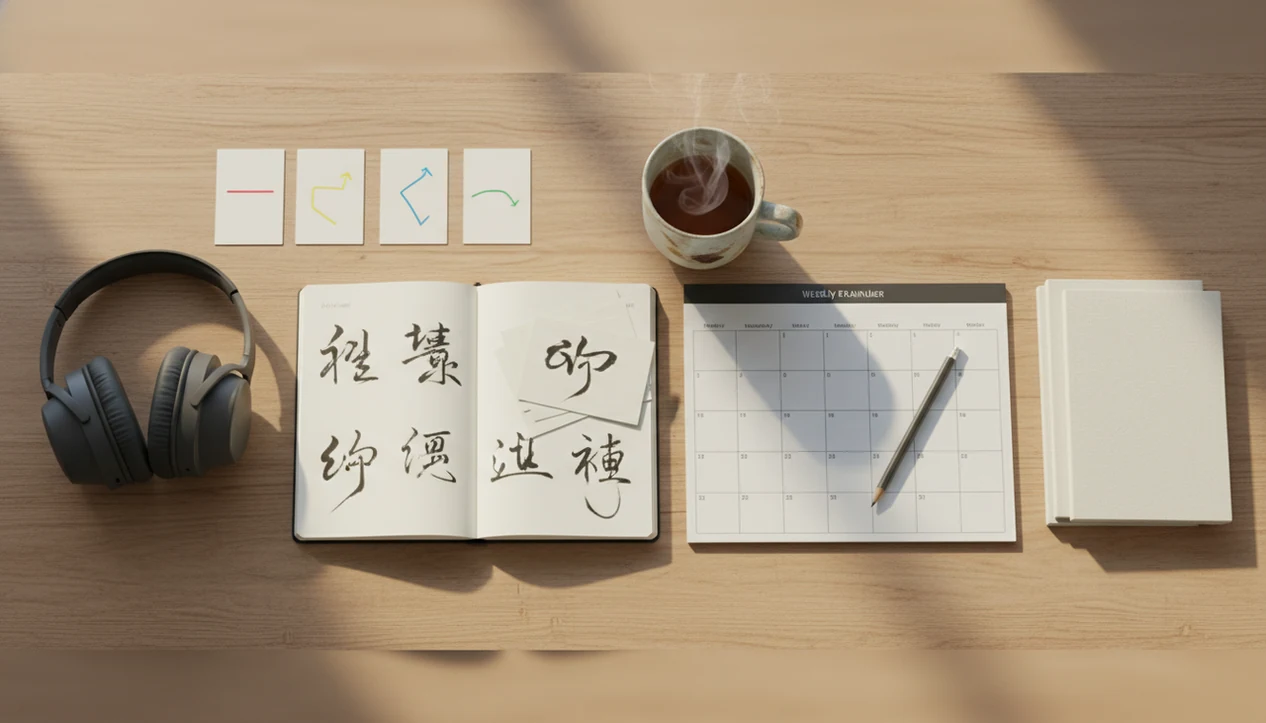
The best English to Mandarin learning path starts with tones and pinyin, then adds survival phrases, common characters, core sentence patterns, listening practice, and simple speaking in a weekly loop. Adult beginners should study in short daily sessions and measure progress with practical milestones, not just app streaks.
Definition: An English to Mandarin learning path is a sequenced beginner roadmap that shows English speakers when to learn pronunciation, pinyin, characters, vocabulary, grammar, listening, speaking, and review.
TL;DR
- Start with Mandarin tones and pinyin before memorizing large word lists.
- Add characters early, but focus on recognition and components before handwriting.
- Use a repeatable weekly loop: listen, speak, read, review, and translate simple sentence pairs.
English To Mandarin Learning Path At A Glance
A practical Mandarin beginner sequence is tones and pinyin, survival phrases, common characters, grammar patterns, listening, speaking, and review. Most adults do better with 20 to 30 focused minutes daily than with one long weekend cram.
Mandarin asks English speakers to build several habits at once, so the plan needs a steady order. Start with sound, then attach sound to meaning, then attach meaning to characters and sentence patterns. A learner with index cards clipped in rubber bands will usually make cleaner progress if those cards follow one sequence, not five unrelated apps.
The U.S. Foreign Service Institute places Mandarin in its highest-difficulty group for English speakers and lists about 2,200 class hours for professional working proficiency: https://www.state.gov/foreign-language-training/. First order. First graded dialogue. First five-minute chat.
How An English To Mandarin Learning Path Works
An English to Mandarin learning path works by training sound, meaning, characters, and sentence order together instead of treating them as separate subjects. Tones are part of word identity in Mandarin, not decoration added after pronunciation.
Pinyin gives English speakers a pronunciation map, but it is not English spelling. The letters can mislead you if you read them with English habits. That is why a good path pairs pinyin with audio, tone drills, and early character recognition. Pinyin helps you enter the system; it should not become the whole system.
The learning mechanism is a loop: input, output, spaced review, and feedback. Input means hearing and reading level-appropriate Mandarin. Output means saying or writing small pieces yourself. Spaced review brings words back before they fade. Feedback catches tone, word order, and register errors before they harden.
One notebook margin may say “formal/informal.” That small label matters.
Before You Learn Mandarin From English
Before you learn Mandarin from English, set the schedule, tools, and feedback channels you can actually keep for months. A busy beginner should usually plan for 3 to 5 hours per week, split into short sessions.
- Time: 20 to 30 minutes most days is enough to build a base if the sessions include listening, speaking, reading, and review.
- Materials: Use structured lessons, native audio, spaced repetition, graded dialogues, and a way to ask questions.
- Feedback: A tutor, language partner, or careful speaker can correct tones that apps may let slide.
- Technology: A meta-analysis of computer-assisted language learning found positive overall effects for technology-supported instruction, but tools work better inside a structured plan: https://doi.org/10.1017/S0958344013000013.
- Source checks: Tools like SiftLearn can help sequence vocabulary, grammar, and translation-pair notes, but you should still cross-check tricky words in a learner dictionary.
Good language learning guides deliver structured lessons and translation pair references for vocabulary, grammar, and practical phrases, not vague promises of instant fluency.
How To Use This English To Mandarin Learning Path
Use this path as a repeatable session routine, not just a reading order. Each study block should move from sound to meaning, then from recognition to small spoken output.
- Start with audio: Listen to tone and pinyin models before you read the lesson text. Let the sound lead, then check the spelling, because pinyin letters can pull English speakers toward the wrong pronunciation.
- Add practical phrase pairs: Choose five to eight English-Mandarin pairs from one daily situation, such as ordering food, giving your name, or asking for a price. Keep them useful enough to say this week.
- Review connected characters: Study a small set of characters that already appear in those phrases. Recognition matters more than copying long columns into a notebook.
- Practice one sentence frame: Take one pattern and swap names, times, places, or objects. Small changes make grammar active without turning the session into a chart.
- Record and mark the misses: Say one short answer aloud, compare it with native audio, then note the tones, characters, or grammar points that were unclear. Those marks become the start of the next session.
Step 1: Build Mandarin Tones And Pinyin First
Build tones and pinyin first because Mandarin words can change meaning when the tone changes. The five tone categories are first tone, second tone, third tone, fourth tone, and neutral tone.
- Learn each tone with one syllable: Use mā, má, mǎ, mà, and ma-style examples to hear pitch movement clearly.
- Treat pinyin as a sound map: Read pinyin with Mandarin audio, not English spelling instincts.
- Drill minimal pairs: Compare syllables that differ by tone or final sound, then mark the ones you miss.
- Shadow short audio: Repeat immediately after the speaker, matching rhythm and pitch as closely as possible.
- Record yourself daily: Play your recording next to the model and listen for tone shape, not just confidence.
Skipping tones creates expensive repair work later. The mouth can feel dry before a new sound, especially with third-tone practice, but that discomfort is part of the early training. For more focused drills, use a dedicated guide to learn Mandarin tones for beginners.
Step 2: Add Survival Phrases In A Mandarin Beginner Plan
Add survival phrases after your first tone and pinyin base, so pronunciation stays controlled while the language becomes useful. Begin with greetings, names, thanks, asking for repetition, numbers, ordering, directions, prices, and basic needs.
- Choose whole phrases: Learn “Please say that again” before studying every grammar label inside it.
- Practice aloud: Say each phrase slowly, then at normal speed, then inside a two-line dialogue.
- Use translation pairs: Compare English to Mandarin and Mandarin back to English to catch word order changes.
- Get early feedback: Ask a tutor or speaker to correct two or three phrases at a time.
- Retire phrases that are too formal: A phrasebook sentence may be polite, but too stiff for a café counter.
SiftLearn-style activation uses English-to-Mandarin translation pairs to make vocabulary usable, not just recognizable. A cashier greeting practiced in the queue can become a small test of tone, rhythm, and courage. For sentence-pair warnings, translate English to Chinese for beginners is the safer habit than copying raw machine output into flashcards.
Step 3: Start Common Chinese Characters Gradually
Start common Chinese characters early, but begin with recognition before full handwriting mastery. The first goal is to recognize high-frequency characters in real words, not to produce hundreds from memory.
Use radicals, components, and stroke order awareness as reading tools. You do not need to become a calligrapher in month one. Learn how characters are built, notice repeated parts, and connect each character to sound and meaning. Early milestones can be simple: first 50 characters, then first 100 characters, then short graded lines without pinyin above every word.
Pinyin-only study feels efficient at first, but it limits reading progress later. Menus, signs, graded readers, subtitles, and dictionaries all depend on character recognition. A learner who labels grocery items with notebook words often discovers the same character appearing in several places. That repetition is useful. If you want help reading unknown signs or labels, compare tools that answer what app identifies Chinese characters.
Step 4: Learn Mandarin Sentence Order From English
Learn Mandarin sentence order through sentence pairs, not through isolated grammar charts. Subject-verb-object order gives English speakers a helpful starting point, but Mandarin quickly adds patterns that English does not handle the same way.
Place time expressions before the action, often near the front of the sentence. Learn place phrases before the verb when the action happens somewhere. Add measure words with numbers and nouns. Practice question particles like 吗, negation with 不 and 没, and 的 for possession or description. These patterns should appear inside real sentences from the beginning.
Do not translate every English word directly into Mandarin. It creates stiff sentences and false grammar. The better method is to compare a Mandarin model sentence with its English meaning, then swap one piece at a time. For English speakers, sentence-pair practice is often easier than rule memorization because each pattern stays attached to a usable phrase.
Spreadsheet tabs labeled with new terms can help, but spoken examples still need to lead.
Step 5: Use A Weekly Chinese Study Sequence
A weekly Chinese study sequence should rotate pronunciation, vocabulary, characters, listening, reading, speaking, and review. The goal is not variety for its own sake; it is balanced contact with the same material from different angles.
| Day | 20 to 30 minute session | If you have 5 to 7 hours weekly |
|---|---|---|
| Monday | Tone review plus 8 new words | Add 20 minutes of tutor correction |
| Tuesday | Survival phrase dialogue | Record and compare your speech |
| Wednesday | 5 to 10 characters | Read a graded paragraph |
| Thursday | Listening with transcript | Replay without transcript |
| Friday | Sentence pairs and grammar pattern | Write 6 new sentence swaps |
| Saturday | Speaking task, such as ordering food | Hold a 10-minute guided exchange |
| Sunday | Review missed cards and audio | Plan next week’s weak point |
This routine turns study into measurable events: first restaurant order, first self-introduction, first 5-minute chat. If most sessions happen on a phone, a guide to how to learn Mandarin with phone can help you divide audio, flashcards, and speaking without turning every break into scrolling.
Step 6: Track Mandarin Beginner Milestones
Track Mandarin beginner milestones with observable tasks, not vague feelings of fluency. Mandarin is globally useful; Ethnologue reports more than 1 billion users for Mandarin Chinese, but your first-year goals should stay concrete: https://www.ethnologue.com/language/cmn/.
- Month 1: Recognize the five tone categories, read basic pinyin initials and finals, say about 50 phrases, and recognize 50 characters.
- Month 3: Give a simple self-introduction, order food with help, understand short graded dialogues, and recognize about 100 to 150 characters.
- Month 6: Hold a guided 5-minute conversation, read short graded texts, and recognize roughly 300 characters if study has been steady.
- Month 12: Understand slower learner audio, discuss familiar topics, and reach 300 to 600 characters depending on time and review quality.
- Ongoing: Keep a “can do” list with dates, recordings, and sample sentences.
A phone screenshot of a phrase list is useful evidence. So is an awkward recording from week two.
Evidence Behind This Mandarin Beginner Plan
The evidence supports the broad shape of this plan: start with sound, review on a schedule, and use technology as support. It does not prove that one exact Mandarin sequence is perfect for every adult learner.
The FSI hour estimate gives the right long-term frame: Mandarin takes sustained work for English speakers, so early milestones should be modest and observable. Tones and pinyin come first because learners need auditory feedback before spelling habits settle in; hearing, shadowing, recording, and correction help stop wrong tone patterns from becoming automatic. Spaced-repetition research also supports bringing words and characters back after a delay, rather than rereading the same list in one sitting.
- Set expectations from difficulty data: Treat Mandarin as a long project, then break it into monthly tasks.
- Train pronunciation with ears first: Pair every pinyin line with audio and a short recording check.
- Review before forgetting wins: Schedule old words, tones, and characters into later sessions.
- Use apps as scaffolding: Let CALL-style tools handle drills and reminders, but keep listening, speaking, and feedback in the loop.
- Adjust the order when evidence runs out: Research supports principles better than one universal timetable, so your weak point should shape the next week.
Common Mistakes In A Mandarin Beginner Plan
Common Mandarin beginner mistakes usually come from avoiding the uncomfortable parts: tones, feedback, real listening, and speaking. A clean plan should flag these early.
- The tone deferrer: This learner memorizes many words without tones, then has to relearn them with corrected pronunciation.
- The app-only learner: Apps such as Duolingo, Memrise, Busuu, Babbel, Rosetta Stone, and Sift Learn can support repetition, but they cannot replace longer listening and human correction.
- The handwriting-first learner: This person copies hundreds of characters before reading simple graded content and burns out fast.
- The grammar collector: Rules go into notes, but sentence pairs never become speech.
- The silent recognizer: Reading improves, yet speaking stays frozen because nothing is said aloud.
Silent recognition feels safe. It also hides weak output.
A balanced plan uses apps, audio, character study, and interaction together. If tones and characters are your main bottleneck, a comparison of the best app for Mandarin characters and tones can help narrow the tool choice.
Limitations
No English to Mandarin learning path can remove the long-term nature of Mandarin for English speakers. A sequence can reduce waste, but it cannot make tones, characters, listening speed, and natural phrasing automatic in a few weeks.
This path assumes Standard Mandarin and simplified characters. Learners targeting Taiwan, heritage-family speech, or region-specific workplaces may need traditional characters, zhuyin, or additional local input.
- Mandarin is not a 30-day fluency project, especially for professional or academic use.
- No written path replaces regular interaction with native speakers or trained tutors for tones.
- Self-study tools can support vocabulary and review, but feedback remains necessary.
- Plateaus are normal, even when the study sequence is sensible.
- HSK-style or character-heavy study can create silent recognition without conversation skill.
- There is limited randomized evidence proving one single perfect Mandarin study sequence.
- Pinyin can become a crutch if character recognition is delayed too long.
- Translation-pair practice helps, but some phrases still need register and context checks.
The practical answer is not to abandon structure. Use structure, then test it against real speech, graded reading, and corrections from people who know the language.
FAQ
Can I learn Mandarin alone?
Yes, self-study can build a strong Mandarin base in tones, pinyin, vocabulary, characters, and grammar. You still need feedback from speakers or tutors for tone accuracy and natural conversation.
Should I learn pinyin first?
Yes, pinyin should come first with tones because it gives English speakers a pronunciation system before characters. It should support character learning, not replace it forever.
Are Mandarin tones hard?
Mandarin tones are unfamiliar for many English speakers, but they are trainable. Daily listening, shadowing, recording, and correction help more than silent memorization.
When should I learn characters?
Add common character recognition early after basic pinyin and tone work. You do not need full handwriting mastery before reading simple graded material.
How long does Mandarin take?
Basic conversation may take months of steady study, while professional working proficiency can require thousands of hours. The Foreign Service Institute estimates about 2,200 class hours for English speakers reaching professional working proficiency in Mandarin.
Can apps teach Mandarin?
Apps can help with repetition, vocabulary, pinyin, and review. They work best when combined with audio, reading, speaking practice, and human feedback.
How much Mandarin should I study each day?
Busy beginners should study Mandarin for 20 to 30 focused minutes per day. Longer sessions are useful when they include listening, speaking, reading, and review.
Is Mandarin grammar difficult?
Mandarin grammar has fewer inflections than many languages, which helps beginners. The challenge is building new habits for word order, particles, measure words, and context.