
Spanish Learning Month 1: What to Study First in 30 Days
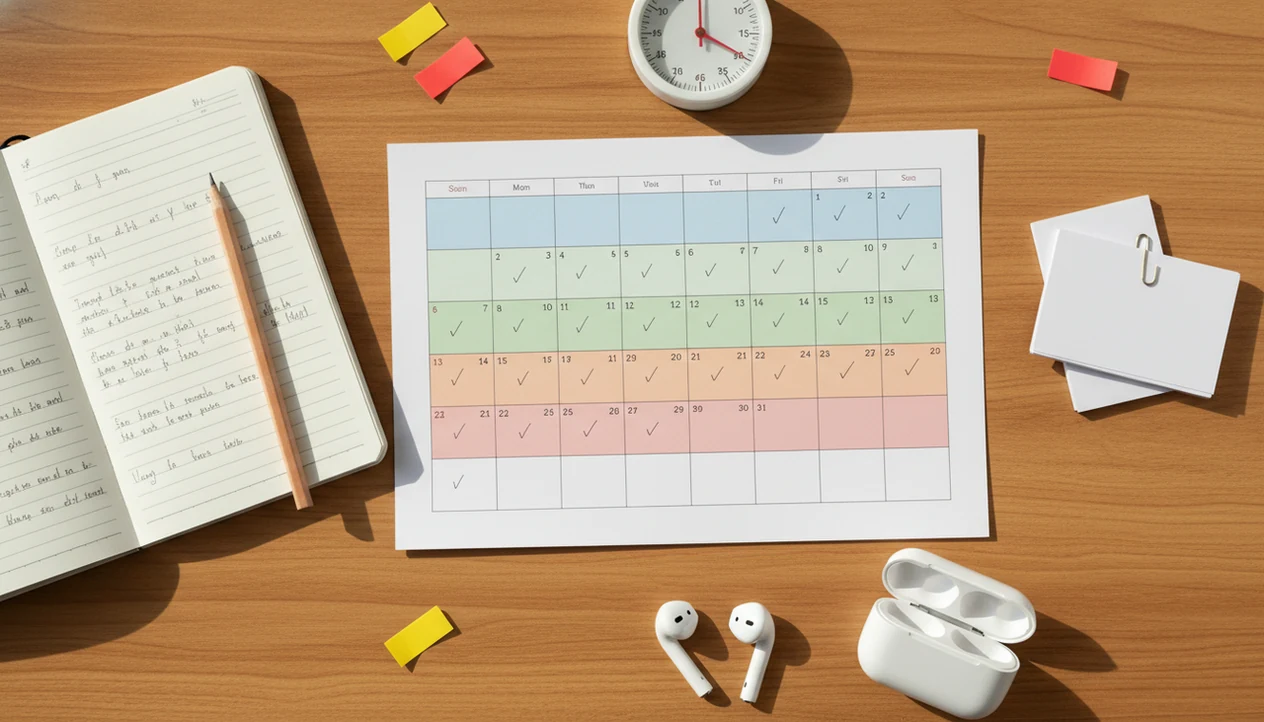
Spanish learning month 1 should focus on pronunciation, greetings, survival phrases, high-frequency vocabulary, basic present-tense verbs, and weekly review. The realistic goal is not fluency; it is being able to introduce yourself, ask simple questions, understand slow beginner speech, and build a study rhythm you can repeat in month 2.
> Definition: Spanish learning month 1 is the first 30 days of beginner Spanish study, organized around sounds, core vocabulary, simple grammar, and practical A1-style communication tasks.
- Study 30–60 minutes per day and aim for steady beginner control, not fluency.
- Prioritize Spanish sounds, greetings, question words, survival phrases, noun gender, articles, and present-tense verbs such as ser, estar, tener, ir, querer, and necesitar.
- Use weekly review, spaced repetition, and English–Spanish sentence pairs so new words become usable in simple conversations.
Spanish Learning Month 1 At a Glance
A first month Spanish plan is a 30-day starter sequence for adult self-study learners, not a fluency sprint. With 30–60 minutes per day, expect basic introductions, simple questions, predictable listening, and short written sentences.
A1 usually takes more guided hours than most learners complete in one month. The Council of Europe’s CEFR level descriptions place A1 within a broader guided-learning path, so treat month 1 as the start of A1-style control, not full completion source.
For an hour-based benchmark, Cambridge English’s CEFR overview uses roughly 90–100 guided learning hours as an A1 estimate, so a 15–30 hour first month should be treated as a start, not completion source.
| Week | Main focus | Practical outcome |
|---|---|---|
| Week 1 | Sounds, greetings, survival phrases | Say who you are and ask for repetition |
| Week 2 | Questions, people, ser | Ask and answer personal questions |
| Week 3 | Needs, places, present verbs | State wants, needs, and locations |
| Week 4 | Review and mini dialogues | Hold a short beginner exchange |
Keep the plan visible. A paper calendar with four checked boxes often works better than another unused app folder.
Before You Start: Spanish Month 1 Prerequisites
Before you start Spanish month 1, set up the study container before you choose a pile of resources. The goal is to remove small decisions so the daily work feels repeatable, even on tired days.
- Choose one notebook, spreadsheet, or document for dated sentences, corrections, and short English–Spanish pairs. Do not split beginner notes across five places.
- Set a daily 30–60 minute study window first, then pick resources that fit that window. A simple morning slot or lunch break is easier to protect than “later tonight.”
- Pick one pronunciation source and one vocabulary review system. That can be a video channel plus flashcards, a course plus a notebook, or an app plus handwritten review.
- Prepare headphones, a phone recording app, and a short phrase list with greetings, repair phrases, and personal sentences like Me llamo... and No entiendo.
- Decide your missed-day rule now: review the last lesson and continue, instead of restarting day 1 or doubling tomorrow’s workload.
Five Facts About a First Month Spanish Plan
- Week-by-week goals work better than random vocabulary lists. A beginner path needs sequence: sounds first, then phrases, then sentence patterns. - A 300–500 word and phrase target is reasonable for consistent learners. That range is an early foundation, not enough for broad independent communication. Treat 300–500 as a planning range, not a validated fluency threshold. Count only words or phrases you can recognize in context and use in at least one sentence. - Month 1 grammar should stay narrow. Focus on pronouns, articles, gender, number, word order, and a few present-tense verbs. - Spaced review is essential. Cramming can feel productive on Sunday night, but it usually leaves weaker recall by Thursday. - Simple real-life tasks matter more than advanced grammar coverage. Ordering water, giving your name, and asking “¿Puede repetir?” are more useful now than memorizing the subjunctive.
If you use SiftLearn alongside this plan, treat it as a place to compare translation pairs and grammar patterns, not as proof that any phone routine can replace sustained practice.
How a 30-Day Spanish Plan Works
A 30-day Spanish plan works through an input-output-review cycle: listen and read first, speak and write next, then review before forgetting wins. In plain terms, you meet the pattern, use the pattern, and return to it before it fades.
Adults often benefit from visible structure, translation pairs, and small daily wins because they can compare meaning directly. A learner staring at three browser tabs, a Duolingo lesson, a Wiktionary entry, and a YouTube pronunciation clip, is not being silly. They are trying to cross-check sound, dictionary form, and usable phrase.
This month should connect to CEFR-style can-do outcomes, such as introducing yourself or understanding slow, familiar speech. It should not promise full A1 completion. A2 generally requires substantially more guided learning time than a 30 day Spanish plan provides, so month 1 is best measured by controlled beginner tasks.
For most beginners, a repeated input-output-review cycle is more reliable than random word collection because each new word gets attached to a sentence job.
How to Use This Spanish Beginner Timeline
Use this Spanish beginner timeline as a repeatable daily routine, not a rigid school schedule. If you miss a day, reset the plan and continue with the next review block.
- Set a 30–60 minute study window and keep it at the same time when possible.
- Study 10 minutes of pronunciation or listening, then 15 minutes of vocabulary.
- Say five short answers aloud and record them on your phone.
- Write three sentences in a notebook, including one English–Spanish translation pair.
- Review yesterday’s words with spaced repetition before adding new ones.
- Reset after a missed day by reviewing, not by doubling the workload.
The phone recording feels awkward at first: you hear pauses, swallowed vowels, and the same sentence three times. Keep the least-bad take, then record it again at the end of the week.
Keep a sentence notebook with dates, not just word lists. If grammar is your weak spot, an app that teaches Spanish grammar with translations can help you compare English word order with Spanish patterns before phrases enter your flashcard deck.
Week 1 Spanish Study Tasks: Sounds, Greetings, and Survival Phrases
Week 1 should make Spanish sound less blurry. Learn the alphabet sounds, five clean vowels, stress marks, ñ, common ll pronunciations, and the difference between r and rr at a beginner level.
Do not turn pronunciation into a laboratory. Ten minutes of whispered vowel drills in the hallway can be enough if you repeat them daily. Add greetings, goodbyes, politeness phrases, classroom phrases, and repair phrases: hola, buenos días, gracias, perdón, no entiendo, repita, por favor.
Week 1 vocabulary targets
Use translation pairs such as “Hello, my name is Ana” = Hola, me llamo Ana and “Please repeat” = Repita, por favor. Add yo, tú, and usted only as needed for basic sentences.
Week 1 speaking outcome
By day 7, you should greet someone, say your name, say Estoy aprendiendo español, and ask for repetition. That is a real first checkpoint.
Week 2 First Month Spanish Tasks: People, Questions, and Ser
Week 2 builds personal information sentences. Learn question words: qué, quién, dónde, cuándo, cómo, cuánto, and por qué.
Add vocabulary for name, nationality, profession, city, languages, phone, and email. Keep articles and noun gender in controlled sets: el profesor, la profesora, un estudiante, una ciudad. Circle article endings in red if that helps; small marks prevent big confusion later.
Week 2 grammar targets
Use ser for identity and origin: soy, eres, es, somos, son. Keep full conjugation charts nearby, but practice only the forms needed for real answers.
Week 2 translation pairs
Try “Where are you from?” = ¿De dónde eres? and “I am from Chicago” = Soy de Chicago. By the end of week 2, aim to ask and answer at least 10 personal questions.
Learners who want a broader starter sequence can pair this plan with a learn Spanish for beginners guide.
Week 3 30-Day Spanish Plan Tasks: Needs, Places, and Present-Tense Verbs
Week 3 turns vocabulary into useful movement, location, and need sentences. Focus on tener, estar, ir, querer, necesitar, hablar, comer, and vivir.
Add places and everyday nouns: home, work, store, bathroom, restaurant, class, street, and station. This is where a restaurant menu with circled words in pencil becomes practical study, especially when agua, cuenta, and sin matter.
Week 3 verb patterns
Practice patterns: Tengo..., Necesito..., Quiero..., Estoy en..., and Voy a.... Contrast ser and estar only in basic terms: identity with ser, location or state with estar.
Week 3 real-life tasks
By day 21, you should ask for help, describe where you are, and state a basic need. For travel-focused phrase work, compare this with a best language learning app for travel guide before paying for extra material.
Week 4 Spanish Beginner Timeline: Review, Mini Conversations, and Next Steps
Week 4 should turn weeks 1–3 into usable mini conversations. Review all vocabulary and verbs with spaced repetition, since distributed practice across days and weeks supports better long-term retention than cramming source.
Build short dialogues for introductions, ordering, asking directions, and explaining basic needs. Add days, time expressions, numbers, and connectors such as y, pero, and porque. The connector pero does a lot of beginner work: Quiero café, pero necesito agua.
Week 4 review checklist
Review pronunciation notes, greetings, question words, articles, gender, number, ser, estar, tener, ir, querer, and necesitar. Use a notebook margin labeled “formal/informal” for tú and usted.
Week 4 self-test
Record 20 spoken sentences, write 10 answers, and complete one two-minute beginner dialogue. If you freeze, repeat week 3 before adding new grammar.
Common Spanish Learning Month 1 Mistakes
Can you become fluent in Spanish in 30 days? No. Month 1 can build useful beginner control, but fluency needs far more input, correction, review, and conversation.
The common errors are predictable. Learners memorize huge isolated word lists without sentence use. They study every tense too early, then forget the present-tense forms they actually need. Some do speaking-only practice, but balanced listening, reading, speaking, and writing creates more stable beginner skill.
Perfectionism causes another problem. A learner misses Wednesday, feels behind, and opens three new apps instead of reviewing Monday’s phrases. App-hopping looks productive, but it often resets the beginner path. If you use tools like SiftLearn, Duolingo, Babbel, Busuu, or Memrise, assign each one a job: vocabulary, grammar, listening, or review.
For month 1, one steady routine usually beats five half-started systems because beginners need repetition more than novelty.
Spanish Month 1 Progress Check
Use can-do statements to judge progress, not vague feelings. A realistic pass means functional control of predictable beginner tasks, not perfect accuracy.
| Skill area | Month 1 check | Repeat before month 2 if... |
|---|---|---|
| Pronunciation | You can read simple words aloud with clear vowels | Stress marks and r/rr still stop you |
| Vocabulary | You recall 300–500 words or phrases in context | Most words exist only as isolated flashcards |
| Grammar | You use articles, gender, number, and key present verbs | ser, estar, and tener feel random |
| Listening | You understand slow, familiar phrases | Greetings and questions still sound like one word |
| Speaking | You answer personal questions aloud | You can only recognize phrases silently |
| Reading | You understand short beginner sentences | Articles and verb forms block meaning |
| Writing | You write 10 simple answers | Word order comes straight from English |
Three hundred to five hundred words is a foundation, not broad communication. If vocabulary feels scattered, a free Spanish vocabulary app may help, but only if you attach each word to a sentence.
Limitations
One month of Spanish has clear value, but its limits matter. Overstating the result makes month 2 harder.
- One month does not produce fluency, even with daily study.
- Results vary by prior language experience, consistency, motivation, and study quality.
- Thirty to sixty minutes per day is usually below the guided-hour range expected for full A1 control.
- Natural-speed listening will still be difficult after month 1.
- Past tenses, subjunctive, idioms, and nuanced grammar should mostly wait.
- Self-study may lack real-time correction from a teacher or skilled speaker.
- Strict daily plans can create guilt, so catch-up days should be allowed.
- Translation pairs help beginners, but every phrase should still be checked against context and register.
Tools like Sift Learn can organize beginner notes and translation-pair thinking, but no guide can verify your accent, register, or sentence choices in every live situation.
FAQ
Can I learn Spanish in 30 days?
You can learn basic phrases, pronunciation habits, and simple sentence control in 30 days. You should not expect fluency.
How much Spanish can I learn in one month?
Most consistent beginners can learn 300–500 high-frequency words and phrases, plus basic present-tense patterns. The useful target is simple conversation tasks, not broad independence.
What Spanish should beginners learn first?
Beginners should start with sounds, greetings, survival phrases, question words, and key present-tense verbs. This gives you usable sentences early.
How many Spanish words should I learn in month 1?
Aim for 300–500 words and phrases if you study consistently. Active use in sentences matters more than the raw count.
Should I study Spanish every day in the first month?
Frequent short sessions are better than one long cramming session. A missed day is fine if you review and continue.
Is Spanish grammar hard for beginners at first?
Month 1 grammar is manageable if you limit it to articles, gender, number, word order, and a few present-tense verbs. Advanced tenses should wait.
What Spanish verbs should I learn first?
Start with ser, estar, tener, ir, querer, necesitar, hablar, comer, and vivir. SiftLearn may be useful for comparing these verbs in translation pairs.
What should I study after Spanish month 1?
Month 2 should add more listening, more present-tense practice, early past-tense awareness, and longer conversations. SiftLearn can fit here as one reference, but live correction is still valuable.