
Hiragana Vs Katakana: What Japanese Learners Should Learn First
Quick answer: Learn hiragana first, then katakana: hiragana vs katakana is mainly a difference in usage, not sound. Both are Japanese kana systems for the same basic syllables, but hiragana carries native words and grammar while katakana marks loanwords, names, sound effects, and emphasis.
Definition: Hiragana and katakana are the two Japanese kana syllabaries that represent the same core sounds with different character shapes and different writing roles.
TL;DR
- Hiragana is the beginner foundation because it appears in particles, verb endings, adjective endings, children’s materials, and many native Japanese words.
- Katakana is essential soon after because it appears in loanwords, foreign names, menus, signs, brand names, onomatopoeia, and visual emphasis.
- Most adult learners should study hiragana first, katakana second, and then begin kanji while practicing all three in real phrases.
Hiragana vs katakana definition for Japanese kana beginners
Hiragana and katakana are not two different alphabets for different sounds; they are two kana syllabaries for the same basic Japanese sound units. The main difference is how each script is used in real writing.
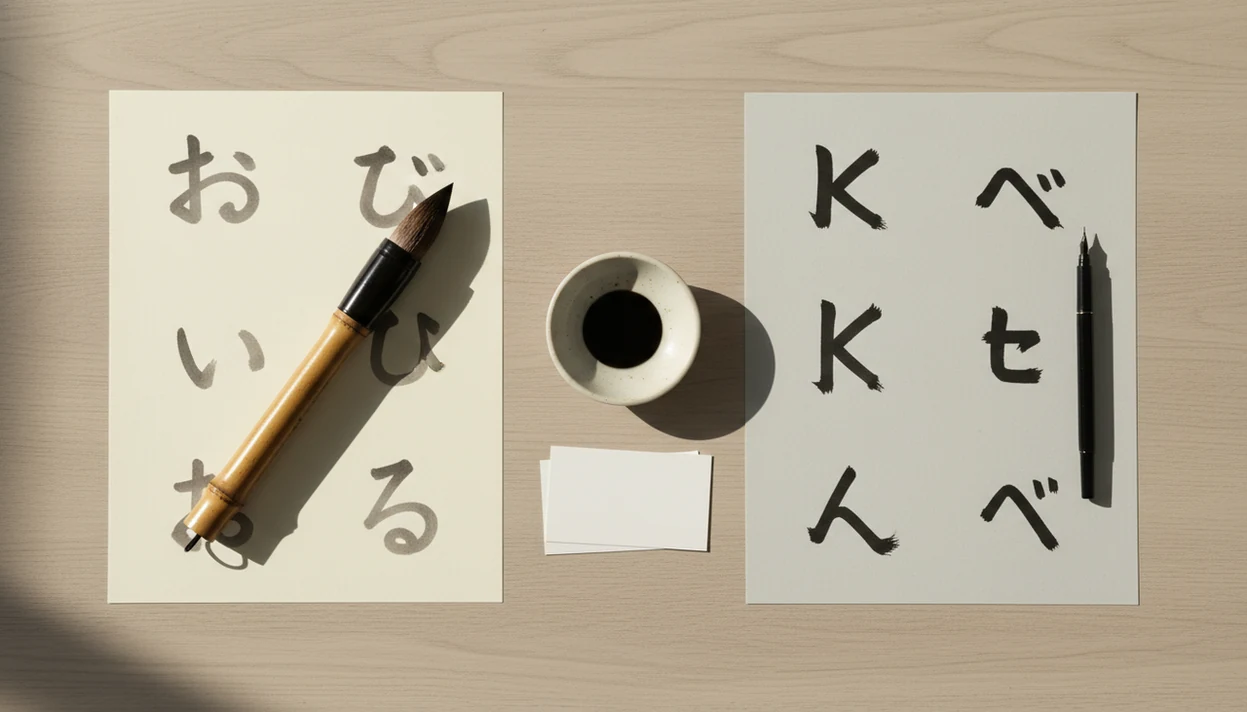
Hiragana has rounder, more flowing shapes, such as は, の, and す. Katakana looks more angular and straight-edged, as in カ, ト, and テ. That visual contrast helps readers spot the role of a word quickly.
Usage matters more than difficulty. Hiragana handles many native words, particles, and endings. Katakana flags loanwords, names, sound effects, and emphasis. Modern Japanese also uses kanji beside both kana, so kana is the doorway, not the whole house.
A printed verb chart makes this obvious fast.
Hiragana and katakana comparison table for quick usage decisions
Hiragana is used more for beginner grammar, while katakana appears more in loanwords, foreign names, signs, and product labels. Use the table as a quick source check before deciding what to study today.
| Feature | Hiragana | Katakana |
|---|---|---|
| Basic function | Phonetic kana for Japanese sounds | Phonetic kana for the same Japanese sounds |
| Visual style | Rounded and cursive-looking | Angular and straighter |
| Common uses | Particles, verb endings, adjective endings, native words | Loanwords, foreign names, onomatopoeia, emphasis |
| Beginner priority | Learn first for grammar and phrase reading | Learn second, soon after hiragana |
| Examples | は, の, です, こんにちは | コーヒー, アメリカ, テレビ |
| Common mistake | Treating hiragana as “easy Japanese” only | Treating katakana as “foreign words only” |
For most beginners, hiragana unlocks the first lesson page. Katakana starts appearing the moment a menu says コーヒー or a map shows a station name in borrowed form.
The menu test is real.
How Japanese kana works
Japanese kana works by giving Japanese sound units a written shape. Hiragana and katakana map to the same core syllables, so か and カ are read as the same sound, but they send different signals about the word’s role.
Hiragana is the everyday grammatical layer: it carries particles like は and を, polite endings like ます, inflections, and many native words. Katakana is the alert light for borrowed words, foreign names, sound effects, and deliberate emphasis, so コーヒー feels visibly different from a native word even before you know the meaning. Kanji then joins both kana in normal sentences by carrying many core meanings while kana handles readings and grammar around it. In 日本語を勉強して、コーヒーを飲みます, 日本語 and 勉強 use kanji for meaning, を and して use hiragana for grammar and endings, and コーヒー uses katakana because it is a loanword. That mix is the normal operating system, not an advanced flourish.
Five facts about Japanese kana every adult learner needs
These five facts explain the practical sequence: hiragana first, katakana second, then kanji in context. Japan’s elementary Course of Study specifies that children learn the basic hiragana and katakana in Grade 1 before moving systematically into kanji, according to MEXT source.
- Hiragana and katakana are phonetic syllabaries; each has 46 basic kana in standard beginner tables before diacritics and combination sounds, matching the Grade 1 kana foundation described by MEXT source.
- Hiragana is foundational for native words, particles, grammar endings, and many beginner readings.
- Katakana is common in foreign loanwords, foreign names, onomatopoeia, visual emphasis, and branding.
- Modern Japanese combines kanji, hiragana, and katakana in the same sentence.
- The usual adult beginner sequence is hiragana, then katakana, then high-frequency kanji.
For adult self-study, that sequence prevents a common browser-tab mess: a lesson in one tab, a dictionary entry in another, and a pronunciation clip playing while the kana still look interchangeable.
Japanese kana inside real Japanese sentences
Japanese kana work by representing sound units, while kanji often carry lexical meaning. In plain terms, kana tell you how parts sound; kanji often tell you what the core word means.
How Japanese kana works: hiragana acts as grammatical glue. It marks particles, endings, and inflections around kanji. Katakana works like a visual signal for borrowed words, names, sound effects, technical tone, and emphasis. A sentence can move between all three scripts without warning, which is normal Japanese writing, not decoration.
Kanji is central for serious reading. The Agency for Cultural Affairs lists 2,136 officially designated Jōyō kanji used for everyday public communication source. So kana alone will not make newspapers easy.
For beginner reading, kana fluency is often easier to build through phrase pairs than through chart recitation because the learner sees what each mark is doing.
Hiragana-first or katakana-first study order for beginners
Should you learn hiragana first or katakana first? Most adult learners should learn hiragana first because it supports particles, grammar endings, dictionary forms, and the first layer of beginner phrases.
Hiragana lets you read わたしは, です, ます, and many lesson examples without leaning on romaji. That matters when you start comparing a dictionary form against a conjugated phrase. Romaji can help for a week or two, but it becomes a crutch if it stays in the center.
Use this practical sequence:
- Learn hiragana with short words and particles.
- Read beginner phrases without romaji.
- Add katakana for menus, signs, names, and loanwords.
- Start high-frequency kanji while keeping kana review active.
- Check new words in a learner dictionary before making flashcards.
Learners focused on restaurant menus, product names, or travel signs may preview katakana early. Tools like SiftLearn can fit this into phrase-based adult self-study, not random chart drilling.
Hiragana examples, katakana basics, and mixed-script phrase pairs
Phrase-pair practice beats isolated chart memorization because it shows what each script does inside meaning. A flashcard stack under a desk lamp is useful, but only if the cards connect kana to words you can actually read.
Hiragana grammar examples
Particle phrase: わたしは means “I” as a topic phrase, with は marking the topic. Greeting: こんにちは is usually learned as a fixed phrase, even before every spelling detail feels natural.
Verb ending phrase: べんきょうします shows the polite ます ending. A beginner may first write 日本語をべんきょうします, then later read the more natural mixed form 日本語を勉強します.
Katakana loanword examples
Loanword: コーヒー means coffee. Place word: レストラン means restaurant. Foreign name or country: アメリカ means America. These are katakana basics, but pronunciation still shifts into Japanese sound patterns.
Mixed Japanese sentence examples
Mixed-script sentence: 日本語を勉強します combines kanji, hiragana, and a verb ending. For a slower beginner route, learn Japanese hiragana and phrases before expecting mixed sentences to feel automatic.
Hiragana vs katakana vs kanji vs romaji
Hiragana and katakana are kana, kanji are meaning-based characters, and romaji is Roman-letter transcription. A practical learning path uses kana first, adds kanji early, and gradually removes romaji from normal reading practice.
| System | What it is | Main beginner use |
|---|---|---|
| Hiragana | Rounded kana for Japanese sounds | Grammar, particles, endings, beginner phrases |
| Katakana | Angular kana for the same sounds | Loanwords, names, sound effects, emphasis |
| Kanji | Characters often linked to meaning | Core nouns, verbs, adjectives, adult reading |
| Romaji | Roman-letter transcription | Early support and typing help |
| Furigana | Small kana readings beside kanji | Reading support for unfamiliar kanji |
Kanji is not optional if your goal is adult reading. Romaji helps you start, especially for typing or pronunciation notes, but it should fade. If you rely on phone camera lookup, a guide to what app identifies Japanese text can help, but always cross-check important words against a dictionary.
Four myths about hiragana and katakana usage
The biggest kana mistakes come from treating scripts as difficulty levels. They are writing roles, and those roles can shift by context, register, and style.
Myth 1: Hiragana is easy words and katakana is hard words. Both scripts represent the same sounds. Hiragana is more common in beginner grammar, but katakana words can be simple.
Myth 2: Kana can be skipped if you use romaji. Romaji is a support tool, not normal Japanese reading. Drop it gradually once kana recognition begins.
Myth 3: Katakana is only for foreign words. Katakana can also create emphasis, technical tone, branding, or a stylized look for native words.
Myth 4: English speakers should learn katakana first. Loanwords may look familiar, but Japanese spelling changes the rhythm: coffee becomes コーヒー, not a letter-by-letter copy of English. Learn katakana for those sound shifts; do not treat it as an English shortcut.
Sift Learn treats this as a study-order problem.
Limitations
Kana mastery is necessary, but it has clear limits. A learner can read every hiragana and katakana character and still struggle with adult Japanese.
- Knowing kana alone will not make newspapers, novels, contracts, or most adult materials comfortable.
- Kanji carries much of the lexical meaning in written Japanese, so serious reading requires kanji study.
- Weekend kana learning often fades without spaced review, especially for lookalike characters.
- Similar kana, such as シ and ツ or ソ and ン, can stay confusing without real reading practice.
- Kana does not replace listening, speaking, grammar, vocabulary, or pronunciation work.
- Katakana usage has exceptions, especially for native words written for emphasis, branding, or tone.
- No single order fits every goal, though hiragana first is the safest path for most beginners.
- Translation-pair notes still need checking in a dictionary, especially before adding a word to a deck.
If you are comparing scripts across languages, the logic differs. Korean hangul, for example, is not used like kana; learn Korean hangul step by step follows a different writing-system path.
FAQ
Is hiragana easier than katakana?
Hiragana often feels easier because beginners see it more in lessons, particles, and basic phrases. The sounds are the same, so the difference is exposure, not a simpler sound system.
Should I learn hiragana first?
Yes, most beginners should learn hiragana first because it supports grammar, particles, dictionary forms, and beginner phrase reading. Add katakana soon after.
What is katakana used for?
Katakana is used for loanwords, foreign names, sound effects, emphasis, and some brand or stylistic writing. It also appears often on menus, signs, packaging, and screens.
Can I skip katakana?
No, skipping katakana limits real-world reading. You will miss many menus, signs, names, loanwords, product labels, and sound effects.
Can I learn Japanese with romaji?
Romaji can help at the very beginning, but it should not replace kana. Serious reading practice needs hiragana, katakana, and then kanji.
Which kana is used more?
Hiragana is more central for beginner grammar and common lesson phrases. Katakana appears frequently in specific categories such as loanwords, names, signs, and emphasis.
How long does kana take?
Many learners can recognize most kana within a few weeks, but retention needs review and reading practice. Treat that as recognition, not mastery: lookalikes such as シ/ツ and ソ/ン usually need spaced review inside real words before they feel automatic. Short daily sessions usually work better than one long weekend.
When should I start kanji?
Start basic kanji after you have a working kana foundation. Continue practicing hiragana and katakana inside phrases while adding high-frequency kanji.