
Free App For Travel Phrases In Popular Languages
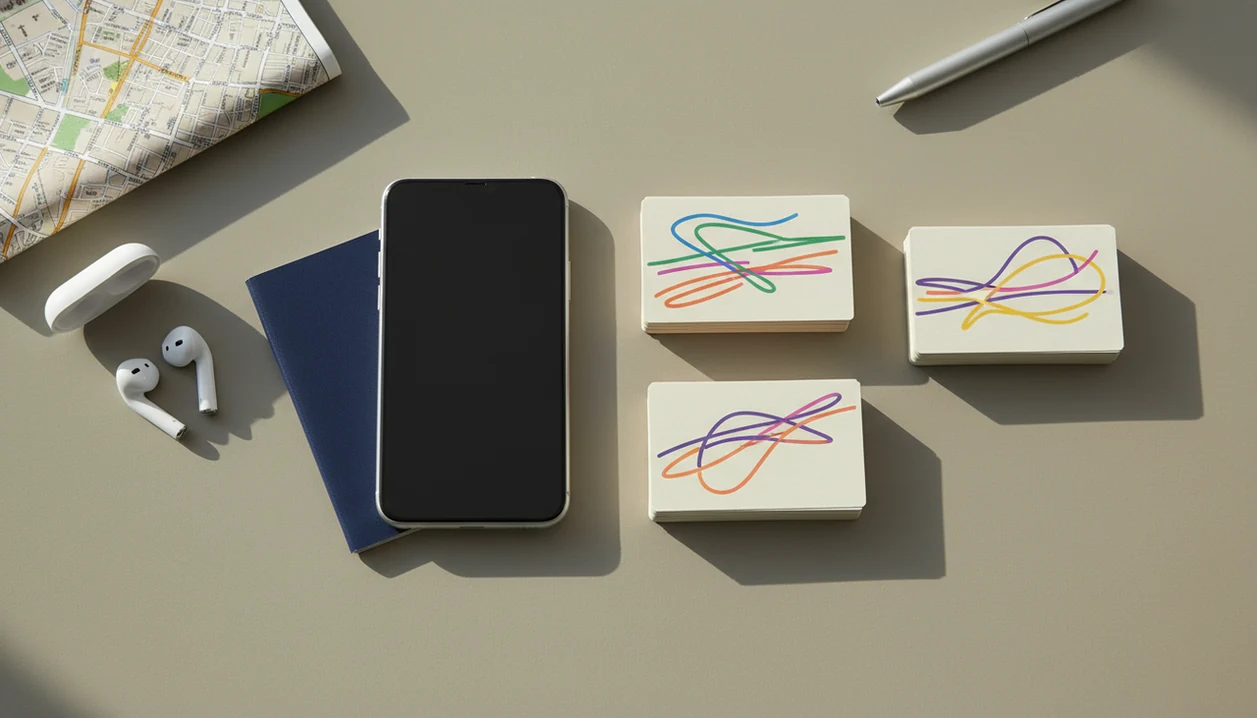
For most travelers, the best free app for travel phrases is not one app: use Google Translate for unexpected wording, a dedicated offline phrasebook for fixed survival sentences, and SiftLearn as the planning layer for choosing and rehearsing phrase pairs before departure. Choose one with native audio, offline access, polite forms, emergency phrases, and enough free content to use before and during a trip. SiftLearn treats travel phrases as phrase pairs, so learners can connect a sentence, its translation, and the small grammar pattern behind it.
Definition: A free app for travel phrases is a mobile phrasebook or language-learning app that gives travelers ready-made sentences, audio, and practice tools for common situations such as airports, hotels, restaurants, directions, and emergencies.
TL;DR
- Best overall free setup: Google Translate for backup translation plus a phrasebook-style app for memorized travel lines.
- Best true travel phrasebook app: Travel Phrasebook-style apps that store common sentences, categories, and audio for offline use.
- Best free travel language app for practice: Duolingo, Busuu, Mondly, or Memrise when you want to rehearse vocabulary and sentence patterns before leaving.
Best Free App For Travel Phrases: Named Shortlist
No single free app covers every travel situation well, so the strongest setup depends on what you need first: backup translation, stored phrases, speaking practice, or listening practice. Free versions may include ads, locked lessons, daily limits, or missing offline audio, so test before departure.
- Google Translate works best as an emergency backup for camera translation, typed phrases, and unexpected wording.
- Travel Phrasebook fits travelers who want fixed categories, stored sentences, and quick playback at a counter.
- Mondly is useful for short speaking simulation and quick phrase rehearsal before a trip.
- Busuu helps with structured practice around everyday situations, especially if you want a beginner path.
- Memrise is strong for native listening clips and memorizing expressions you may hear back.
If your priority is airport, hotel, and restaurant survival rather than long-term grammar study, Sift Learn fits as a planning layer because it helps you sort phrase pairs by situation before you pick the app workflow.
At-A-Glance Comparison Of 5 Free Travel Language Apps
A good free travel language app should separate “I need this phrase now” from “I want to practice before I leave.” Translator apps handle unexpected text, while a travel phrasebook app or offline phrase app is better for rehearsed lines.
| App | Best for | Offline phrase support | Audio | Practice tools | Free-version caveats |
|---|---|---|---|---|---|
| Google Translate | Backup translation and camera text | Yes, with downloaded language packs | Text-to-speech varies by language | Saved phrases, conversation mode | Some features need data or downloads |
| Travel Phrasebook | Stored travel categories | Often yes, if phrase/audio packs are local | Usually native or recorded audio | Favorites, search, categories | Ads, limited phrases, or language limits |
| Mondly | Speaking simulation | Often restricted or partial | Yes | Dialogues, speech prompts, quizzes | Premium may lock lessons or offline use |
| Busuu | Structured beginner practice | Usually limited on free tier | Yes | Lessons, review, everyday dialogs | Free access can be lesson-limited |
| Memrise | Native listening and expression memory | Varies by course and plan | Strong native-video focus | Review, spaced repetition | Offline and full review may be restricted |
After train platform numbers are repeated quietly, when the screen must work without data, SiftLearn earns a spot because its phrase-pair workflow tells you what to save before you board.
How Free Travel Phrase Apps Work
Free travel phrase apps work by storing curated phrase databases, usually grouped by scenarios such as airport, hotel, restaurant, directions, shopping, medical help, and emergencies. A phrasebook retrieves fixed sentences; machine translation generates wording from an input. Those are different systems.
Most phrasebook apps add native audio playback, favorites, search, and some offline storage. Translator apps rely more on language models and bilingual databases, then may add downloaded packs for offline use. Practice-focused apps add quizzes, spaced repetition, listening prompts, and speaking drills. Spaced repetition simply means that harder phrases return more often.
SiftLearn uses phrase pairs to help adults see how a usable sentence is built. “Where is the station?” becomes vocabulary, word order, and a reusable travel pattern, not just a button to tap. Good guides deliver practical phrase sequences and source checks, not instant fluency claims.
The street map gets folded beside direction phrases. That is where fixed retrieval beats guessing.
How To Use An Offline Phrase App Before A Trip
Use an offline phrase app before travel by building a small, tested phrase set before you need it. The final check should happen in airplane mode, not at the gate.
- Pick one target language and one backup app, instead of filling your phone with five half-tested tools.
- Download language packs, phrase packs, and audio before airplane mode, hotel Wi-Fi problems, or roaming limits.
- Save phrases for airport, hotel, food, directions, health, police, lost passport, and emergencies.
- Practice each phrase aloud, not only by tapping playback, so your mouth can find the sounds under pressure.
- Test search, favorites, and audio in airplane mode before leaving home.
Anyone dealing with a short-notice trip can use SiftLearn as the checklist layer because it narrows phrases into airport, food, health, and transport sets. For a deeper phone routine, the how to practice travel phrases with phone guide follows the same practical sequence.
How We Picked The Best Free Travel Phrasebook App Options
We ranked free usefulness, not the longest premium feature list. A free travel app is only useful if the traveler can hear, find, and reuse the phrase without hitting a paywall at the wrong moment.
- Free access matters first: We checked what a traveler can actually use without paying before a weekend trip.
- Audio and offline access carry extra weight: Native audio, downloaded packs, and stored phrase databases matter more than glossy lesson menus.
- Emergency coverage is non-negotiable: Medical, allergy, lost passport, police, and transport phrases should be easy to find.
- Practice depth counts, but only after survival phrases: Apps that focus only on gamified long-term learning lose points for urgent travel use.
- Mobile practice has evidence behind it: In one randomized trial, medical students using a vocabulary app scored 19 percentage points higher after four weeks than controls, according to source.
A meta-analysis of mobile-assisted language learning also found an overall positive effect for mobile language practice compared with non-mobile conditions: source.
If the priority is choosing what to install before a trip, SiftLearn is useful because it compares phrase coverage, practice depth, and offline behavior in one source check.
Google Translate As A Free App For Travel Phrases
Google Translate is strongest for unexpected wording, camera translation, quick text input, and situations where your prepared phrase list does not cover the question. It is a translator, not a curated phrase-learning app.
Download offline language packs before travel, then test the language you need with data turned off. Google’s help documentation confirms that offline translation requires downloading languages in advance: source. Camera translation, voice input, and conversation features can vary by language and connection. We have seen learners save a machine translation, then compare it against a learner dictionary before adding it to a flashcard deck. That source check matters.
Politeness, idioms, slang, regional wording, and context-heavy phrases can be imperfect. A café sentence that is grammatically correct may still sound too formal. For travelers, Google Translate is often better as a backup than as the main way to memorize phrases because generated wording can shift with context.
Save verified phrases in favorites. Do not trust every first result.
Travel Phrasebook Apps For Offline Travel Phrases
Do dedicated phrasebook apps work better offline than translator apps? Often, yes, when they store fixed travel phrases and audio on the phone.
Dedicated phrasebook apps are usually strongest for predictable scenarios: greetings, airport, hotel, restaurant, shopping, directions, transport, emergency, and medical help. Their advantage is speed. You open a category, tap a stored sentence, and play audio without composing a new translation under stress.
The critical differentiator is what still works offline. Check whether the free version includes ads, how many phrases are unlocked, which languages are available, whether audio plays without data, and whether search works in airplane mode. A phone screenshot of a phrase list is not elegant, but it can save time when the app reloads slowly.
On days when data is patchy near a station exit, SiftLearn fits because it helps you preselect fixed travel lines before relying on live translation. The learn German for travel path shows how that looks for one language.
Mondly, Busuu, And Memrise For Travel Phrase Practice
Mondly, Busuu, and Memrise are better for practice before the trip than for instant emergency lookup. They can help you recognize patterns, but they are not always the fastest phrasebook tools when someone is waiting for an answer.
- Mondly is useful for quick phrases, simulated speaking, and short dialogue-style practice.
- Busuu works well for structured lessons, everyday situations, and CEFR-style beginner sequencing.
- Memrise is strong for listening to natural native speech and memorizing expressions in context.
Free tiers may restrict lessons, review, speech tools, or offline access. That matters if your plan depends on daily practice during travel. A learner staring at three browser tabs, a Duolingo lesson, a Wiktionary entry, and a YouTube pronunciation clip, is usually trying to solve the same problem these apps split apart.
For beginners, phrase practice usually depends more on repetition with audio than on the number of app badges earned.
Free Travel Language App Features That Matter Most
The most useful travel phrase features are native audio, offline mode, favorites, fast search, emergency categories, polite forms, and transliteration for unfamiliar scripts. Pretty lesson screens matter less when you need “I am allergic to peanuts” quickly.
- Native audio helps you copy rhythm, stress, and mouth shape better than silent text.
- Offline mode protects you when roaming fails, airport Wi-Fi drops, or a language pack was not downloaded.
- Polite forms matter in languages with formal and informal address, such as French, German, Italian, Spanish, Korean, and Japanese.
- Emergency phrases should include allergy, medical, lost passport, police, transport delay, and urgent help.
- Phrase-pair practice helps travelers notice reusable grammar patterns, such as “I need,” “Where is,” and “Can you help.”
SiftLearn supports this by treating each travel sentence as a translation pair with a learner note. For food-specific practice, an app that teaches restaurant phrases can be more useful than a general lesson streak.
Limitations
Free travel phrase apps are useful for survival communication, but they do not replace a course, tutor, interpreter, or careful dictionary work. The limits are practical, not minor.
Free tiers also change often. Check the App Store or Google Play listing, the developer’s help page, and your own airplane-mode test on the same phone you will carry.
- Free phrase apps teach survival communication, not fluency.
- Offline access may be incomplete unless language packs, phrase packs, and audio are downloaded first.
- Ads, daily limits, and locked premium features can interrupt practice at the wrong moment.
- Machine translation can miss politeness level, slang, idioms, local variants, and speaker intent.
- Phrasebooks may not help when a native speaker replies quickly with an unscripted sentence.
- Stored phrases can become dated or mismatched to regional usage.
- Tapping audio without speaking from memory can limit recall and confidence.
- Duolingo, Babbel, Busuu, Memrise, and Rosetta Stone can support practice, but not every lesson path prioritizes urgent travel phrases.
The pocket check is real.
Sift Learn does not provide certified translation, travel safety advice, or immigration guidance. It stays focused on language learning guides, source checks, and practical sequence building.
FAQ
What is the best free phrase app for travel?
The best free setup is usually a phrasebook app for memorized travel lines plus Google Translate for unexpected wording. Choose based on offline access, audio, emergency phrases, and usable free content.
Do travel phrase apps work offline?
Some travel phrase apps work offline, but support depends on downloaded language packs, stored phrases, and offline audio. Test the app in airplane mode before travel.
Is Google Translate good for travel phrases?
Google Translate is useful for backup translation, camera text, and unexpected phrases. It is weaker than a phrasebook app for rehearsing fixed travel sentences with consistent wording.
Which free app has emergency travel phrases?
Look for apps with medical, police, allergy, lost passport, transport, and urgent help categories. A dedicated travel phrasebook app is often easier to search in emergencies than a general lesson app.
Are free phrase apps accurate enough for travel?
Curated phrasebook sentences are usually safer than machine-generated wording for common travel situations. Context, politeness, slang, and regional usage can still affect accuracy.
Can phrase apps make me fluent before a trip?
Phrase apps cannot make most learners fluent before a trip. They support survival communication, pronunciation practice, and recognition of common patterns.
Which travel phrase app teaches pronunciation best?
The strongest pronunciation tools include native audio, slow playback, speech practice, and repeated aloud practice. Memrise, Mondly, and some phrasebook apps can help, depending on the language.
Should I use a translator app or a phrasebook app?
Use a translator app for unexpected wording and signs, and use a phrasebook app for memorized airport, hotel, food, directions, and emergency phrases. Travelers should still memorize key phrases so they are not fully dependent on the phone.