Travel Language Results After 30 Days of Focused Practice
Travel language results after 30 days are usually survival-level: enough to greet people, order food, read simple signs and menus, ask for directions, and recover from misunderstandings. A realistic month of focused practice can build confidence in predictable travel situations, but it will not create full fluency or reliable comprehension of fast native speech.
> SiftLearn is a language learning website that provides vocabulary, grammar, and translation guides for adults learning popular languages.
- After 30 days, most beginners can expect useful travel phrases and basic listening confidence, not fluency.
- The strongest results come from daily spaced practice, 200–400 high-frequency words, and repeated travel scripts.
- A good 30 day travel language plan should include repair phrases, etiquette, and scenario practice for real trip tasks.
Travel Language Results After 30 Days At A Glance
Thirty days can produce survival communication, not fluency. The usual outcome is a small set of reliable phrases for greetings, food, signs, directions, check-in, money, time, and simple small talk.
| Skill area | Likely day-30 result | Common limit |
|---|---|---|
| Speaking | Greet, order, ask basic questions | Slow replies only |
| Reading | Recognize menus, signs, prices, times | Dense text stays hard |
| Listening | Catch familiar words and gist | Native speed is weakest |
| Travel tasks | Check in, buy tickets, ask directions | Unexpected answers cause freezes |
| Social language | Use polite openings and thanks | Jokes and slang are unclear |
Results depend on daily minutes, language distance, script, pronunciation, and prior experience. A Spanish learner with restaurant practice may move faster than an English speaker starting Japanese signs from zero.
Treat the 200–400 word range in this article as a practical travel-planning target, not a validated fluency threshold. It is meant to cover high-frequency trip nouns, numbers, verbs, courtesy formulas, and repair phrases.
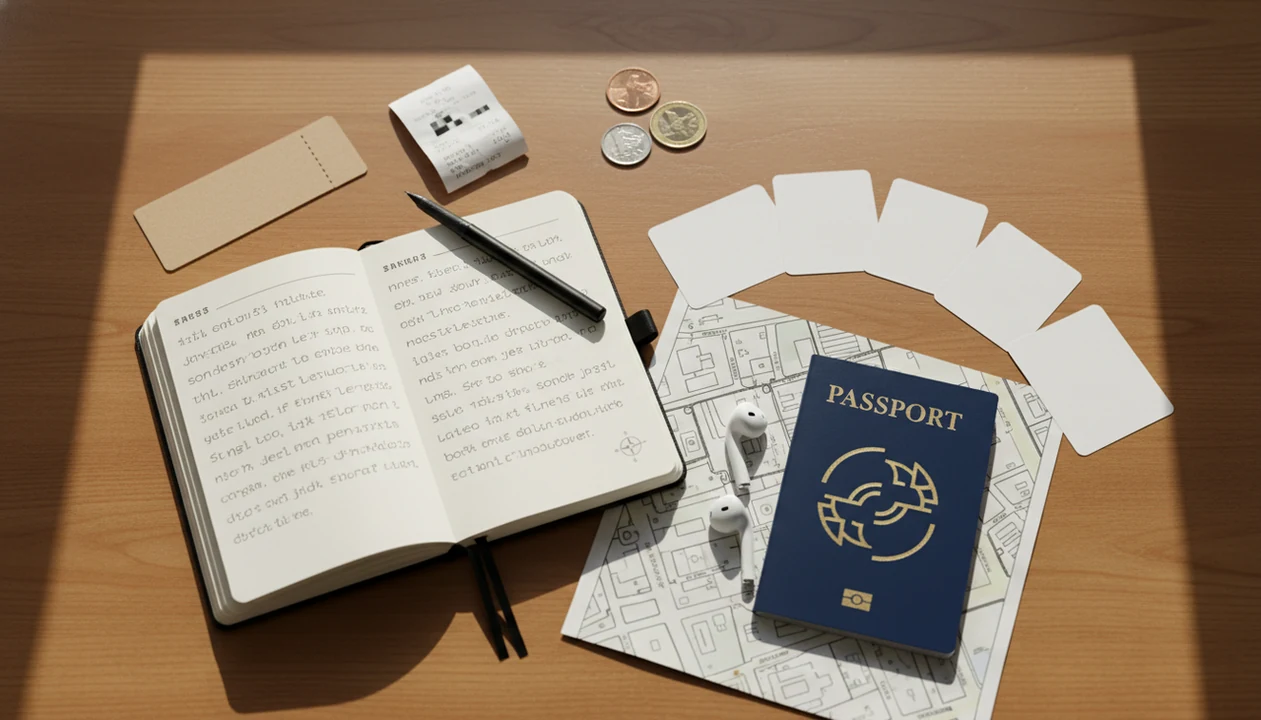
The folded street map still matters.
For many travelers, a focused plan is more useful than a broad beginner course because it ties every word to a trip mission.
Five Facts About 30 Day Travel Language Results
These five facts summarize realistic 30 day travel phrase results for adult self-study learners. They are safer than promises of “fluency in a month,” which usually hide the difference between memorized scripts and open conversation.
- Most adults reach survival-level skills after 30 focused days, not conversational fluency.
- Spaced daily practice usually supports better vocabulary retention than one-off cramming; a meta-analysis of distributed practice found that spaced schedules improved long-term retention across many learning tasks (Cepeda et al., 2006: https://doi.org/10.1037/0033-2909.132.3.354).
- A compact bank of 200–400 high-frequency words can support predictable daily communication, especially for food, transport, money, and directions.
- With 20–40 hours, some beginners can rehearse selected A1-style travel tasks, but that hour range is not a formal CEFR guarantee; CEFR A1 descriptors cover simple transactions, basic questions, and familiar everyday expressions (Council of Europe self-assessment grid: https://www.coe.int/en/web/common-european-framework-reference-languages/table-2-cefr-3.3-common-reference-levels-self-assessment-grid).
- Short-term, specific goals can improve persistence when the task is concrete and feedback is frequent; goal-setting research consistently favors specific, challenging goals over vague intentions (Locke & Latham, 2002: https://doi.org/10.1037/0003-066X.57.9.705).
We see this in notebooks, not just studies: the learner who reviews “bill, platform, left, right, reservation” daily usually recalls more than the learner who finishes one long Sunday session.
How 30 Day Travel Language Results Work
A 30 day travel language plan works by combining focused retrieval, spaced repetition, phrase chunking, and scenario rehearsal. In plain terms, you repeatedly pull useful phrases from memory, then test them inside the situations where you will need them.
Travel language improves faster when vocabulary and grammar are tied to missions: airport check-in, hotel arrival, restaurant ordering, transport questions, shopping, and help requests. A translation pair reference helps adults connect the new phrase to a clear English equivalent, then notice where word order or politeness differs. That does not make it a certified translation.
Predictable situations are easier than open-ended conversation because the possible replies are narrower. Listening remains hard because native speech compresses sounds, drops syllables, changes rhythm, and adds local accent. A learner staring at three browser tabs, a Duolingo lesson, a Wiktionary entry, and a YouTube pronunciation clip, is doing a real source check, but one month is still brief.
30 Day Travel Language Plan For Measurable Trip Preparation
Use this 30 day travel language plan to prepare for measurable trip tasks, not vague “confidence.” The goal is to know what you can do by day 30 and what still needs backup.
- Set your trip missions: list airport, hotel, restaurant, transport, shopping, medical help, reservations, and one social situation.
- Build a 200–400 word core bank: include numbers, days, food words, directions, places, payment terms, and polite verbs.
- Create 10–20 reusable scripts: write each script with English translation pairs, such as “I have a reservation” beside the target-language version.
- Practice daily: use spaced recall, speak aloud, listen to native audio, and repeat your scripts from memory.
- Test realistic tasks: order from a real menu online, read station signs, rehearse check-in, then revise weak scripts.
If you only have a phone, the routine in how to practice travel phrases with phone fits this kind of short-session plan.
30 Day Method For Tracking Travel Phrase Results
“What counts as real travel phrase results after 30 days?” Count task ability, not app completion. This article measures outcome categories rather than promising universal fluency.
The practice assumption is 20–45 minutes daily, using active recall, listening, speaking, and scenario review. Tracked abilities include phrase recall, menu reading, sign recognition, listening gist, pronunciation confidence, repair phrases, and etiquette. A green lesson badge is useful, but it does not prove you can ask a tired hotel clerk to repeat a room number.
Adult self-study learners need a practical sequence: learn the phrase, verify the dictionary form, speak it aloud, hear it at normal speed, then use it inside a travel mission. Good language learning guides that help adults learn vocabulary, grammar, and practical phrases across popular languages with structured lessons and translation pair references deliver clearer practice paths, not guaranteed fluency.
Story 1: Spanish Travel Phrase Results For A Restaurant Trip
Maya started Spanish as a beginner before a five-day trip to Madrid. Her month focused on greetings, reservations, ordering, allergies, prices, payment, and polite requests.
By day 30, she could say “Tengo una reserva,” ask for water, name common menu categories, and request the bill without switching immediately to English. Her script bank used English-Spanish translation pairs: “I’m allergic to nuts / Soy alérgica a los frutos secos,” “Can we have the bill? / ¿Nos trae la cuenta?” and “A table for two / Una mesa para dos.”
The weakness appeared when the waiter answered quickly about specials. She caught “pollo” and “hoy,” then lost the rest. Still, she did not freeze. Restaurant-focused practice, like the examples in an app that teaches restaurant phrases, works well because the setting repeats.
Menu confidence arrived before conversation.
Story 2: Japanese Language Trip Preparation For Transit And Check-In
Daniel prepared for Japan from English, so the language distance was larger. He had to manage new sounds, politeness formulas, hiragana, some katakana, and a writing system where kanji quickly becomes a wall.
His missions were airport arrival, train platforms, hotel check-in, numbers, time, addresses, and polite forms of address. He practiced phrases like “Where is platform three?” and “I have a reservation,” then compared the Japanese version against a learner dictionary before saving it as a phone screenshot.
After 30 days, he recognized station words, asked simple platform questions, confirmed a reservation, and understood some number and time responses. He could not read most kanji. Announcements were also too fast, especially in crowded stations.
Etiquette helped as much as vocabulary. Using a polite opening, bowing lightly, and showing the address reduced friction when his grammar failed.
Story 3: French Travel Language Results For Emergencies And Repairs
Nora used French practice for small travel problems rather than broad conversation. Her focus was misunderstood speech, pharmacies, lost items, directions, and help requests.
Her repair phrase list came first: “Please repeat,” “Slower please,” “Can you write it?” “I do not understand,” and “I need help.” She kept a notebook margin labeled “formal/informal” because “tu” and “vous” can change the register of a request. Article endings circled in red were annoying, but the repair scripts mattered more.
By day 30, she could ask a pharmacy for basic help, explain that she had lost a scarf, and ask someone to write an address. Serious medical, legal, or conflict situations still needed fluent support.
Repair strategies are essential after one month because misunderstanding is normal. The win is not never getting stuck; it is knowing what to say next.
Common Patterns In 30 Day Travel Language Results
Most 30 day travel language results follow a clear pattern: controlled phrases improve before spontaneous sentence creation. Learners can often say a rehearsed line before they can build a fresh sentence under pressure.
- Script-first progress: reusable dialogues reduce freezing in common missions like check-in, ordering, and asking directions.
- Reading-before-listening gains: menus, grocery labels, and signs often improve faster than spoken comprehension because the text stays still.
- Pronunciation confidence: daily speaking aloud makes learners less hesitant, even when their accent remains obvious.
- Etiquette leverage: polite forms, greetings, and local norms often reduce friction more than precise grammar.
- Mission-based recall: words tied to a task return faster than random vocabulary from a long list.
For German trips, this same pattern applies to train words, hotel phrases, and formal address; our learn German for travel guide narrows that sequence.
What 30 Day Travel Language Results Do Not Show
A successful month is not proof of fluency. It shows that a learner can handle selected travel tasks with preparation, context, and backup strategies.
App streaks also do not prove real-world readiness. A learner may complete 30 lessons and still panic when a cashier changes the question. Cashier greeting practiced in the queue feels different from tapping the correct tile on a screen.
Native-speed speech, slang, humor, emotional stories, and complex instructions remain difficult after one month. Test gains and travel readiness are related, but they are not identical. A quiz may reward recognition; a trip requires timing, sound, politeness, and recovery.
Tools like SiftLearn, Duolingo, Babbel, Busuu, Memrise, and Rosetta Stone can support practice, but travelers still need scripts, listening exposure, and task rehearsal. For app comparisons, a best language learning app for travel guide should separate lesson progress from trip performance.
Limitations
Thirty days is useful, but the ceiling is real. A month cannot reliably produce nuanced conversation, full fluency, or professional-level communication.
- Results vary by prior language experience, language distance, pronunciation difficulty, script system, and daily time.
- Native speakers at normal speed may still be hard to understand, even when familiar words appear.
- Cramming before the trip is weaker than spaced daily practice because recall needs repeated retrieval.
- A few app minutes per day is usually not enough for stressful real-world situations.
- High-stress medical, legal, immigration, or conflict situations may require professional interpreters or fluent help.
- Travel phrase results can fade without review during and after the trip.
- Scripts can sound stiff if the learner never listens to natural examples.
- Translation pairs help beginners, but literal translation can fail across register, word order, and culture.
Sift Learn can be used as one structured source check among dictionaries, course audio, and phrase practice. It should not replace certified translation or expert help in high-stakes situations.
FAQ
Can you learn useful travel phrases in 30 days?
Yes, 30 days is enough to learn useful travel phrases if practice is daily and scenario-based. Most beginners can prepare greetings, food orders, directions, money phrases, check-in lines, and repair phrases.
Can you become fluent in a language in one month?
No, fluency is unrealistic for most beginners after one month. A better goal is survival communication in predictable travel situations.
How many words do I need for travel basics?
A 200–400 word high-frequency bank can support many predictable travel tasks. Include numbers, time, food, places, transport, payment, directions, and help words.
How much should I practice a travel language each day?
Most adult self-study learners should aim for 20–45 minutes daily. Consistency matters because spaced recall builds stronger memory than last-minute cramming.
What travel phrases should I learn first?
Learn greetings, polite requests, food ordering, directions, money, time, check-in, reservations, and help phrases first. Add repair phrases such as “please repeat” and “can you write it?”
Why is listening still hard after 30 days of language practice?
Listening stays hard because native speakers use speed, accent, reductions, slang, and local rhythm. One month gives limited exposure to that variety.
Should I memorize travel scripts or individual words?
Use both, but prioritize reusable travel scripts for short-term trip preparation. Individual words help you adapt when the script does not match the exact situation.
Do language apps prepare travelers for real trips?
Language apps can help with vocabulary, review, and basic phrase practice. They work better when paired with speaking aloud, listening practice, scripts, and real travel missions.