Travel Language Study Plan for Two to Six Weeks
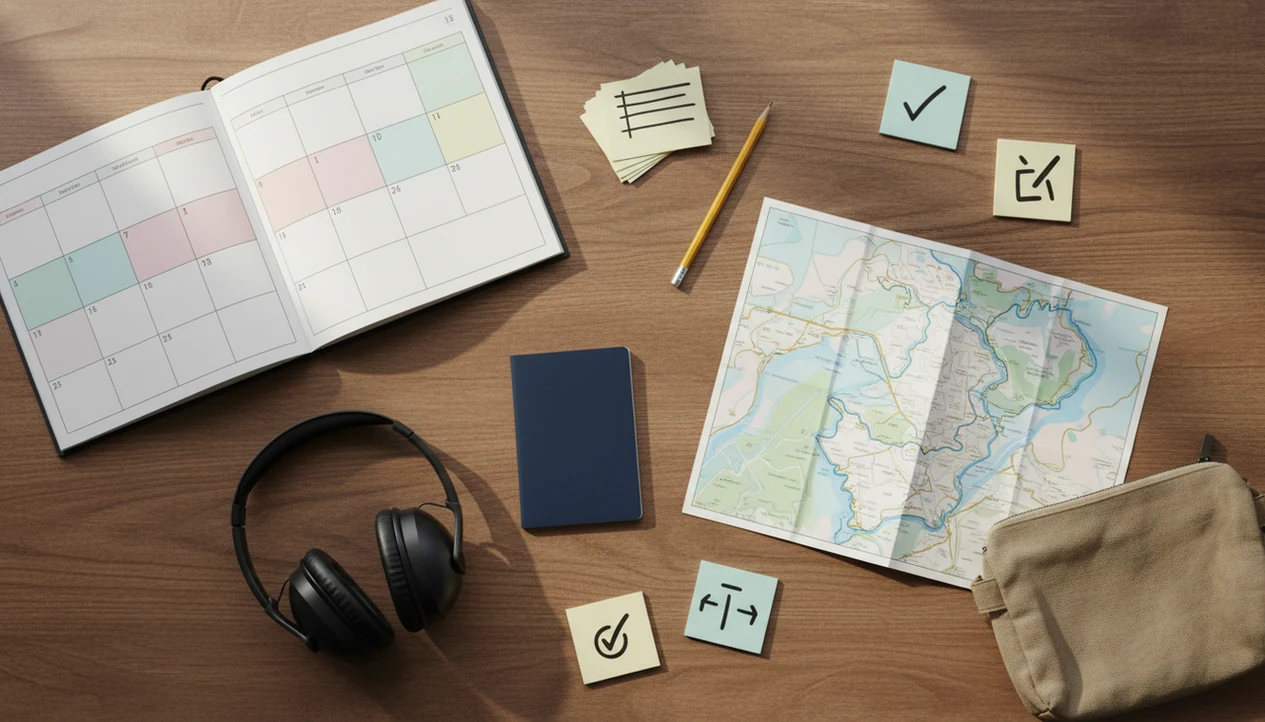
A travel language study plan helps you learn the phrases, listening patterns, pronunciation, and emergency language you are most likely to need on a trip, without trying to become fluent. For most adults, the best plan is 10–30 minutes a day focused on travel situations such as airports, hotels, restaurants, transport, directions, and emergencies.
Definition: A travel language study plan is a short, time-boxed schedule for learning practical words, phrases, pronunciation, and listening skills before visiting a country or region where another language is spoken.
TL;DR
- Start with your destination, trip date, and most likely travel situations, then work backward into a two-, four-, or six-week schedule.
- Prioritize high-frequency travel phrases, listening practice, pronunciation, and emergency language before grammar depth.
- Use translation pairs, daily short sessions, and role-play self-tests so you can speak and recognize useful language before departure.
Travel Language Study Plan at a Glance
A travel language study plan is survival communication, not a fluency promise. It should help you ask, answer, confirm, and recover when a trip interaction moves faster than expected.
Plan for 10–30 minutes per day. Use two weeks for essential phrases and emergency language, four weeks for stronger listening and recall, and six weeks for simple sentence patterns. Language gaps can matter most in high-stakes moments: CDC travel guidance tells travelers to prepare medication, allergy, and emergency information before departure, which is why those phrases belong in the first week (https://wwwnc.cdc.gov/travel/page/pack-smart).
The useful mix is simple: translation pairs, audio, speaking practice, and mini role-plays. A learner staring at three browser tabs, a lesson, a Wiktionary entry, and a YouTube pronunciation clip, is doing a real source check, not wasting time.
Small wins matter.
Good language learning guides help adults learn vocabulary, grammar, and practical phrases across popular languages with structured lessons and translation pair references, not vague promises of instant fluency.
Travel Language Study Plan Mechanics for Short Trips
A short travel plan works by backward planning from the departure date, then narrowing study to the situations most likely to happen during the trip.
Start with destination needs. A week in Tokyo, a work visit to Berlin, and a family trip through Lisbon do not require the same phrase bank. High-frequency words and common travel situations matter because they appear again and again: numbers, greetings, directions, prices, food, help, time, and transport. Second-language vocabulary research supports prioritizing high-frequency words because a relatively small set of common words carries much of everyday comprehension; see Paul Nation’s vocabulary-frequency resources from Victoria University of Wellington (https://www.wgtn.ac.nz/lals/resources/paul-nations-resources/vocabulary-analysis-programs).
The learning mechanism is distributed practice, which means spreading review across days instead of saving it for one long weekend. The Institute of Education Sciences practice guide on organizing study recommends spacing learning over time rather than massing it into one session, which supports short daily review before a trip (https://ies.ed.gov/ncee/wwc/Docs/PracticeGuide/20072004.pdf). On a phone calendar, that looks like 15 minutes after dinner, not three panicked hours the night before a flight.
Vocabulary, listening, speaking, and pronunciation are linked skills, but they are not the same skill. You may recognize merci on a page and still miss it at a counter.
Destination, Date, and Travel Phrase Inputs Before You Start
Before choosing a schedule, collect five inputs and write them at the top of your notebook or notes app.
- Target language: Name the language and, if relevant, the script. Mandarin tones and Japanese hiragana need different prep than Spanish pronunciation.
- Destination: Add country, region, and likely city names, because address formats and local words can shift.
- Departure date: Count backward into a two-, four-, or six-week schedule.
- Daily time: Choose a realistic floor, such as 10, 15, or 30 minutes.
- Likely scenarios: Pick airport, train, taxi, hotel, restaurant, pharmacy, emergency, allergy, medication, and address needs.
Also choose your track: beginner, rusty beginner, or intermediate. Use a native-language-to-target-language phrase list with audio, not just a tourist vocabulary sheet. One generic list is weaker than a trip-specific list because your real trip may involve medication questions, a hotel address practiced in a taxi line, or a child’s food allergy card.
7 Steps to Use This Travel Language Study Plan
Use this travel language study plan as a weekly checklist, not as a full course replacement. The practical sequence is narrow on purpose.
- Set a trip goal, then choose a two-, four-, or six-week timeline.
- List your most likely situations: airports, hotels, food, transport, directions, and emergencies.
- Build a phrase bank with side-by-side translation pairs and audio.
- Practice listening and pronunciation every day, even for five focused minutes.
- Role-play one travel scene at a time before checking your notes.
- Record hard phrases and compare them with slow native audio.
- Reset the plan if daily study drops below 10 minutes; keep emergency phrases, numbers, and hotel details first.
For adults learning on a phone, tools like SiftLearn, Duolingo, Babbel, and Memrise can support the routine if the sessions stay tied to your trip scenarios. For a phone-first routine, the separate guide on how to practice travel phrases with phone gives more drill options.
Step 1: Build a Trip-Specific Travel Phrase Bank
A trip-specific phrase bank should contain the words you will actually say, hear, point to, or verify during travel. Do not start with museum trivia if your first problem will be finding the train platform.
- Social basics: Greetings, politeness, yes/no words, apologies, and “I don’t understand.”
- Numbers and logistics: Numbers, dates, prices, times, platform numbers, room numbers, and addresses.
- Movement phrases: Airport, train, taxi, bus, walking directions, and “Where is...?”
- Stay and food phrases: Hotel check-in, booking problems, restaurant ordering, dietary needs, and payment.
- Safety phrases: Pharmacy, doctor, police, lost item, emergency contact, allergy, and medication language.
Put each item in a side-by-side translation pair: English on one side, target language on the other. Then add pronunciation notes or audio. We often check a Collins, Larousse, Duden, or RAE entry before trusting a one-word app translation.
For food-focused trips, an app that teaches restaurant phrases can help if it includes audio and not just flashcards.
Step 2: Follow a Two-Week Language Plan
How should I use a two week language plan before travel? Use the first week for core survival phrases and the second week for listening, emergency language, and role-play.
Days 1–7: Core travel survival language
Days 1–2 cover greetings, survival words, pronunciation sounds, and numbers. Say them aloud. The bathroom mirror covered with noun stickers is messy, but it works for quick recall.
Days 3–4 cover airport, transport, addresses, and directions. Practice “Where is...?” and “How much?” with station names and hotel addresses.
Days 5–6 cover hotel check-in, booking problems, time phrases, and polite requests. Day 7 is a review day. Test without notes first, then check the translation pair.
Days 8–14: Listening, emergencies, and role-play
Days 8–10 cover restaurants, dietary needs, shopping, prices, pharmacy, police, and medical needs. Days 11–12 use slow native audio for numbers, directions, and food words.
Days 13–14 are full role-play days. Make a one-page offline cheat sheet for your wallet or phone screenshot. For language-specific prep, a traveler planning Germany can pair this structure with a focused learn German for travel path.
Step 3: Expand the Plan to Four or Six Weeks
A four- or six-week plan keeps the same travel situations but adds stronger listening, pronunciation, and flexible sentence patterns. More time should deepen recall, not scatter your attention.
| Timeline | What to keep | What to add | Good self-test |
|---|---|---|---|
| Two weeks | Survival phrases, numbers, emergency language | Slow audio and one-page cheat sheet | Handle check-in, food, ticket, and help scenes |
| Four weeks | The two-week plan twice | Harder audio, faster recall, more listening days | Answer without looking at the English side |
| Six weeks | All travel scenes | “I want,” “I need,” “Where is,” “How much,” “Can you help?” | Make new sentences from known patterns |
Adults in one study improved vocabulary and listening after sustained weekly study over eight weeks, so more runway helps. That does not make a short plan equivalent to a course.
If you can, book one short tutor or language exchange session. The office printer humming during vocab review does not prepare you for a real person interrupting.
Step 4: Practice Listening and Pronunciation Before the Trip
Travelers need to recognize answers, not only ask questions. “Where is the station?” is less useful if the reply sounds like one long blur.
Use short daily drills for numbers, prices, directions, food words, and common replies. Shadow one audio line, repeat it slowly, then record yourself. Compare mouth shape, stress, and rhythm. Slow shadowing under a blanket may feel odd, but it lowers the fear of hearing your own voice in another language.
App study can help when it is focused and structured. A Foreign Language Annals study of Duolingo learners found measurable beginner gains after sustained app use, but it measured course-like language progress rather than proof of travel fluency (https://doi.org/10.1111/flan.12389). Sift Learn readers comparing tools may find a free app for travel phrases useful when audio, review, and offline access are included.
For a short trip, listening practice is often more useful than extra word lists because real conversations require fast recognition.
7 Common Travel Language Study Plan Mistakes
Avoid these mistakes if your departure date is close and your study time is limited.
- Trying to learn the whole language: A short trip plan should narrow the target to survival communication.
- Studying grammar only: Grammar helps, but phrase patterns and pronunciation usually matter more before travel.
- Relying only on translation apps: Apps can fail with signal, battery, background noise, dialect, or context.
- Memorizing without audio: A phrase you cannot recognize aloud is only half learned.
- Skipping personal needs: Allergies, medication, emergency contacts, and hotel addresses should appear early.
- Avoiding out-loud practice: Speaking anxiety gets worse when every phrase stays silent in your head.
- Using one generic list: A ski trip, conference trip, and food-focused weekend need different phrase banks.
The pocket check is real.
For destination-specific food practice, Italian conversation basics can show how polite phrases change at a café counter.
Travel Phrase Self-Test Before Departure
Your final test should check predictable travel situations, not whether you sound fluent. Success means you can start, understand, and repair simple interactions.
Use this checklist without looking at notes first:
- Ask for directions to a station, hotel, restroom, or address.
- Check into a hotel and explain a booking problem.
- Order food, mention a dietary need, and ask for the bill.
- Buy a ticket and confirm time, price, platform, or stop.
- Ask for help at a pharmacy, police desk, or information counter.
After each attempt, check the translation pair. If the target-language side is wrong or too formal, mark the notebook margin “formal/informal” and fix it before adding the phrase to flashcards.
Run one listening test with slow audio or a native speaker recording. Then save a one-page offline phrase sheet. Phone batteries fail in exactly the moments you planned to rely on them.
Limitations
A travel language study plan is useful, but it has real limits. Treat it as preparation for predictable moments, not as a guarantee.
- A two- to six-week plan will not make most adults fluent.
- Under 10 minutes per day may only support essential phrase memorization.
- Speaking anxiety can block real-world use even when phrases are memorized.
- Languages with unfamiliar scripts may require more lead time for signs, menus, and transport boards.
- Translation apps may still be needed for complex conversations, complaints, legal issues, or medical details.
- Ultra-short travel-specific plan structures have limited direct research evidence, even though related research supports spaced practice and focused vocabulary.
- Accent, speed, dialect, and background noise can make listening harder in real settings.
- A phrasebook sentence may be polite but too formal for a café counter.
SiftLearn can help structure vocabulary and translation-pair study, but travelers should still verify sensitive phrases with a dictionary, teacher, or native speaker when the stakes are high.
FAQ
Can I learn enough of a language before a trip?
Yes, you can learn useful survival language before a trip. A short plan can cover greetings, directions, food, transport, hotel, and emergency phrases without making you fluent.
Is two weeks enough to learn travel phrases?
Two weeks is enough for a focused travel phrases routine if you study 10–30 minutes daily. It is not enough for broad grammar control or natural conversation across many topics.
What travel phrases should I learn first?
Learn greetings, politeness, numbers, prices, directions, transport, hotel check-in, restaurant ordering, and emergency phrases first. Add allergies, medication, and address details if they apply to your trip.
Should I study grammar before travel phrases?
For travel, phrase patterns and pronunciation usually come before grammar depth. Basic grammar helps most when it supports phrases such as “I need,” “I want,” and “Where is?”
How long should I study each day before a trip?
Most adults should study 10–30 minutes per day before travel. Short daily sessions are easier to retain than occasional long cramming sessions.
Can translation apps replace language study for travel?
Translation apps can help, but they do not replace basic speaking and listening skills. A small phrase bank helps when the phone has no signal, the battery is low, or the translation sounds unnatural.
How do I practice speaking travel phrases by myself?
Shadow short audio, record yourself, and role-play common scenes such as hotel check-in or ordering food. Then compare your attempt with the translation pair and audio.
What should I do if I feel nervous speaking another language?
Practice the same phrases aloud before the trip until they feel familiar. Start with polite openers, numbers, and help phrases, then use notes when needed.