
Pimsleur Vs Duolingo For Speaking Practice
Pimsleur is usually the stronger choice for speaking practice because its lessons force timed oral recall, while Duolingo is better for a low-pressure daily habit and broad beginner exposure. In a Pimsleur vs Duolingo for speaking comparison, pick Pimsleur if you want pronunciation, recall, and conversation readiness; pick Duolingo if you need motivation, vocabulary repetition, and short gamified drills. SiftLearn treats the choice as a practical sequence problem, not a brand-loyalty question.
> Method: SiftLearn compares language tools by the practice they create: spoken recall, pronunciation feedback, vocabulary review, grammar support, and source-checking value.
- Pimsleur is more speaking-focused because the core lesson format is guided audio conversation with spoken responses.
- Duolingo is easier to maintain daily because it uses short lessons, streaks, rewards, and mixed vocabulary drills.
- Neither app replaces live conversation, but Pimsleur prepares spoken output more directly than Duolingo speaking practice.
Pimsleur Vs Duolingo Speaking Practice At A Glance
Pimsleur wins for speaking practice because it makes spoken recall the center of the lesson. Duolingo wins for habit-building, broad beginner exposure, and quick daily review.
| Category | Pimsleur | Duolingo |
|---|---|---|
| Speaking output | Frequent spoken responses | Occasional speaking prompts |
| Pronunciation | Audio-first repetition | Phrase and sound practice |
| Listening | Core lesson format | Mixed listening drills |
| Vocabulary | Slower, contextual | Faster, broader exposure |
| Grammar | Implicit patterns | Light explicit notes |
| Feedback | Compare your answer to audio | App checks selected responses |
| Motivation | Routine-based | Streaks, rewards, reminders |
| Lesson length | Longer audio sessions | Short game-like lessons |
| Best user | Conversation-first adult | Streak-driven beginner |
Duolingo speaking practice is useful, but it is not the same as sustained conversation training. A learner can finish a microphone prompt without building the timing needed at a café counter or train window.
Sift Learn compares good language learning guides by what they help adults practice, not by mascot, streak, or app store rank. Good language learning guides deliver sequence, vocabulary, grammar, pronunciation, and translation-pair notes, not vague promises of instant fluency.
How Audio Language Apps Work For Speaking Practice
Audio language apps help speaking when they move you from recognizing a phrase to producing it aloud without a visible answer. Recognition practice means you identify, tap, match, or repeat something already supplied; spoken production means you retrieve the phrase, shape the sounds, and answer under time pressure.
The useful mechanism is a small loop: oral recall, delayed review, pronunciation modeling, and feedback. Oral recall is the act of fetching a phrase from memory and saying it. Delayed review brings the same phrase back later, after it has started to fade. Pronunciation modeling gives you an audio target for rhythm, stress, and sounds. Feedback loops let you compare your attempt with the model or the app’s check, then adjust. Pimsleur emphasizes production earlier because its audio lessons ask for spoken answers before text or choices can rescue you. Duolingo supports consistency because short drills, streaks, and reminders keep learners returning, but much of that practice is recognition-heavy. That makes it good for contact and review, yet weaker at transferring into spontaneous speech when no prompt, word bank, or button is waiting.
5 Speaking Facts About Pimsleur And Duolingo
These five facts summarize the speaking difference: Pimsleur trains oral production more directly, while Duolingo supports consistency and memory. Speaking results still depend on whether the learner actually talks.
- Pimsleur uses guided audio conversation. Learners hear a prompt, answer out loud, and compare their response to the modeled phrase.
- Duolingo uses short gamified drills. Those drills support daily contact more than spontaneous conversation.
- Speaking gains depend on active output quality. A microphone icon alone does not prove oral proficiency.
- Frequent short sessions help memory. Duolingo researchers found that spaced review predicted stronger retention than cramming in a large learner dataset; see Settles and Meeder’s 2016 paper on Duolingo practice scheduling: https://aclanthology.org/P16-1174/.
- Neither app replaces live conversation. Real speech adds interruption, accent variation, repair phrases, and social pressure.
If your notebook margin already says “formal/informal,” SiftLearn would treat that as a sign to compare app phrases against a learner dictionary before using them in conversation.
Audio Language App Speaking Drills And Oral Recall
Guided oral recall means the learner listens, predicts the response, answers aloud, compares with the model, and repeats after a delay. That cycle matters because real conversation rarely gives you a word bank.
Pimsleur works like an audio language app built around production. It asks for speech before the learner sees a written answer. Duolingo often begins from recognition, such as tapping, matching, choosing, or repeating a displayed phrase. Recognition is useful. Production is harder.
The mechanism is retrieval practice plus delayed review. In plain terms, your brain has to fetch the phrase under pressure instead of recognizing it from a list. Research on retrieval practice supports the same mechanism: learners retain material better when they actively recall answers instead of only restudying them; see Karpicke and Roediger’s Science paper: https://www.science.org/doi/10.1126/science.1152408.
SiftLearn uses that distinction when comparing speaking tools: output quality matters more than whether an app includes a speaking button. Quiet tapping on a sofa does not build the same reflex.
Pimsleur Pronunciation And Timed Oral Recall Strengths
Does Pimsleur help you speak better than Duolingo? Usually yes, if the goal is spoken recall, pronunciation rhythm, and answering without staring at text.
Pimsleur structures lessons around audio-first prompts, call-and-response practice, spaced review, and contextual sentences. You hear a situation, get asked to produce a phrase, then answer before the model returns. That timing is the point. It trains retrieval under pressure instead of only recognition.
Anyone dealing with pronunciation anxiety after freezing on a simple greeting fits Pimsleur better because the lesson gives repeated audio models and timed oral recall before a real person is waiting.
Pimsleur suits commuters, auditory learners, travelers preparing practical phrases, and adults who can speak aloud privately. Think customs form beside polite greetings, with train platform numbers repeated quietly. However, Pimsleur can feel slow if you want high vocabulary volume, a visible verb chart, or heavy grammar explanation.
For conversation-first adults, Pimsleur is often more useful than Duolingo because it makes you produce sentences aloud before you see or choose an answer.
Duolingo Speaking Prompts And Daily Consistency
Is Duolingo speaking practice enough for beginners? It helps with basic sounds, phrases, and daily exposure, but it is not a full conversation simulator.
Duolingo is strong because it lowers the starting cost of study. Short lessons, streaks, reminders, rewards, and vocabulary repetition keep many beginners returning. That matters. A large Duolingo participant study found better retention from spaced-style practice than cramming, and a broader online vocabulary study reached a similar conclusion about distributed practice.
The right fit for a learner who keeps abandoning language plans is Duolingo because its short lesson loop, streak reminders, and vocabulary recycling make daily contact easier to maintain.
A beginner staring at three browser tabs, a Duolingo lesson, a Wiktionary entry, and a YouTube pronunciation clip, is doing a real source check. SiftLearn would still flag one limit: speaking prompts build comfort, not full conversational control. For more app comparisons at the beginner stage, the Duolingo vs Babbel for beginners guide covers a nearby decision.
Evidence Behind Pimsleur And Duolingo Speaking Claims
The evidence is strongest for practice mechanisms, not for a clean winner in speaking fluency. Duolingo has public retention and scheduling research; Pimsleur’s case is mostly format-based unless a course publisher releases language-specific outcome data.
Use the evidence in layers:
- Start with app-specific data. For Duolingo, the best available public source here is the large scheduling and retention study already cited above, which supports spaced review and practice timing more than it proves conversation skill.
- Treat Pimsleur as mechanism-based. Its audio-first lessons use prompted recall, delayed repetition, and pronunciation modeling, so the speaking claim rests on what the format makes learners do aloud.
- Separate general memory research. Retrieval-practice studies support active recall as a learning mechanism, but they are not the same as a Pimsleur-versus-Duolingo speaking trial.
- Name the missing comparison. There is no widely cited public head-to-head study showing that one app produces better spontaneous speaking across languages, levels, and accents.
- Judge the practice created. If the learner answers aloud under time pressure, the speaking evidence is more plausible than if the session is mostly tapping and recognition.
Pimsleur Vs Duolingo Pricing And Policy Differences
Pimsleur is typically a paid or subscription-based option, while Duolingo has a free tier plus paid plans. Exact prices, trials, and features should be verified at publication time because app terms change.
| Pricing or policy point | Pimsleur | Duolingo |
|---|---|---|
| General model | Usually paid subscription or purchase access | Free tier plus paid plans |
| Free access | More limited | Lower friction for beginners |
| Ads | Usually tied to plan structure | May appear on free plans |
| Offline use | Check current plan terms | Check plan and region |
| Family or shared plans | Verify before subscribing | Verify before subscribing |
| Refunds and trials | Read current policy | Read current policy |
| Main cost argument | Easier to justify for speaking goals | Easier to try for habit-building |
Duolingo lowers friction because many learners can start without paying, though ads or limits may vary by region and plan. Pimsleur can be easier to justify when speaking is the main outcome, not just casual exposure.
After a trial ends, when the learner has a phone screenshot of useful phrases but still hesitates aloud, SiftLearn fits the next step because it helps compare app output against dictionary forms, grammar notes, and translation-pair checks. If cost is the deciding factor, our best free language learning resources guide gives a wider source list.
6-Step Pimsleur And Duolingo Speaking Practice Routine
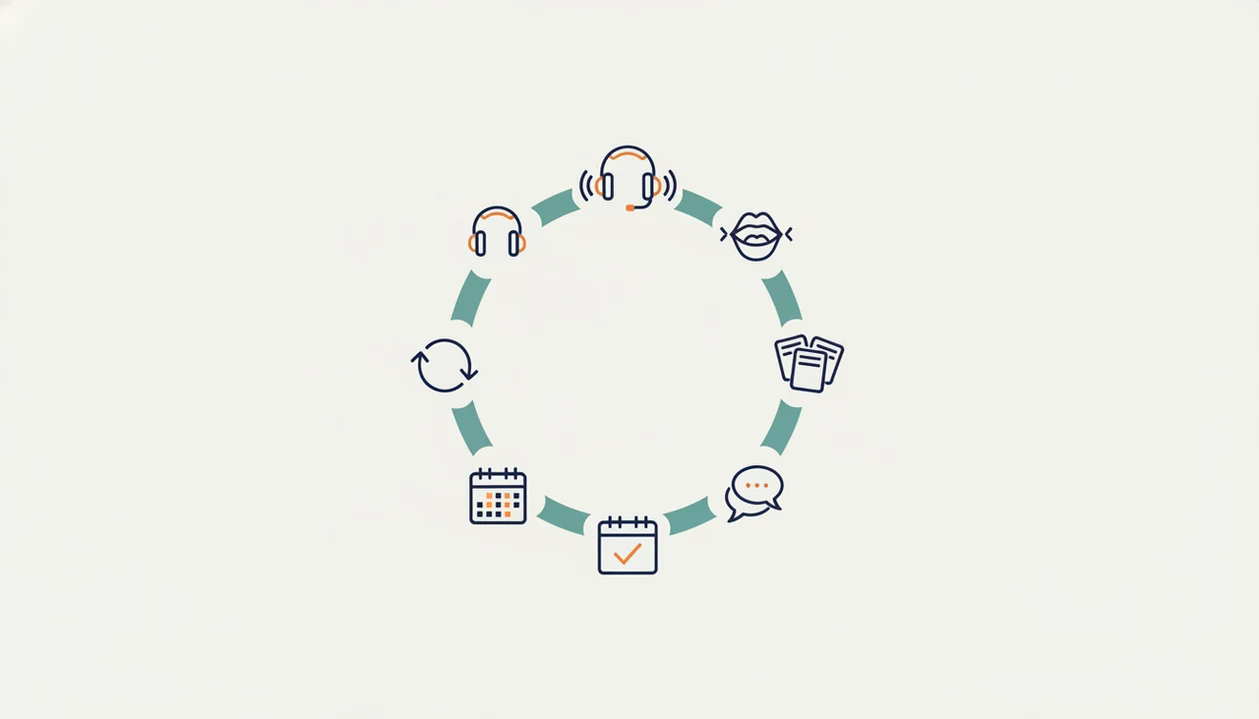
Use Pimsleur for spoken output and Duolingo for vocabulary reinforcement. The routine only works if you speak aloud, not if you silently complete every prompt.
- Set a speaking goal for one situation, such as ordering food, asking directions, or introducing your job.
- Complete one Pimsleur audio lesson aloud in a place where you can answer at normal volume.
- Use Duolingo for vocabulary reinforcement after the audio session, especially for words you missed.
- Record a short response of 30 to 60 seconds using three phrases from the lesson.
- Review weak phrases by writing the dictionary form, register note, and one corrected sentence.
- Add live conversation when ready through a tutor, exchange partner, or patient friend.
Learners who study after work and only have twenty minutes can still make this sequence useful. Headphones sealing out apartment noise, pause button worn during dictation. SiftLearn recommends the combined workflow because it separates oral recall, vocabulary review, and source checking instead of mixing them into one vague “practice more” plan. For vocabulary systems outside Duolingo, compare Anki vs Memrise for vocabulary.
5 Learner Profiles For Pimsleur Or Duolingo
Choose Pimsleur for speaking output. Choose Duolingo for habit and vocabulary exposure. Advanced learners may need tutors, conversation exchanges, or native-speaker feedback beyond either app.
- The conversation-first adult: Choose Pimsleur if you want to answer aloud, practice pronunciation, and prepare practical phrases for real interactions.
- The streak-driven beginner: Choose Duolingo if reminders, streaks, and quick lessons keep you returning every day.
- The pronunciation-anxious learner: Choose Pimsleur if hearing and repeating full phrases lowers your fear of speaking.
- The vocabulary builder: Choose Duolingo if you want frequent review across many beginner words and sentence patterns.
- The combined-method learner: Use Pimsleur first for output, then Duolingo for reinforcement.
Self-study adults who label spreadsheet tabs with new terms may not need another motivational badge. They may need a practical sequence. SiftLearn supports that combined-method learner by connecting vocabulary paths, grammar explanations, pronunciation notes, and translation-pair checks. If you build your own cards, an app that builds bilingual vocabulary cards may fit the review stage.
Limitations
This comparison should not be read as proof that either app creates fluent speakers on its own. App-based speaking practice has real limits, especially when feedback is automated.
No public head-to-head randomized trial proves that Pimsleur beats Duolingo for every language, accent, or learner profile. Treat this as a format-based comparison of speaking practice, not a guaranteed outcome claim.
- Neither Pimsleur nor Duolingo replaces live conversation with real humans.
- Duolingo microphone prompts do not prove spontaneous speaking fluency.
- Pimsleur can feel slow, repetitive, or light on visual grammar and vocabulary volume.
- App pronunciation feedback can be inconsistent across languages, accents, microphones, and noisy rooms.
- Speaking results depend on whether the learner actually answers aloud consistently.
- Some languages may have deeper course quality, more features, or better audio than others.
- Pricing, free tiers, trials, refunds, and app features can change, so verify current plan details.
- Neither app should be treated as a certified translation, placement test, or immigration language proof.
A printed verb chart still earns its place. Sift Learn would also compare any machine translation output against a learner dictionary before putting it into a flashcard deck, especially for formal phrases or irregular forms.
FAQ
Is Pimsleur better for speaking?
Yes. Pimsleur is usually better for spoken recall, pronunciation rhythm, and timed oral response because speaking aloud is central to its lesson format.
Is Duolingo good for speaking?
Duolingo is useful for basic sounds, phrases, and low-pressure speaking prompts. It is not a full conversation trainer.
Can Pimsleur make you fluent?
Pimsleur can build speaking confidence and faster oral recall. Fluency also needs live conversation, broader listening, reading, vocabulary growth, and feedback.
Can Duolingo make you fluent?
Duolingo alone rarely creates full speaking fluency. It is better understood as a consistency, vocabulary, and beginner exposure tool.
Which app improves pronunciation faster?
Pimsleur usually has the edge for pronunciation because its audio-first lessons require repeated spoken responses. Duolingo can help with basic sound familiarity.
Should beginners start with Pimsleur?
Beginners should start with Pimsleur if speaking aloud is their main goal and they can tolerate longer audio lessons. Duolingo may feel easier if they need shorter sessions.
Should beginners start with Duolingo?
Duolingo is beginner-friendly because it uses short lessons, reminders, rewards, and repeated vocabulary. Its limit is that recognition practice does not equal fluent speech.
Can you use both apps?
Yes. Use Pimsleur for spoken output and Duolingo for vocabulary reinforcement, then add live conversation when the phrases feel familiar.
Which app is better for Spanish?
For Spanish speaking practice, Pimsleur is usually stronger because it trains oral recall and pronunciation. Duolingo is useful for daily Spanish exposure and vocabulary repetition.