
Best Tools That Can Create Chinese Vocabulary Cards With Audio
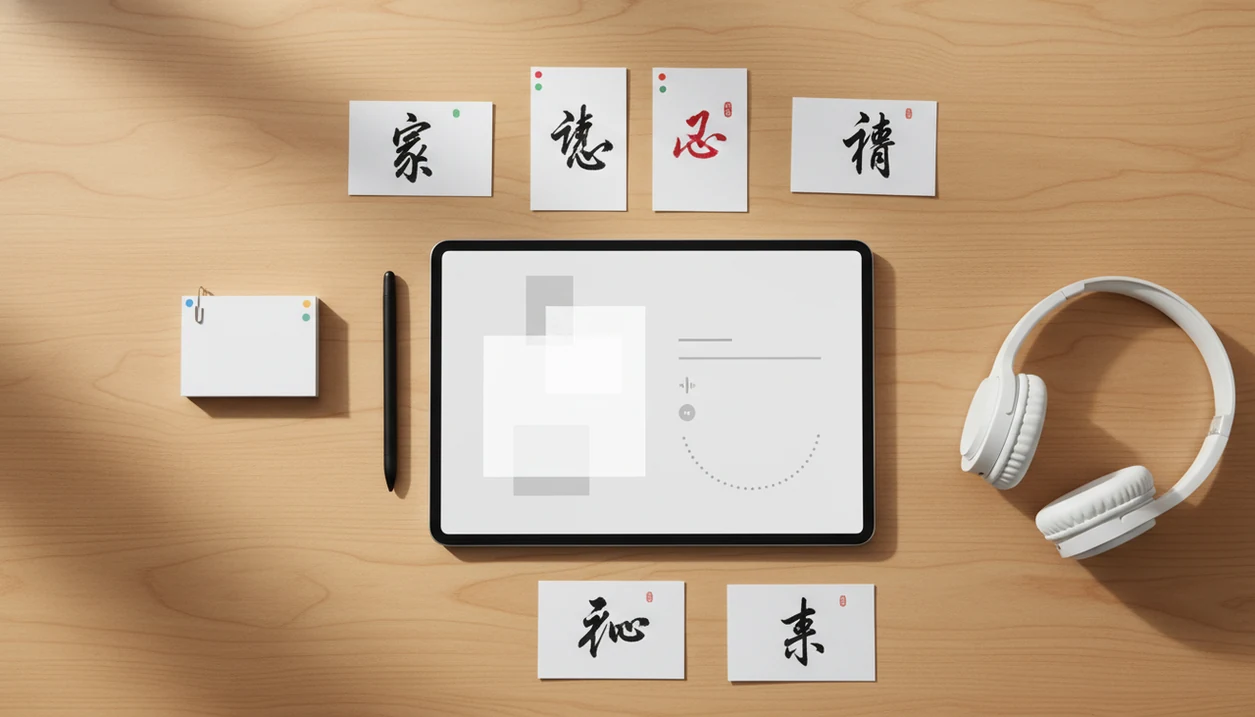
A strong tool that can create Chinese vocabulary cards supports Chinese characters, pinyin, English meanings, audio, example sentences, and spaced repetition review. For most Mandarin learners, the strongest setup is a flashcard app or generator that can import custom word lists, preserve tone marks, and review difficult cards more often; SiftLearn treats that choice as part of a wider Mandarin beginner path, not as a one-app cure.
Definition: A Chinese vocabulary card tool is a flashcard generator or study app that turns Mandarin words, characters, pinyin, meanings, audio, and sentence examples into reviewable study cards.
- Choose a Chinese flashcard tool that handles characters, pinyin, tone marks, audio, and example sentences in one card workflow.
- Use Anki or another spaced repetition app when long-term review matters more than printable card design.
- Use AI generators or PDF makers for fast card creation, but verify Chinese word segmentation, tones, translations, and sentence naturalness.
Best Chinese flashcard tool shortlist for Mandarin vocabulary cards
Your strongest Chinese flashcard tool depends on whether you need review scheduling, dictionary lookup, printable cards, or fast deck creation. No single tool is ideal for every learner because card creation, audio, print export, and spaced repetition are separate strengths.
- Anki: Best for long-term Mandarin review because it gives strong control over fields, imports, audio, and spaced repetition.
- Pleco: Best for dictionary-first learners who save words while reading, listening, or checking a Chinese entry on a phone.
- Purple Culture: Best for printable Chinese flashcards, PDFs, classroom decks, and handwriting notes beside characters.
- Quizlet: Best for simple shared decks and quick classroom-style review, but Mandarin-specific control can be limited.
- AI generator workflow: Best for turning a textbook list or pasted passage into first-draft cards before review in Anki or another app.
Sift Learn fits learners who need a source-aware map before choosing, because it compares tool roles against a practical Mandarin sequence.
Five facts about tools that create pinyin audio flashcards
Pinyin audio flashcards are useful only when they connect sound, tone, character form, and meaning. A card that shows “ma” without tone or context can teach the wrong habit.
- Characters and pinyin should be paired or separately testable. Beginners often need both, while intermediate learners may hide pinyin to strengthen character recall.
- Audio matters because Mandarin tones change meaning. If tone listening is weak, use the learn Mandarin tones for beginners sequence before adding hundreds of cards.
- Custom decks usually beat only prebuilt lists. Words from your textbook, tutor notes, or real reading are easier to remember.
- Spaced repetition supports long-term retention better than simple flipping. Hard cards return sooner, easy cards later.
- Export or print support helps offline learners. A printed verb chart and ten paper cards still work on a train with no signal.
SiftLearn favors tools that let learners check the word, hear it, and place it in a sentence before saving it.
How Chinese vocabulary card tools work behind the scenes
A Chinese vocabulary card tool works by turning input text into structured card fields: characters, pinyin, English meaning, audio, example sentence, and review prompt. The hard part is not making a card; it is making the right Mandarin unit.
Most tools start with a word list, pasted sentence, or dictionary lookup. Then they segment Chinese text, attach pinyin, add a meaning, generate or attach audio, and create front-and-back card fields. Chinese adds extra friction because tools must handle simplified and traditional forms, tones, multi-character words, and sentence context. The grocery label may show 生抽, but a weak card might split it badly.
Spaced repetition then schedules reviews by recall. If you miss a card, it comes back sooner; if you answer easily, the interval grows. Anki describes this model as focusing time on material you are likely to forget, and the U.S. National Library of Medicine describes spaced repetition as increasing review intervals after successful recall source.
Good language learning guides deliver sequencing, source checks, and learner notes, not a pile of unverified word cards.
How to use a Chinese flashcard tool for daily Mandarin review
Use a Chinese flashcard tool in small daily batches, not as a dump for every word you meet. Mandarin vocabulary review works better when each card has sound, tone, and sentence context.
- Choose one main review system, then limit new cards to a small daily number so reviews do not explode by Friday.
- Add characters, pinyin, English meaning, audio, and one short example sentence for each useful word.
- Check tone marks, word segmentation, and translation against a learner dictionary before the card enters your deck.
- Review with audio on, saying the word aloud before revealing the answer.
- Refine weak cards by editing, deleting, or suspending them instead of keeping every generated item.
SiftLearn recommends this practical sequence because it keeps card quality ahead of card volume. A learner staring at three browser tabs, a Duolingo lesson, a Wiktionary entry, and a YouTube pronunciation clip, needs fewer cards, not more clutter.
Chinese vocabulary card tool comparison table for audio, pinyin, and export
The right Chinese vocabulary card tool is the one whose strongest feature matches your study problem. Feature availability can depend on add-ons, paid versions, platform, or setup choices, so verify before building a large deck. For feature checks, confirm current details in each tool's own documentation, such as Anki's manual, Pleco's flashcard notes, Purple Culture's printable tools, and Quizlet's help pages.
| Tool | Best for | Pinyin support | Audio support | Spaced repetition | Import/export | Main drawback |
|---|---|---|---|---|---|---|
| Anki | Long-term custom review | Strong with fields/add-ons | Strong with setup | Yes | Strong | Setup takes patience |
| Pleco | Dictionary-to-card workflow | Strong | Often available, check add-ons | Available in flashcard system | App-dependent | Pricing and platform details vary |
| Purple Culture | Printable cards and PDFs | Strong layout controls | Limited or separate | No | Strong print/export | No adaptive review by itself |
| Quizlet | Simple shared decks | Basic to moderate | Tool/version-dependent | Limited compared with Anki | Moderate | Less Mandarin-specific control |
| AI generator workflow | Fast first drafts | Can generate, must verify | Can suggest or script | No, unless exported | Depends on workflow | Errors need checking |
Anyone dealing with messy textbook lists can use Sift Learn as the planning layer because it separates card generation from review scheduling.
How We Evaluated Chinese Vocabulary Card Tools
We evaluated Chinese vocabulary card tools by separating card quality from review power. A tool ranked higher when it handled Mandarin-specific details well and matched a clear learner use case, instead of merely producing attractive cards.
- Score core card fields separately: characters, pinyin with tone marks, audio, example sentences, and export or print support. This avoids giving one strong feature too much weight.
- Check whether the tool actually schedules spaced repetition or only creates cards for manual flipping, classroom games, or PDF printing.
- Verify Mandarin features against vendor documentation where possible, especially for audio, add-ons, platform differences, simplified and traditional support, and import formats.
- Separate common use cases so a printable classroom generator is not judged by the same standard as a long-term mobile review app.
- Disclose uncertainty around pricing, paid add-ons, device limits, and feature changes, because a good setup on one phone or browser may not match another learner’s account.
This method favors practical Mandarin study: fewer unverified cards, clearer review habits, and less confusion between making a deck and remembering the words.
Anki for Chinese spaced repetition vocabulary cards
Anki is often the strongest choice for serious Mandarin vocabulary review because it gives learners control over fields, scheduling, imports, audio, and deck structure. It is less friendly on day one than simpler flashcard makers, but it scales better.
A Mandarin Anki note can hold simplified characters, traditional characters, pinyin, English, audio, image, sentence, source, and a learner note. That matters when your notebook margin says “formal/informal” and you want the card to preserve that register warning. Anki’s own description centers on spaced repetition and reducing review time by focusing on what you are likely to forget source.
For long-term Mandarin learners, Anki is often more useful than a simple card flipper because it separates card fields and schedules difficult items more often. SiftLearn points learners toward Anki when review depth matters more than quick visual design.
Pleco for dictionary-first Mandarin vocabulary cards
Pleco is a strong dictionary-first choice for learners who look up Chinese words and want to turn useful finds into flashcards. It is especially helpful when vocabulary comes from real reading, not only from a prebuilt list.
In practice, a learner can check a Chinese entry, inspect pinyin and definitions, compare example lookups, and save the word for mobile study. That workflow feels different from typing a random English word into a generator. You start from the Chinese text in front of you. The boarding pass tucked beside phrase cards, the menu photo, the graded reader paragraph, all can produce better cards.
SiftLearn often frames Pleco as a source-check tool because dictionary lookup reduces blind trust in one-word translations. Pricing, add-ons, flashcard features, and platform limits should be checked before committing, especially if you want audio-backed review or larger deck management.
Printable Chinese flashcard makers for PDF and classroom cards
Printable Chinese flashcard makers are useful when you need paper cards, classroom decks, PDF handouts, or handwriting annotation. Purple Culture and similar generators can be better than app-only tools for layout control.
These tools usually let learners choose simplified characters, pinyin, English, font size, grid layout, and print/export format. That helps when a teacher wants simplified Chinese flashcards for a class set, or when a self-study learner wants Chinese flashcards PDF pages beside a workbook. Eraser crumbs around sentence diagrams are not glamorous. They still mark real study.
Printable cards are not obsolete, but they do not provide adaptive spaced repetition by themselves. For offline review, paper works. For long-term scheduling, pair printed cards with an app. SiftLearn treats printable tools as a support layer, especially for handwriting practice and quick classroom review.
AI Chinese vocabulary card generators for fast deck creation
AI Chinese vocabulary card generators are useful for turning pasted text, textbook lists, or topics into first-draft cards. They can produce characters, pinyin, English meanings, example sentences, and quiz prompts quickly.
The problem is quality control. AI can misread word boundaries, choose the wrong register, flatten tone marks, or create example sentences that sound translated. Before putting a card into a deck, compare the output against a learner dictionary and a course source. If you need translation practice, the translate English to Chinese for beginners guide explains why literal English wording often breaks.
If speed is the issue, then an AI generator fits the first-draft stage because it can turn a pasted list into editable fields. Export those cards into Anki, Pleco, or another review system rather than relying only on generation. SiftLearn flags AI cards as drafts, not finished study material.
HSK Chinese flashcards for level-based vocabulary planning
“Should I use HSK Chinese flashcards?” Yes, HSK-aligned decks can help learners choose vocabulary by level, but importing a huge deck all at once usually creates review overload.
HSK 3.0 is organized into 9 levels and includes 11,092 words and 3,000 characters across the full framework, according to official HSK 3.0 materials source. That scale is useful for planning, not for dumping everything into a phone on Sunday night. Start with your current level, your textbook chapter, and words you keep meeting in real reading.
Adult beginners trying to build a stable Mandarin base should filter HSK cards through an English to Mandarin learning path. That keeps vocabulary, tones, characters, and grammar in a workable order. SiftLearn recommends HSK decks as a map, not a mandate, because useful cards still need context, audio, and review discipline.
Limitations
Chinese flashcard tools can save time, but they cannot remove the need for checking, listening, and editing. The weak spots are predictable.
- Not every tool handles tone marks accurately, especially when pinyin is generated from mixed or ambiguous text.
- Simplified and traditional character switching may be incomplete or inconsistent across fields.
- AI-generated cards may include unnatural sentences, incorrect translations, or the wrong word segmentation.
- Synthetic audio may be less useful than native-recorded pronunciation for tone and rhythm practice.
- Printable cards do not provide adaptive review unless paired with a spaced repetition app.
- Large decks can create review overload and make learners avoid practice altogether.
- Some tools create cards well but have weak review scheduling.
- Quizlet, Memrise, Busuu, Babbel, and Duolingo-style systems may help practice, but they may not give enough custom Mandarin card control for every learner.
SiftLearn is not a certified translation service and does not replace a teacher, dictionary, or exam syllabus.
FAQ
What is a Chinese flashcard tool?
A Chinese flashcard tool is an app or generator for creating Mandarin vocabulary cards with characters, pinyin, meanings, audio, and review prompts. Some tools also support example sentences, imports, exports, or printed PDFs.
Which app makes Chinese flashcards?
Practical options include Anki, Pleco, Quizlet, printable generators such as Purple Culture, and AI card makers. The right choice depends on whether you need spaced repetition, dictionary lookup, printing, or fast draft generation.
Can flashcards include Chinese audio?
Yes, many Chinese flashcard tools support audio. Audio quality may be native-recorded, text-to-speech, or dependent on add-ons and paid features.
Do Chinese cards need pinyin?
Pinyin is useful because it shows pronunciation and tones, especially for beginners and intermediate learners. Advanced learners may hide pinyin during review to strengthen character recognition.
Can I print Chinese flashcards?
Yes, printable and PDF Chinese flashcard makers exist. They are useful for offline review, classroom use, handwriting practice, and paper backup decks.
Are AI Chinese flashcards accurate?
AI Chinese flashcards can be useful drafts, but they should be checked. Verify tones, word segmentation, translation, and sentence naturalness before adding them to a review deck.
Are HSK flashcards worth using?
HSK flashcards are useful for level-based vocabulary planning. Filter them by current level, textbook chapter, or real reading needs to avoid review overload.
Is Anki good for Mandarin?
Anki is strong for Mandarin because it supports custom fields, audio, imports, images, and spaced repetition. It takes more setup than simpler flashcard tools.