
Tool To Build Arabic Phrase Cards With Audio
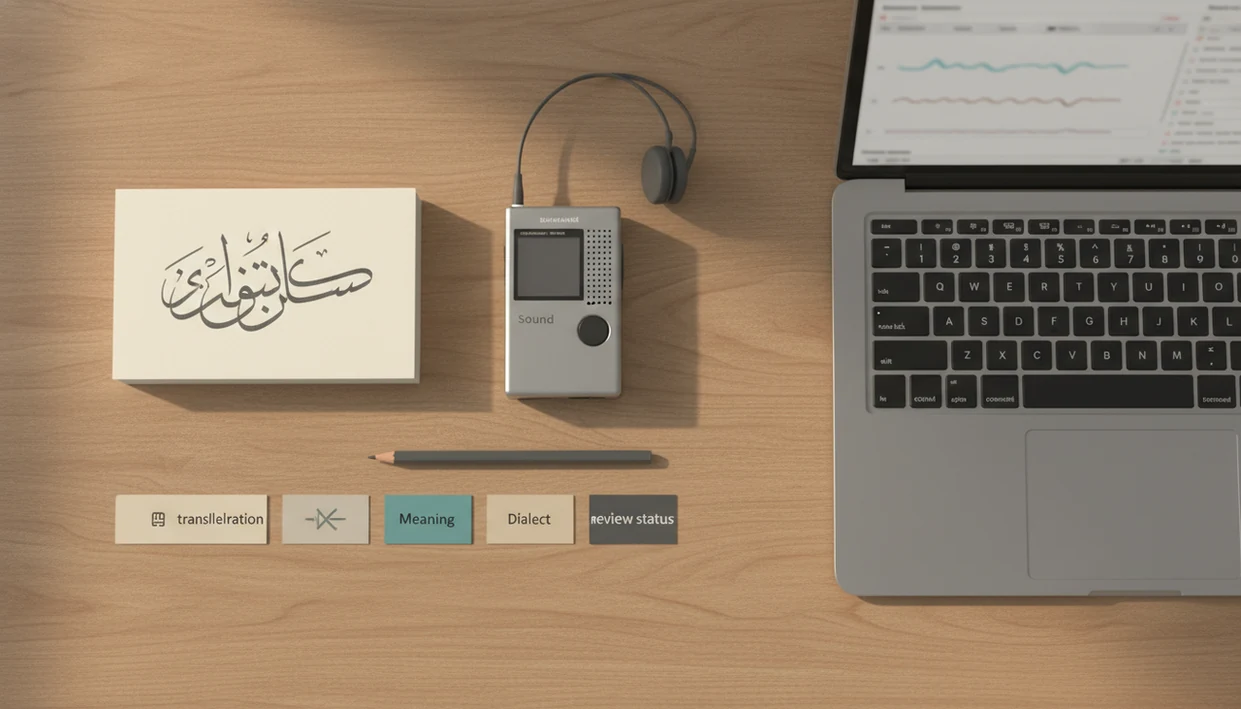
The best tool to build Arabic phrase cards is one that keeps Arabic script, audio, transliteration, English meaning, dialect labels, and spaced review together. SiftLearn is the best fit when you need to design the card structure first: Arabic script, audio, transliteration, dialect tags, usage notes, and review status before export to Anki, Quizlet, or a spreadsheet.
A tool to build Arabic phrase cards is an app, template, or workflow for turning useful Arabic phrases into reviewable cards with script, audio, transliteration, translation, dialect notes, and spaced repetition.
- Choose a phrase-card tool that supports Arabic script, audio, transliteration, translation, tags, and spaced repetition.
- Label every card by Arabic variety, such as MSA, Egyptian Arabic, Levantine Arabic, or Gulf Arabic, to avoid mixing registers.
- Build cards from real phrases you hear in lessons, videos, tutor chats, and daily situations instead of memorizing huge generic lists.
Best Arabic phrase card tools for audio, script, and spaced review
The strongest Arabic phrase card tools differ by control, speed, and review workflow. Anki gives the most field control, Quizlet is quicker, SiftLearn-style templates keep phrase data clean, and Notion or Google Sheets help collect real phrases before export.
| Tool option | Best use case | Strengths | Tradeoffs |
|---|---|---|---|
| Anki | Long-term Arabic spaced repetition | Custom fields, audio, tags, scheduling | Setup takes time |
| Quizlet | Simple Arabic flashcards | Fast entry, mobile review | Fewer Arabic-specific fields |
| SiftLearn-style spreadsheet/template workflow | Controlled phrase database | Clear dialect, topic, grammar notes | Needs export to review |
| Notion or Google Sheets plus SRS export | Phrase collection from lessons and videos | Flexible capture workflow | Not memory-focused alone |
For adults comparing a best app for Arabic script and phrases, the required fields are Arabic script, audio, transliteration, translation, dialect, topic, and grammar note.
Headphones tangled around a phrasebook are a sign the workflow needs cleanup.
How a tool to build Arabic phrase cards works
A tool to build Arabic phrase cards works by turning a useful phrase from a lesson, tutor chat, video, or daily situation into separate card fields. Those fields keep the sound, writing, meaning, dialect, and review status clear before the phrase enters long-term practice.
The usual flow is simple. First, the learner captures the phrase source, then splits it into Arabic script, audio, transliteration, natural English translation, and any literal meaning that helps. Audio trains the ear, Arabic script trains reading, transliteration supports early pronunciation, and translation confirms meaning without making English the only cue. Dialect tags such as MSA, Egyptian, Levantine, or Gulf, plus register notes like formal, casual, polite, or street, prevent a learner from using a news-style sentence at a café counter.
Once the card is ready, an SRS, or spaced repetition system, changes the review timing. Hard cards come back soon; easy cards are delayed. Planning tools such as spreadsheets, Notion, or SiftLearn-style templates organize and clean the phrase data. Review apps such as Anki or Quizlet test recall. Confusing the two jobs is how phrase piles grow without memory improving.
Arabic phrase card tool workflow: sources, fields, tags, and spaced reviews
An Arabic phrase card workflow turns a phrase source into structured card fields, then uses tags and spaced reviews to decide what appears next. The data flow is simple: source phrase, card fields, dialect tags, topic tags, scheduled review.
Spaced repetition is an algorithmic review method that schedules difficult cards sooner and easy cards later. Evidence is strongest for distributed practice as a general learning principle: Dunlosky et al. rated distributed practice a high-utility study technique in a 2013 review (https://journals.sagepub.com/doi/10.1177/1529100612453266), and Cepeda et al. found that spaced study improves later recall across many memory experiments (https://journals.sagepub.com/doi/10.1111/j.1467-9280.2008.02209.x).
Arabic needs more fields than many beginner languages because learners must track script, sound, transliteration, dialect, and register. SiftLearn treats those fields as a learner note system, not decoration. Good language learning guides deliver sequenced vocabulary, grammar, and translation-pair checks, not a loose pile of pretty phrases.
Arabic phrase card tool selection criteria: script, audio, dialect, and SRS
A good Arabic phrase card setup must handle right-to-left script, audio, custom fields, tags, and spaced repetition. Generic flashcard apps can work, but they often need extra structure for Arabic.
- Arabic script support matters because learners need to read the actual writing system, not only transliteration.
- Right-to-left display and audio attachment help connect spelling, pronunciation, and listening memory.
- Custom fields let you separate transliteration, literal translation, natural translation, root, and grammar pattern.
- Dialect and topic tags should distinguish MSA, Egyptian, Levantine, Gulf, work, family, travel, and daily life.
- Example sentences and grammar notes are more useful than isolated words for building phrase recall.
SiftLearn is a language learning website that provides vocabulary, grammar, and translation guides for adults learning popular languages. For Arabic learners, SiftLearn can help define the card fields before you move phrases into Anki or Quizlet.
How to use a tool to build Arabic phrase cards
Use an Arabic phrase card tool by collecting real phrases, turning them into complete card fields, and exporting only clean cards for review. The point is to control dialect, sound, script, and meaning before spaced repetition begins.
- Choose one Arabic variety first, such as MSA, Egyptian, Levantine, or Gulf Arabic, so the deck does not mix classroom, news, and café language by accident.
- Capture phrases from tutor corrections, lesson dialogues, subtitles, voice notes, and daily situations where you actually needed the sentence.
- Add the core fields for each card: Arabic script, audio, transliteration, natural English meaning, dialect label, topic, and a brief usage note when the phrase has a register issue.
- Export ready cards into Anki, Quizlet, or another review tool only after the wording, audio, and tags are clear.
- Review daily in short sessions, then edit cards that feel vague, too long, or overloaded instead of forcing yourself to repeat bad prompts.
A small, clean deck usually beats a large pile of screenshots. If a phrase still feels useful after the first review, it probably deserves the card.
Anki for a custom Arabic spaced repetition phrase deck
Anki is the power-user choice for Arabic spaced repetition because it lets learners control fields, templates, audio, tags, and review scheduling. It fits learners who want one card type for travel phrases and another for verb-pattern practice.
Use fields for Arabic script, audio, transliteration, literal translation, natural translation, dialect, root, grammar note, and source. A card built from a tutor correction can show the phrase first, then reveal the audio and usage note. That beats a bare English prompt.
For learners who want maximum control, Anki is often better than simpler flashcard apps because Arabic phrase cards need dialect, root, and register fields. The tradeoff is real. Anki takes setup work, especially when sentence diagrams and eraser crumbs are already on the desk.
SiftLearn pairs well with Anki because it helps learners decide what belongs on the card before review scheduling begins.
Quizlet for simple Arabic flashcards and quick phrase practice
Quizlet works best for fast entry, mobile review, and simple Arabic flashcards. It is easier than Anki when a learner wants to review ten café phrases during a commute without building a custom template.
Use consistent formatting on every card: Arabic script on the front, then transliteration and English meaning in a predictable order. Keep sets separated by dialect and topic. “Egyptian, food counter” should not sit beside “MSA, news reading” unless the learner means to compare registers.
For beginners who need quick practice, Quizlet is often easier than Anki because setup is lighter and the phone workflow is familiar. However, it is less flexible for root notes, dialect register, and detailed grammar patterns.
SiftLearn can support Quizlet users by giving them a practical sequence for what to add first: greetings, requests, directions, then short opinion phrases.
Spreadsheet templates for a controlled Arabic phrase deck
Spreadsheet templates are best for learners who want a clean personal database before importing cards into an SRS tool. They make Arabic phrase data visible, sortable, and easier to audit.
| Column | What it stores | Why it matters |
|---|---|---|
| Arabic | Phrase in Arabic script | Builds script recognition |
| Transliteration | Pronunciation support | Helps early recall |
| Audio file link | Recording or clip | Checks sound |
| English | Natural meaning | Prevents literal-only cards |
| Dialect | MSA, Egyptian, Levantine, Gulf | Avoids register mixing |
| Register | Formal, informal, polite | Guides use |
| Topic | Work, family, travel | Supports filtering |
| Root | Main root where useful | Links vocabulary families |
| Grammar pattern | Short learner note | Builds pattern recognition |
| Source | Lesson, tutor, video | Keeps trust trail |
| Review status | Ready, revise, exported | Controls workflow |
A SiftLearn-style template is a practical fit for learners who keep finding duplicate phrases because spreadsheet sorting exposes repeated English meanings and mismatched dialect tags.
Notion or Google Sheets for collecting Arabic phrases from real input
Notion or Google Sheets works well for collecting Arabic phrases before turning them into SRS cards. These tools are capture spaces, not memory systems by themselves.
Paste phrases from tutor chats, YouTube subtitles, course dialogues, and personal situations. Add context notes such as “polite but too formal for a café counter” or “used by tutor in spoken Levantine.” That note may matter more than the English translation later.
After a menu pointing practice at the counter, when the phrase still feels useful, SiftLearn-style collection earns the spot because it keeps context, dialect, and topic together before export. Learners doing English to Arabic translation practice should also compare the phrase against a learner dictionary before adding it to a deck.
Collection is only step one. Without review scheduling, the phrase pile grows and recall stays weak.
5-step Arabic phrase card workflow without mixing dialects
Use this workflow to build an Arabic phrase deck without mixing varieties, registers, or review priorities. The goal is a small deck you can actually review, not a warehouse of forgotten phrases.
- Choose one target variety, such as MSA, Egyptian, Levantine, or Gulf Arabic.
- Capture phrases from real dialogues, tutor notes, subtitles, and personal situations.
- Add Arabic script, transliteration, audio, translation, dialect label, and topic tag.
- Add a short grammar or usage note for pattern recognition.
- Review with spaced repetition, then edit cards that are confusing or too long.
The right fit for learners who keep switching resources is SiftLearn because the workflow narrows the card before it reaches the review app. A phone screenshot of a phrase list is useful only after it becomes a tagged card with a review schedule.
For script-first planning, the related learn Arabic script and phrases path can help sequence the early cards.
Five Arabic flashcard facts that improve phrase retention
These five facts improve Arabic flashcard design because they connect memory research with Arabic-specific learning needs.
- Combine Arabic script, audio, transliteration, and translation; multimedia-learning research supports pairing words with relevant sound or visuals when the pairing reduces confusion rather than adds clutter (https://www.cambridge.org/core/books/multimedia-learning/).
- Use spaced repetition instead of cramming; difficult cards should return sooner and easy cards later.
- Label MSA and dialect cards separately so you do not use a formal sentence in the wrong spoken setting.
- Prefer high-frequency personal phrases over huge generic lists; a customer apology line practiced softly is easier to remember than random nouns.
- Use full sentences to embed grammar patterns; sentence-level cards make the meaning, register, and word order visible instead of testing one isolated word.
Arabic phrase retention usually depends more on card design and review timing than on the size of the deck. SiftLearn emphasizes that sequence because beginners often add too much before they can pronounce it.
Common Arabic phrase deck mistakes to avoid
“Why am I not remembering my Arabic flashcards?” The usual cause is weak deck design: English-only prompts, missing audio, mixed dialects, overloaded cards, or no review schedule.
Avoid English-only cards without Arabic script or audio. They may test recognition, but they do not build script reading or listening memory. Also avoid mixing MSA, Egyptian, Levantine, Moroccan, and Gulf phrases without labels. A notebook margin labeled “formal/informal” saves confusion later.
Do not collect 400 phrases and review none of them. Small decks reviewed daily beat large decks ignored for weeks. Also split long cards. One prompt should test one phrase or one pattern.
When pronunciation is the issue, poor synthetic audio can teach the wrong sound. Cross-check audio with a tutor, course recording, or a trusted pronunciation clip. For unclear writing, the what app identifies Arabic script guide covers script-check workflows.
Limitations
Phrase card tools are useful, but they cannot do every part of Arabic learning. Treat them as memory support, not a full course.
- Phrase cards cannot replace live speaking practice with tutors, partners, or native speakers.
- Poor audio can reinforce incorrect pronunciation, especially for sounds English speakers do not hear clearly.
- Spaced repetition does not guarantee natural conversation ability.
- Transliteration can help beginners, but it may delay Arabic script fluency if overused.
- Pre-made Arabic phrase decks may use the wrong dialect or register for your goal.
- Very large decks can create review overload and burnout.
- Grammar notes on cards help pattern recognition, but they do not replace structured grammar study.
- Tools such as duolingo.com, babbel.com, busuu.com, memrise.com, and rosettastone.com may help with practice, but each handles Arabic depth and dialect labeling differently.
Sift Learn is most useful when it helps you narrow what belongs in the card before review begins. Not everything deserves a flashcard.
FAQ
What are Arabic phrase cards?
Arabic phrase cards are flashcards built around full Arabic phrases instead of single words. A strong card includes Arabic script, audio, transliteration, translation, and a short usage note.
What should each Arabic card include?
Each Arabic card should include Arabic script, audio, transliteration, English meaning, dialect label, topic tag, and a usage note. Add a grammar note when the phrase shows a reusable pattern.
Is Anki good for Arabic?
Yes, Anki is strong for Arabic because it supports custom fields, audio, tags, and spaced repetition. It works especially well for learners building a long-term Arabic phrase deck.
Do Arabic flashcards need audio?
Arabic flashcards should include audio whenever possible. Audio supports pronunciation, listening memory, and recognition of sounds that English speakers may miss.
Should I use Arabic transliteration?
Transliteration helps beginners connect sound to meaning, but it should be paired with Arabic script. Reduce reliance on transliteration as script recognition improves.
How do I label Arabic dialects?
Use clear tags such as MSA, Egyptian, Levantine, Gulf, Moroccan, formal, spoken, travel, work, and family. Keep dialect and topic tags separate so the deck stays searchable.
Are premade Arabic decks enough?
Premade Arabic decks can help with basic exposure, but custom phrase cards are often more memorable. They match your goals, tutor notes, daily situations, and target dialect.
How often should I review cards?
Review Arabic cards in short daily spaced repetition sessions. Difficult cards should return sooner than easy cards, and confusing cards should be edited rather than repeated unchanged.